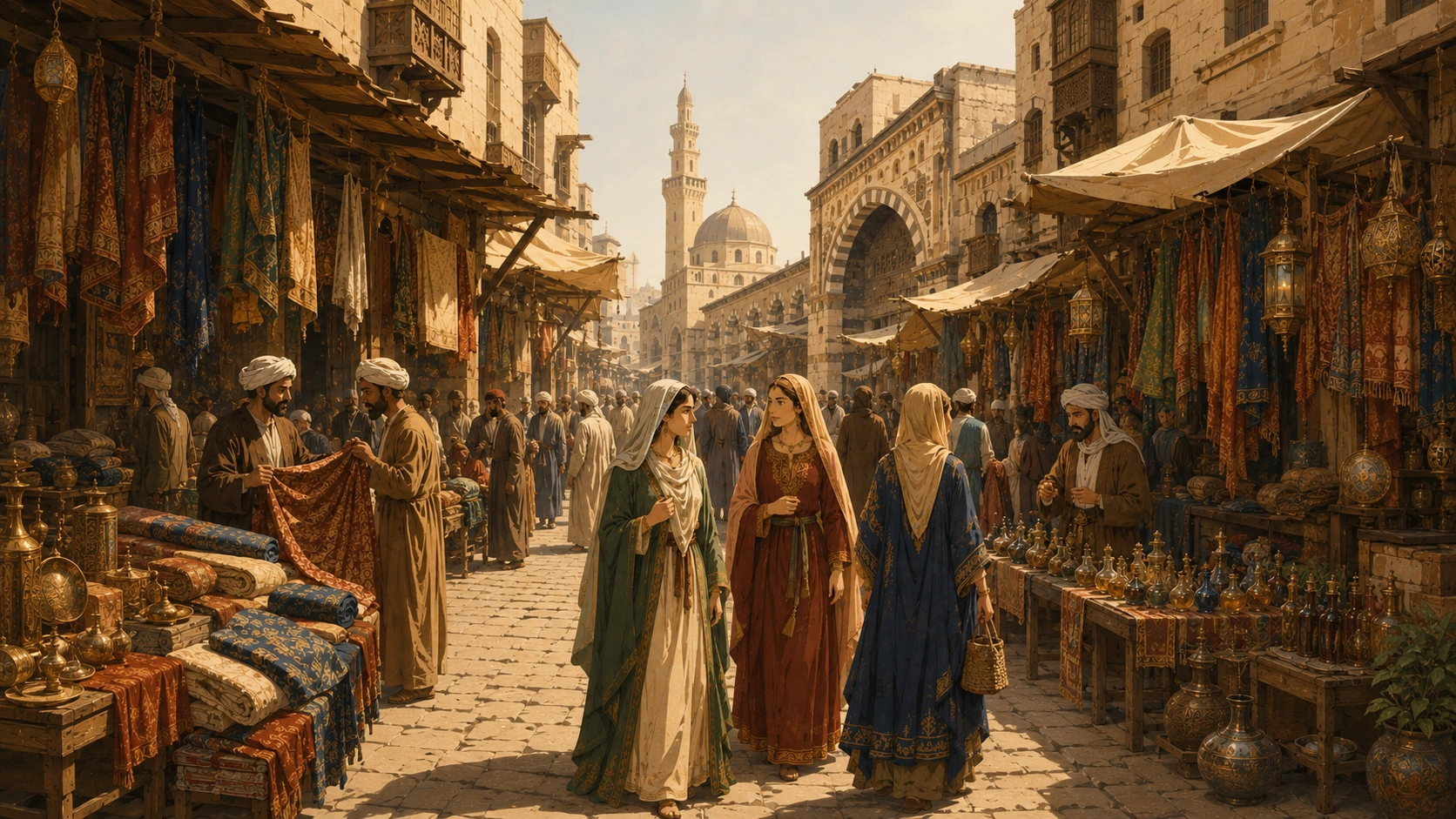
If we were to open a window onto one of the markets of Umayyad Damascus, we would see caravans arriving, merchants displaying silk, brocade, and linen, and women crossing the alleys in garments whose colours and decorations revealed a city where multiple civilizations met. These clothes tell part of the history of Damascus, just as they reflect the prosperity of its trade and the breadth of its connections with the world.
When Caliph Muawiya ibn Abi Sufyan entered Damascus and made it the capital of the Umayyad state in 41 AH/661 CE, the city entered a new stage in its political history while continuing the civilizational role it had established over many centuries. Since ancient times, Damascus had been a major station on trade routes and a meeting place for peoples and cultures arriving from east and west. The Umayyad state then gave it the status of a capital from which one of the largest states of its age was governed.
Trade flourished, with caravans arriving from Egypt, Yemen, Iraq, Persia, and Central Asia, while Mediterranean goods from Constantinople and Alexandria reached the ports of Bilad Al-Sham. In the markets of Damascus, Chinese silk, Egyptian linen, Persian brocade, Syrian glass, and Arab and Eastern perfumes came together. This commerce brought with it the distinctive cultures of its peoples, along with textile traditions and unique decorative techniques.
Women’s clothing therefore becomes an entry point for reading the social and cultural history of Damascus and the details of life that flourished during the Umayyad era.
This picture leads us to the most important question: How was Damascus’s status reflected in the clothing of its women?
The Umayyads inherited lands that had formed part of the Byzantine Empire, while the Arabs brought with them the customs of the Arabian Peninsula. Strong Persian influences also reached Damascus after the conquest of Iraq and Iran. The Umayyads then reshaped these influences within a new Arab-Islamic identity. The clothing of Damascene women was therefore neither purely Arab, Byzantine, nor Persian, but a balanced mixture of these three worlds. This can be seen clearly in the surviving wall paintings of Umayyad palaces, in historians’ descriptions, and in textiles surviving from the first and second centuries AH.
Women’s clothing showed considerable diversity in garments, fabrics, decorations, and colours:
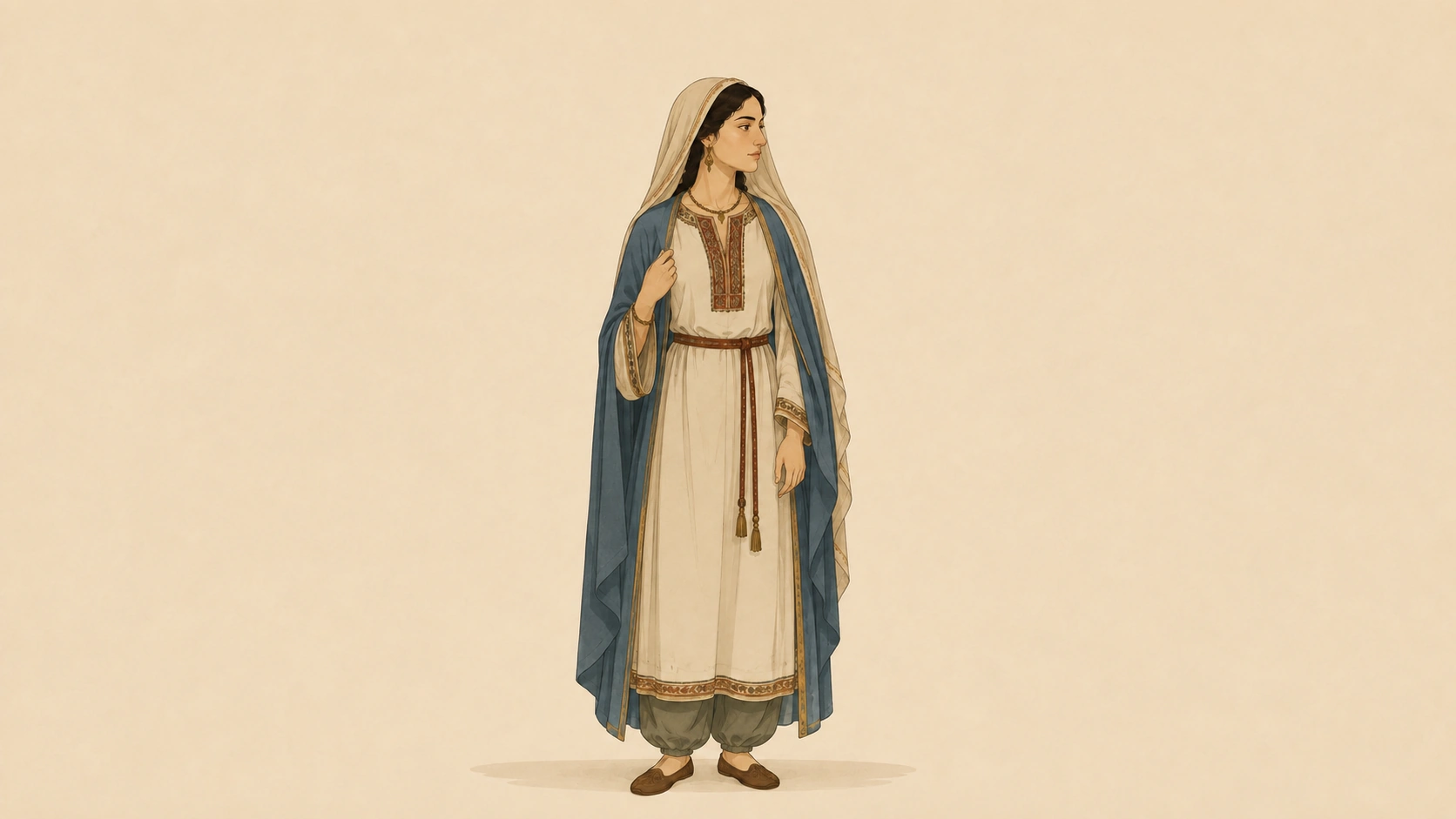
The qamis, or dir as some sources call it, formed the basis of Damascene women’s clothing. It was a long, loose garment extending to the ankles, with long sleeves that allowed freedom of movement. Its length and width varied according to social status. Everyday garments were made from linen or cotton, while women from wealthy families, daughters of leading merchants, and women of the court wore silk and brocade. Some of these garments were specially decorated around the collars and sleeves with gold and silver threads in vegetal and geometric designs, while human imagery became less prominent with the spread of Islamic culture. Some women also used thin fabric or leather belts tied around the waist, giving the garment balance and elegance, particularly on special occasions.
Trousers… A Persian Legacy That Became Damascene:
Women also wore loose trousers beneath the qamis, providing comfort during movement, work, and travel. Trousers entered Bilad Al-Sham through Sasanian influence before Islam and later became a familiar garment for both men and women. They were usually made from linen or cotton, while silk was used by wealthier classes. Over time, they became an established part of Islamic clothing in most major cities.
When a woman left her home, her clothing was completed with an outer garment worn over the qamis and trousers. It was known by several names, including the jilbab, milhafa, or abaya, depending on social custom and occasion. This garment combined the practical function of providing protection from dust and changing weather with the Islamic requirement of modesty for women.
Hair was covered with the khimar, an established part of Damascene women’s clothing, consisting of a long piece of fabric that often extended to the shoulders or upper chest. Umayyad wall paintings, together with historians’ descriptions, reveal different ways of wrapping and wearing it, with variations associated with age, social status, and the nature of the occasion. Full covering of the face, “the niqab,” was a prevailing style among all women, but was associated with the customs of certain environments and families and cannot be generalized to all women of Damascus.
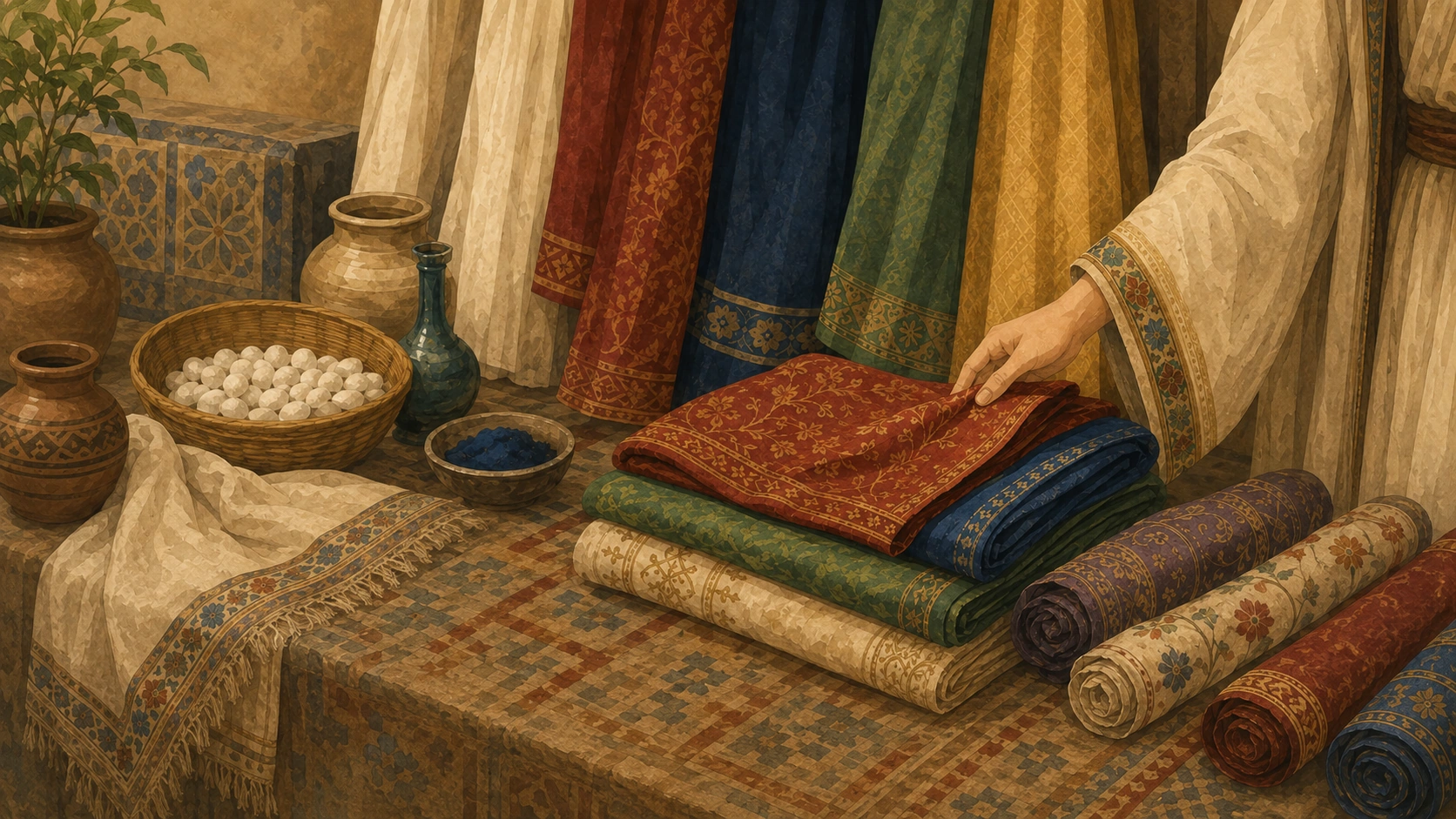
Colours gave Damascene clothing a distinctive presence. Fabrics appeared in various shades of white, crimson red, indigo blue, green, and saffron yellow. These colours were extracted from natural dyes, and access to some of them indicated wealth. Purple required rare marine dyes, saffron colouring was extracted from the saffron plant, while blue came from indigo. Some of these dyes reached Damascus through trade routes connecting the city with Egypt, Persia, Yemen, and the Mediterranean lands.
The embroidery of fabrics received particular attention. Collars, sleeves, and garment edges were decorated with precise vegetal and geometric patterns executed in silk threads, while gold and silver threads were used for luxurious garments. This craftsmanship reveals the level reached by the textile workshops of Damascus, which contributed to the establishment of the profession of tiraz, later widespread throughout the Islamic world.
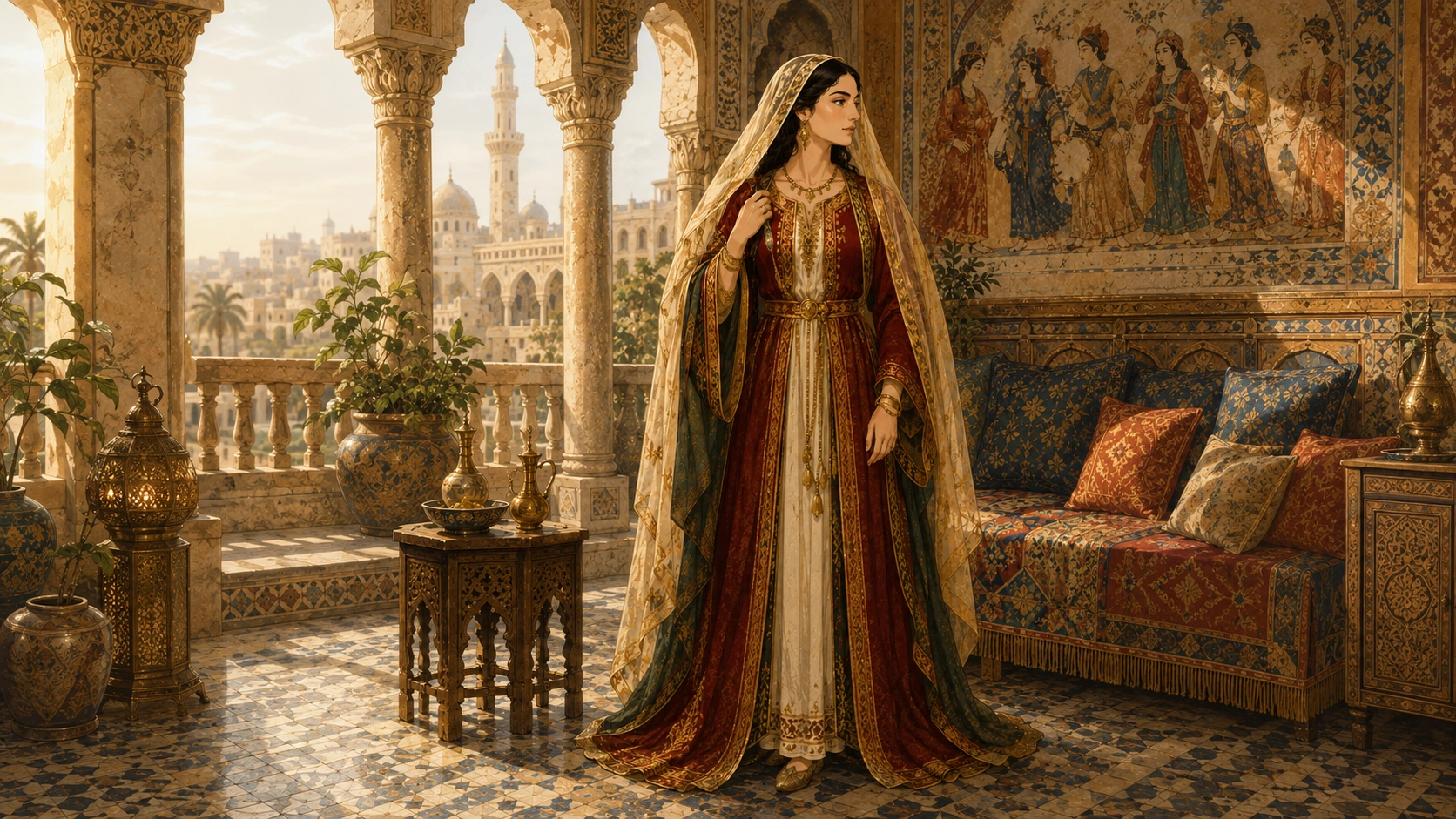
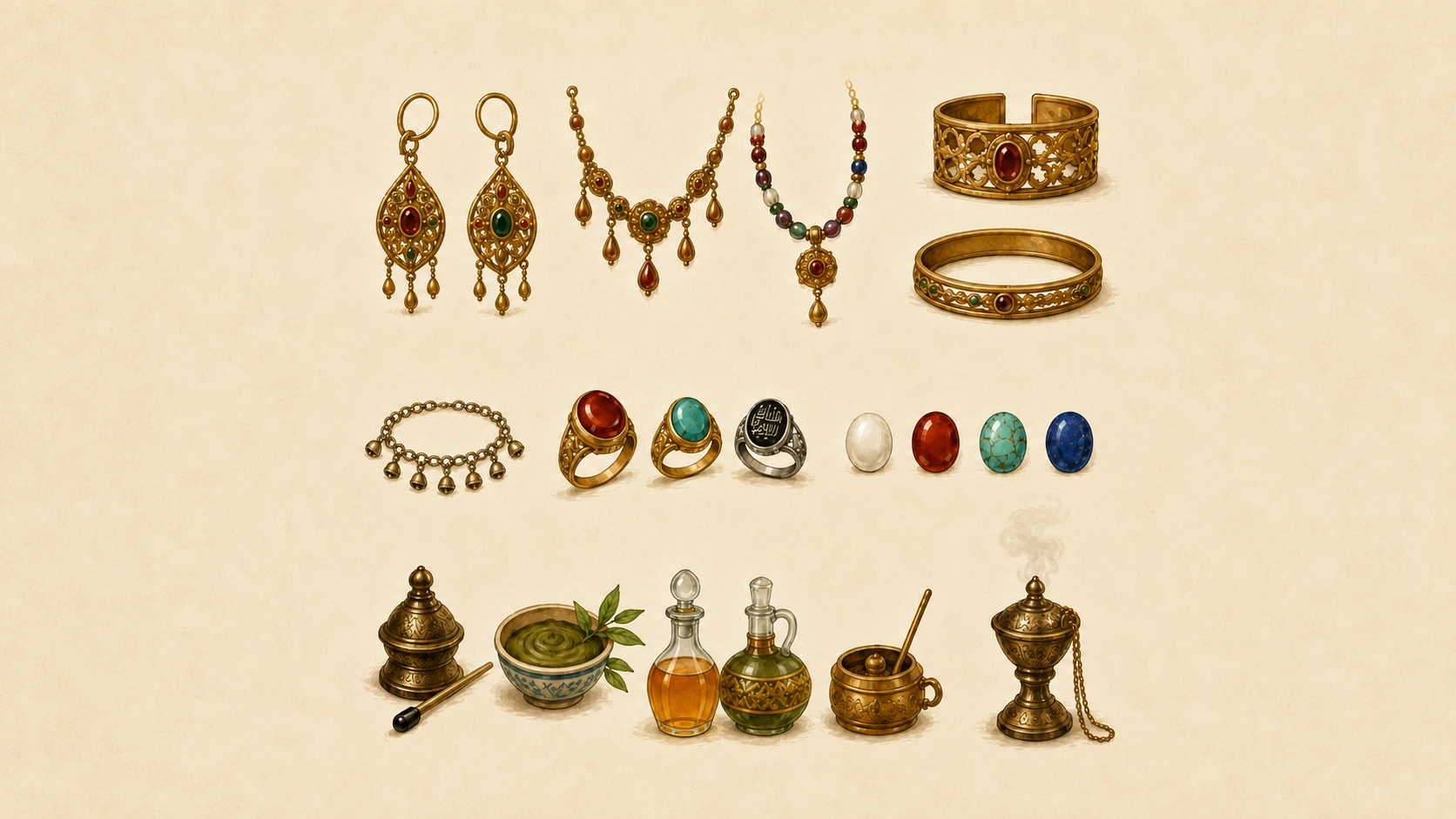
Jewellery occupied a position equal to clothing, expressing social status and economic means. Women wore gold earrings, ornamented necklaces, bracelets, anklets, and rings, while less wealthy women used silver, copper, or coloured glass. Sources indicate the circulation of pearls from the Arabian Gulf, Yemeni agate, and turquoise from Khurasan, stones that increased the diversity of personal adornment in Damascene society.
Interest was not limited to clothing and jewellery but also extended to perfumes and beauty products. Musk, ambergris, rose oil, jasmine, and violet were used alongside kohl, henna, and natural oils for caring for the hair and skin. These elements formed part of a culture concerned with appearance and personal cleanliness in Umayyad society.
Although women shared the basic features of dress, the quality of fabrics, density of embroidery, and type of jewellery reflected economic and social differences. A woman in the caliph’s palace might wear a silk garment embroidered with gold threads, while a woman working in one of the markets of Damascus might wear a simple undecorated cotton dress. Despite these differences, the qamis, trousers, khimar, and outer garment remained the principal components of Damascene women’s clothing.
The Umayyad wall paintings and decorations at Qasr Amra and Khirbat Al-Mafjar provide us with a visual window onto the clothing of that period. They show women wearing long decorated garments with wide sleeves and varied colours, accompanied by jewellery and carefully arranged hair. Although these scenes generally reflect aristocratic environments, they provide an important image of the prevailing artistic taste and reveal the diversity and sophistication of clothing production.
Today, more than thirteen centuries later, those garments are no longer physically present before us, but their traces remain distributed among wall paintings, surviving textiles, and historians’ descriptions. Through these sources, we can see Umayyad Damascus as its people once saw it: a city that wove silk as it wove its civilization, preserving in the garments of its women the story of a city that stood at the heart of the Islamic world and at the crossroads of its routes and cultures.