
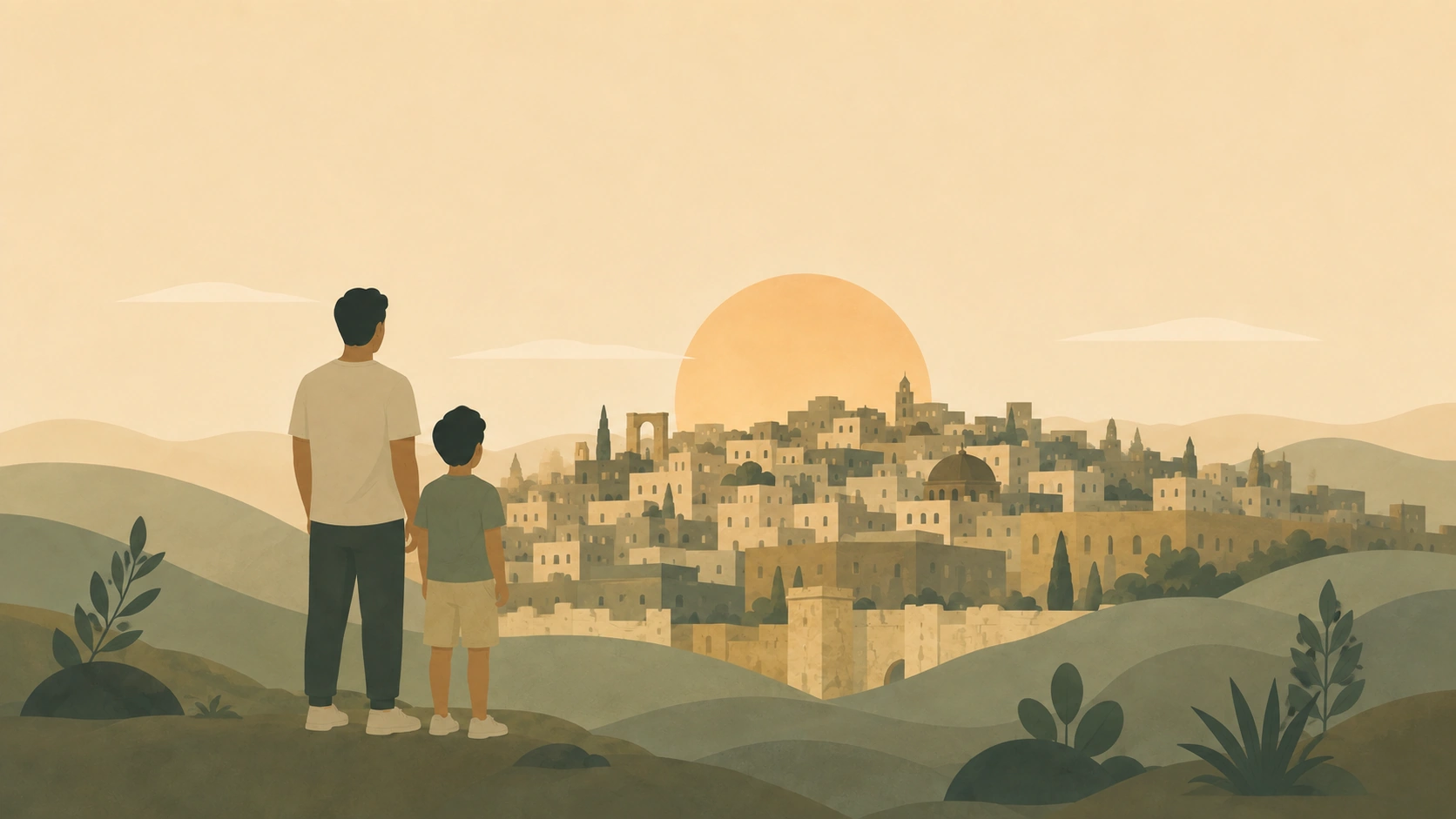
The Father Returns to His Homeland, While His Son Arrives There for the First Time
“Dad, why do you say we’ve returned when I’m coming here for the first time?” He said it while pressed against the airplane window, watching the ground grow larger beneath us and the tightly packed houses slowly emerge through the summer dust. Only moments earlier, I had told him with an excitement I could not hide: “We finally arrived… we’re back.” He turned toward me and asked his simple question. But some children’s questions are not really questions at all. They are mirrors suddenly placed in front of words we have spent our lives repeating without ever stopping to consider what they truly mean. I had returned. He, however, had arrived.
A Homeland Inherited Through Stories
My son was born in exile. He opened his eyes in a distant city, learned to walk on pavements whose stones knew nothing of my childhood, and spoke a language whose words I had to think about before saying them. Syria, however, he knew through me. He knew it through the photographs hanging in our home, the names of relatives appearing on the phone screen, and the old songs I played on weekend mornings. He knew it through cups of tea around which the conversations of adults stretched endlessly, and through a phrase repeated whenever we tasted a certain food, smelled a familiar scent, or encountered someone who reminded us of what we had left behind: “Back home in Syria…” For him, Syria was a country that always began with those words. It was a country inhabited by a grandmother who kissed the phone screen and relatives who knew everything about him even though he barely knew their names. Before the journey, he asked me: “Is our house there big?” I found myself wondering which house he meant. The family home I had left years earlier, which later disappeared as those who remained moved somewhere unfamiliar? The house I had continued building for him through stories? Or that entire homeland we had reduced to a single word and then asked our children to feel toward it exactly what we felt?
The Things He Saw for the First Time
We left the airport and the warm air of Damascus struck us. Ah, Damascus. I breathed it in like a drowning man reaching the surface. The air carried dust, the smell of petrol, and the heat of July, yet it entered my chest as something deeply familiar, as though my body remembered it before I did. The memory of the body does not disappear. On the road, I began pointing enthusiastically at everything like a tour guide explaining a city to an important visitor: “Look… my school was here… and there used to be an ice-cream shop over there, I’ll take you to it… and this road goes to your grandfather’s house.” He watched through the window as cars tangled around one another, people crossed the street from places he never expected, and motorcycles suddenly appeared before disappearing again between buses and clouds of exhaust. Placing his hands over ears that were highly sensitive as a child on the autism spectrum, he asked: “Why is everyone honking?” I told him: “They’re greeting each other, Dad.” He was not convinced, but remained silent.
When we reached the neighbourhood, my cousin and lifelong friend called to him from the balcony of his second-floor home: “Marcel! Uncle’s here, here… You’ve lit up Damascus!” My son stopped and looked at me, asking silently for a translation. In a low voice, he asked: “How does this man know me?” Before I could answer, a woman came out onto the balcony and called him by name as well. Then another person appeared, followed by an elderly man he seemed accustomed to seeing online. He called him “Grandpa, Grandpa” in a gentle voice, his eyes heavy with tears. They had been waiting for us since morning. Abroad, my son was used to living among people who did not know his name until he introduced himself. Here, everyone knew him before he knew them.
When the Lights Went Out
On the first night, the electricity went out. The fan stopped, the room suddenly went dark, and a brief silence settled before everyone began calling out: “Did it come back or go out?” My son, who fears unexpected surprises, became anxious and grabbed my hand. “Dad, when will the lights come back?” he asked. I answered with perhaps the most truthful Syrian phrase: “God knows.” Phones lit up one after another before the solar power illuminated the place. Everyone then moved to the balcony to escape the heat, and the stories began. One story pulled another behind it, one laugh awakened an older laugh, and a plate of watermelon passed from hand to hand while the family taught my son Damascene words and laughed whenever he tried to imitate them, until he completely forgot about the darkness.
I watched him laughing in the dark, surrounded by people he had met only hours earlier, yet he no longer behaved as a stranger among them. In his distant city, the electricity never went out, but doors closed early and every visit required an appointment. Here, the lights went out, but the people remained. For the first time, my son discovered that darkness does not always mean being alone.
Do Not Turn the Homeland into a Test
During the following days, I wanted to show him everything. I took him to our old street, my old university, and even the shop where I used to buy small luxuries. I showed him the tree behind which we once stole moments of love in Al-Jahiz Park. I spoke quickly, as though I feared the place might disappear before I finished explaining it. But soon, he grew tired of my memories. He wanted to chase a cat he had seen near the mosque, buy ice cream from a small local shop we passed, and continue playing the survival game between cars every time we crossed the road while adrenaline filled the place.
That was when I understood that I had been trying to make him remember things he had never experienced. I wanted him to love Syria for the same reasons I loved it, to long for the alleys that had witnessed my childhood, and to feel something that had taken an entire lifetime to form inside me. Those of us living in exile often do this to our children. We tell them about the homeland until it becomes an idealised being in their minds. We ask them to love it before they know it, to miss it before they have lived in it, and to defend it as though it were an examination of their loyalty.
His Own Damascus
I stopped explaining. I allowed him to see the city in his own way. He befriended a child in the neighbourhood, and together they invented an entire language made of football, gestures, and laughter. He learned to stand patiently among crowds to get a hot chocolate croissant, to tell the shopkeeper “Yislamo,” and then rush back as though he had completed a major national mission. He memorised the route to the neighbourhood shop and chose a type of biscuit I had never liked during my own childhood. Every morning, he began waiting for his cousin, then climbing with him to the rooftop to watch pigeons circle above the houses.
He continued complaining about the heat, asking when the electricity would return, and covering his ears against the sound of cars. He could not understand why everyone who met him for the first time kissed him, or why people kept insisting on feeding him even after he said he was full. But I no longer asked him to love the whole picture. Even those of us who were born here never loved everything. A homeland is not a perfect place. It is the place to which we become attached despite knowing its imperfections, perhaps because we are able to see ourselves within them. I had to allow him to build his own relationship with Syria, one that was not based on an emotional debt to his father or on old photographs that did not belong to him. I had the Damascus hidden inside my memory. He needed a Damascus of his own.
When Are We Coming Back?
On the road back to the airport, he was quieter. This time I did not tell him: “We’re leaving.” I was afraid of weighing down the moment with the words of adults. After a long silence, he asked: “Dad… when are we coming back here?” I stopped at the word “back.” Only weeks earlier, he had said he was going to Syria. Now, he was talking about returning to it. I simply said: “Soon.”
In only a few weeks, I discovered that a homeland is not inherited through genes. It does not pass from parents to children the way names, features, or eye colours do. We cannot pass our entire longing down to our children, because longing is born of experience, not instructions. All we can do is open the door for them. Tell them. Show them. Give them roots, allow them to water those roots, and simply wait. Perhaps it is enough to leave them enough space to create a homeland capable of living in their own memories. I returned on the day the plane landed. My son returned on the day he asked me: “When are we coming back?”