The world of advertising in Syria is a social, economic, and cultural condition worth pausing over at length — a condition with its own particular nature, at once dismal and luminous. From deeply intimate ads built on light jingles and rhymed melodies that lodged in the mind, and directors who turned commercial breaks into popular sketches that flirted with the consumer's emotions; through a partial market opening and the retreat of the simple jingle in favor of the "creative concept"; into a long stretch of unadorned decline; and finally to the promising moment of liberation today, when an industry buried under the ashes is waking up — carried back by sons and daughters who studied in foreign capitals and trained in global agencies, returning, perhaps, to write a new chapter: Syrian advertising as it has never been written before.
Stage One — Foundation (1960 – mid-1980s): the rare ad under the censor's ceiling
In its infancy, Syrian advertising was not commercial in any real sense; it was political, broadcast on a screen owned by the state, which chose whom to address and in what language. Syrian Television, launched in 1960, was built on the philosophy of "mobilizing media," which left only a small corner for commercial advertising — and that corner could only be reached through one gate: the Arab Advertising Corporation, attached to the Ministry of Information. In practice this body combined the trio of licensing, censorship, and commission. Any advertiser who wanted to reach the Syrian household had to pass through it: text was sifted, image was sifted, the corporation took its cut, and only then was the work released into the official media.
There was one screen, one mood, and a strictly pre-set ad slot between the seven-o'clock news and the evening drama. Commercials resembled a government circular more than an invitation to buy. In that era the product was not so much chasing the consumer as waiting for the consumer to be permitted to see it.
One screen, one mood, and an advertisement that read like a government circular.
Stage Two — The first birth (mid-1980s – 1990): the visual ad for the local product
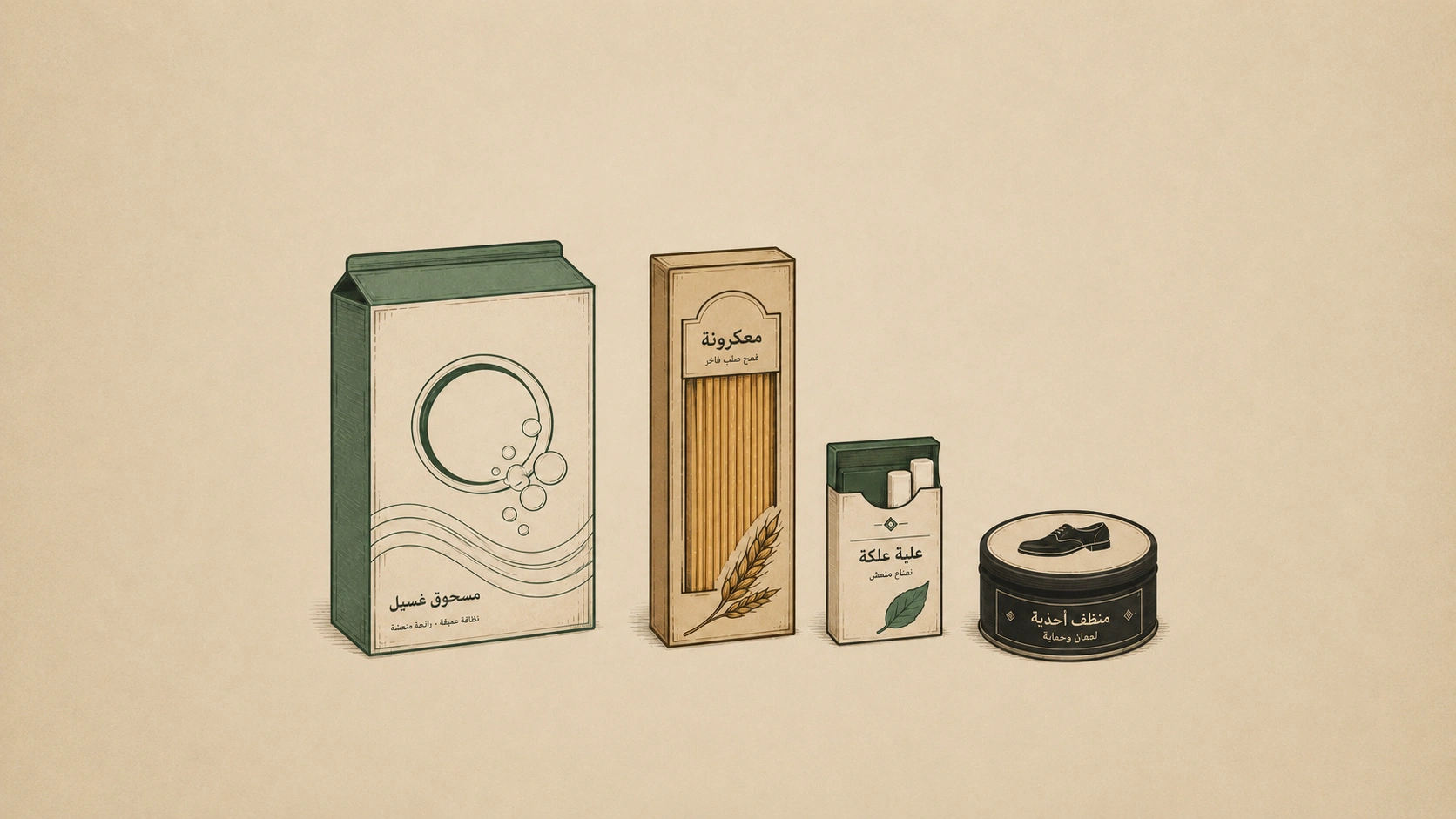
In the mid-1980s something new entered the Syrian household: people began to see their products move on screen, instead of reading them on a shop sign. It was a new experience for a viewer who had not been used to seeing local products in visual form. For the first time soap had a face, a sweet had a song, a pack of tissues had a little hero. Technically the work was still primitive — harsh lighting, stiff sound, limited motion — but it was anticipated and desired, precisely because it had been so late in coming.
Most advertisers were local Syrian factories, not international brands. The Syrian market was built on a domestic base, not on branches of foreign corporations — and that would shape the distinct character of Syrian advertising in the years to come.
Stage Three — The jingle peak (1991 – 2004): the era when we bought what sang to us
This period defined Syrian advertising in the form an entire generation now remembers. The industry discovered its magic recipe: do not address the mind, slip into the memory. The best vehicle was a short song with a catchy tune, simple memorable phrases, and music borrowed from Eastern maqam, Western melodies, and folk memory alike. We bought what sang to us, not what argued with us.
There were no "agencies" in the modern sense; advertisers worked directly with a director or a small production crew. This production simplicity meant that agencies were almost absent while the director and the production house dominated, giving Syrian advertising a craftsman's identity rather than a strategic one. Around the recipe gathered a school of directors, composers, sound engineers, emerging actors, fashion models, and beauty queens from Lebanon — Haifa Wehbe in the spaghetti spot, Katia Kaadi for Dima tissues, Nicole Bardawil for Buffalo, and many more.
Products and phrases were carved into a generation's memory: "Ammar shu Hide ya Ammar," "Do Re Mi," gum, loofah, tissues, Barash, fans, refrigerators, soap, chips, gaufrettes — the list is long. In those years Syrian advertising was a meticulous craft long before it was an organized industry, manufacturing seconds and minutes that stuck in the viewer's memory.
Stage Four — Economic shift (2005 – 2010): the rise of brands
In six short years more happened than in the four preceding decades, thanks to the gradual opening that followed Investment Law No. 10 and what came after: mobile operators, private banks, private TV channels, and international advertising agencies entered the Syrian market. Between 2005 and 2010, Syria experimented for the first time with being a market of brands, not just a market of products.
The budgets of telecom, private banks, real-estate developers, hotels, food brands and others suddenly opened doors for the Syrian advertising industry. At the heart of this shift, modern advertising thinking began to take shape for the first time, through agencies organized along international lines. Capping it all was the spread of outdoor billboard networks across major cities and travel routes — a sight unfamiliar before 2005.
These years were the only moment in Syrian history when the market was on the verge of catching up with the schools of the regional capitals. It hadn't yet, but it was on the way. The most important thing built in those years was not the advertising work itself, but the people: a generation of Syrian designers, directors, copywriters, and account managers who learned, for the first time, inside structured agencies operating to international standards.
Everything pointed to the next ten years being the era of full bloom. But the winds, as the saying goes, do not always blow as the ships wish.
Stage Five — The break (2011): when the killing machine defeated creativity
2011 was no ordinary year on the timeline. As much as it was a hope for an entire people and country, it also marked the rupture of a sector still finding its form. That year the Syrian people paid the price for demanding freedom and dignity — met by a machine of violence that turned cities into shelling zones, citizens into targets, and the economy into ash.
What happened to Syrian advertising was no more than collateral damage in a much larger tragedy. But it shows precisely how brutality kills creativity: before killing a person physically, it kills them professionally; before displacing families, it displaces minds; before silencing voices, it starves ideas.
Marketing budgets that had been designed to buy a smile were now spent on evacuating families and paying for exile rent. A factory leveled to the ground cannot advertise; a company whose owner was displaced cannot plan; a public whose dreams have been crushed cannot consume; agencies that lost their clients cannot continue. The agencies left, the minds emigrated, creativity was killed, dreams were stolen.
The numbers tell the rest of the story: independent estimates put the contraction of the Syrian economy at over 70% since 2011. Syria fell from rank 77 globally in 2010 (as a country pushing out talent) to rank 11 in 2022 — among the worst in the world. Regional and international brands withdrew one after another under the weight of sanctions and collapsing purchasing power, closing branches or shrinking to bare-minimum operations.
Advertising as an industry only lives in a society presumed to have a marketable future. When tomorrow becomes a giant question mark, advertising loses its core function: to promise. At its deepest, the war on the Syrian people was a war on the very idea of the promise — and therefore on the very idea of advertising.
Stage Six — Creative exile (2012 onward): the Syrian mind expands globally
The Syrian advertising mind did not die; it migrated. That migration opened an unexpected chapter — a wave of talent forced out of Syria into major regional capitals that received them as gifted operators essential for running their own creative machines. There the Syrian met other schools — Lebanese, Gulf, Egyptian, Moroccan, American, French, British, Indian — and learned what Damascus could never have taught, while teaching them what none of those schools could have produced alone.
In those years the Syrian learned what the home market could not have given in decades. Methodology and multilingual communication; long-term campaign thinking across multiple touchpoints and channels; the integration of traditional and digital media, the use of celebrities and trends. The young Syrian became capable of running regional accounts at global agencies, creative enough to lead teams in some of the world's best-known shops, strategic enough to head brand-strategy practices across the region. They participated in international shows and awards, met global creative standards instead of local ones. Most importantly, the mindset shifted from advertising as aesthetic to advertising as a measurable result for a paying client. Syrian creative instinct and commitment merged with global professional discipline, producing a new visual language that exceeded the limits of any single place.
Step back and the great paradox appears: the Syrian market was a prisoner of its own successful formula and could only break out of it after losing it. Syrian advertising, which would not have evolved inside Damascus, evolved in its exile. This is not a tribute to the war — that is a tragedy beyond healing — but an acknowledgment that human creativity, when denied its home, finds other walls to climb.
Stage Seven — Today and beyond: a return with new tools
After fifteen years buried under the weight of weapons, fear, and sanctions, Syria today wakes to a different reality. The borders open slowly, regional and international advertising firms come back to study the market again, and sanctions are gradually loosened from a sector long held by the throat. Syrian advertising — like its siblings in every other field — stands today on the edge of a rare opportunity: to be re-founded, not merely repaired.
The essential difference this time is that those returning are not the same people who left. When they left, they were skilled operators looking for a roof. When they return in 2026 — if they decide to return — they are professionally mature, saturated with international standards, and have moved through every seat: from running global-agency accounts in Riyadh, to leading strategic planning across global networks in Dubai, to creative direction in regional shops in Doha, to founding digital studios in Istanbul or Berlin. They carry today what was not available before 2011: a full ecosystem of strategic thinking, digital production, influencer media, measurement, and a partnership mindset with the client rather than subservience.
On the other side, the local market itself has changed. Those who stayed inside Damascus, Aleppo, Latakia, Homs, Hama, Tartous, Deir ez-Zor, Al-Hasakah and other cities went through experiences that taught them under enormous pressure: crisis management, stretching scarce budgets, relying on free digital channels, producing social-media content with home-grade equipment, and understanding the Syrian consumer at their hardest moments. This "besieged" expertise is itself industrial capital not to be underestimated.
Rebuilding this sector will not be a return to nineties-style jingle advertising — the world has changed, the consumer has changed, the screen has changed. It can be something more ambitious: founding a contemporary Syrian school that draws on the intimacy of the old school, fused with a global strategic mind and the art of survival, with deep understanding of the Syrian consumer.
If we manage to bring back to Damascus what deserves to come back — no more, no less — Syrian advertising will have completed its full cycle:
Born under the censor's ceiling… matured in exile, inside and out… returning to found a new school with all its tools.
In closing
Anyone who grew up in the eighties and nineties watching Ammar, Buffalo, Dima and the rest has the right to ask today — now that they carry enough experience to lead an agency in Dubai, Riyadh, Cairo, or far outside the region: are we going back? And what would we bring back to Damascus if we did? Do we revive the jingle in its warm nostalgia? Or do we carry across the border everything we have learned, and use it to re-found an industry that nearly disappeared?
The answer is not in cloning the past, nor in importing the foreign template with all its complications. The answer, for me as a brand and communications strategist of more than twenty years, is to found a hybrid, inventive Syrian advertising industry. We are called today to fuse the experience of two generations: the "exile" generation armed with global strategies and rigorous methodology, and the "inside" generation that mastered the art of survival and the elasticity of producing under scarcity. And to recognize, above all, that advertising — like any industry born of the heart — only truly succeeds when its own people write it with honesty and ease, exactly as Syrians have written their creativity in every arena.