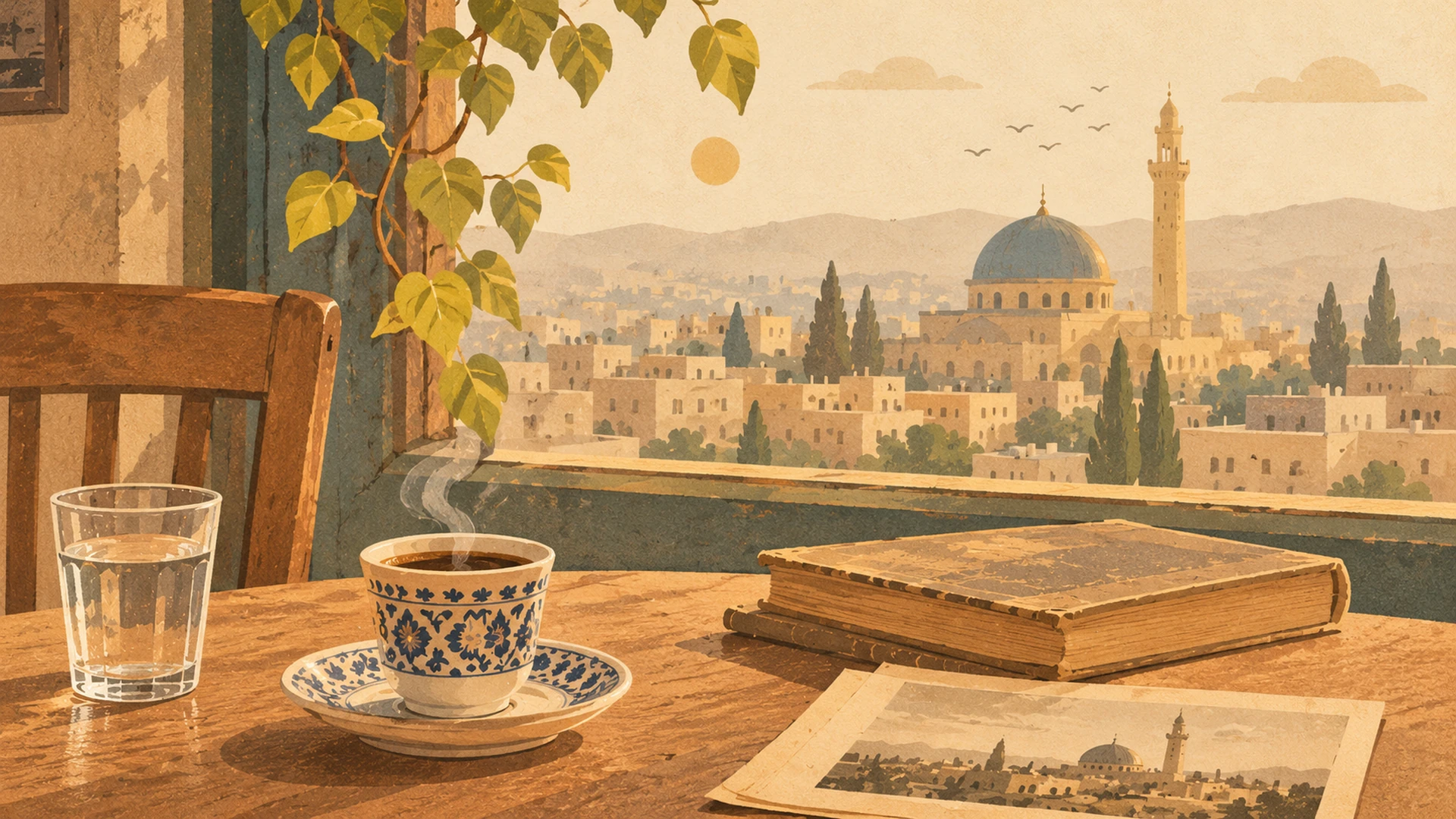
After every visit to Damascus, I return carrying a handful of Syrian words and expressions, Damascene ones in particular, hiding them in my heart the way a child hides holiday money in a pocket.
“Tikram Ainak”… “Dakhil Ainak”… “W enta el-muhraz wallah.”
Gentle expressions repeated by the people of Damascus, heard often in passing conversations, among friends, while shopping, or while walking down the street.
And of course, after every absence, it is perfectly natural to hear: “Lak, you’re still exactly the same!”
Suddenly, all the years of exile between us disappear. I do not know exactly what the word “lak” does… but somehow, it knows the address of home.
You might be somewhere outside Syria and hear someone say something unmistakably Syrian: “Shu?” “Hallaq…” “Lissa…” “Ey wallah…”
The secret is not necessarily in the word itself, but in the way it is pronounced, in the tone, the stretched sounds, in that small melody perhaps heard only by someone who was once from there.
Suddenly, without making any conscious decision, your own dialect changes too. Because we are from there, the words return before we do. You find yourself speaking an old Damascene dialect as though the years you spent away had never passed.
During the years of exile, our dialect changes without us noticing. We soften certain words, replace others, pick up vocabulary from the cities in which we live, and choose expressions everyone can understand.
It is not artificial.
Nor is it a denial of who we once were.
Perhaps it is simply a form of linguistic adaptation.
But sometimes I wonder: Are we the ones changing our dialect… or does the dialect itself learn how to survive in exile?
Then we meet another Syrian, or specifically another Damascene, someone who knows the same words, tones, and expressions, and suddenly all the adjustments we made over the years disappear.
We do not think before saying “hallaq.”
We do not explain what a word means.
We do not monitor how we pronounce our letters.
The dialect knows it is somewhere safe.
Perhaps that is why our original dialect returns in front of certain people: when a person feels safe, they stop translating themselves.
Sometimes it is not a person who brings our dialect back.
Sometimes it is a song.
That is what happened to me when I heard Assala singing “Al-Sandouq.” This song means something very personal to me, and perhaps that is why I heard it differently. It means something because it carries the memory of an entire people, because it is written with the water of nostalgia, with longing for family and for who we were before exile made us older.
I was not simply listening to a Syrian song, nor was it merely the joy of hearing a Syrian singer perform in our dialect.
There was something more intimate.
I was hearing our dialect being sung.
And suddenly, the distance between here and there felt a little shorter.
There is a difference between understanding the words of a song and hearing them spoken in the way someone in your own home might have said them.
Perhaps that is why, when we hear a song in our dialect, its words do not reach our ears first…
They reach memory.
They wake people.
Gatherings.
Streets.
Details we thought we had forgotten.
Sometimes they even awaken an older version of ourselves.
That is why “Al-Sandouq” was more than a song to me.
Perhaps it really was a box…
But not merely a box for words.
It was a box opened by dialect, releasing many things I thought exile had carefully arranged inside me.
Strangely, nostalgia always seems to work this way. The homeland rarely returns to us as a complete picture. Instead, it returns as a detail.
Mahmoud Darwish captured something of this feeling when he wrote: “I long for my mother’s bread, my mother’s coffee, my mother’s touch.”
He did not need to say: I long for my homeland.
The bread was enough.
The coffee was enough.
The touch was enough.
And I think dialect is one of those small details capable of carrying an entire homeland.
We do not always miss Damascus simply as a city.
We may miss the way our neighbor used to say, “Good morning.”
The “Tikram Ainak” of the shopkeeper.
The “Dakhilak” of a friend.
The “lak” that you can never quite tell is the beginning of affection, reproach, or a story that will go on for a long time.
We miss something much simpler:
Speaking without having to explain ourselves.
Because dialect is not only words.
Dialect is people.
“Hallaq” is not simply another word for “now” when it is your mother’s voice calling it out to you.
We do not carry our homelands only in our passports.
We carry them in the way we pronounce our words.
And so a question comes to mind:
After all the years we have spent away, after all the cities, dialects, and expressions that have entered our language…
In what dialect do we speak to ourselves?
When we are afraid, in what dialect do we think?
When we are angry?
When we are happy?
And when we say “Ya Allah” from the heart?
Perhaps in our most truthful emotions, all our acquired dialects fall away and our first language emerges.
As though emotion knows a shorter road home than the mind does.
Many cities have grown inside our voices.
We took words from them, gave them some of ours, and learned how to speak in ways everyone could understand.
But sometimes it is enough to sit across from someone from there…
Or hear a song in our dialect…
Or hear someone call out to us…
For something small and invisible to happen.
The letters relax.
The distances fall away.
And our dialect returns home.
Perhaps because dialect, just like us, knows where it feels safe.
And perhaps because, just like us, it longs.
And because we are from there…
“there” still lives in our voices.
Our Dialect When It Feels Safe
A reflection on dialect as memory, identity, and an inner home, and on how our first words and original tone return when we feel safe or hear a song that brings back the voices, people, and places we left behind.
Hala Khabbaz