
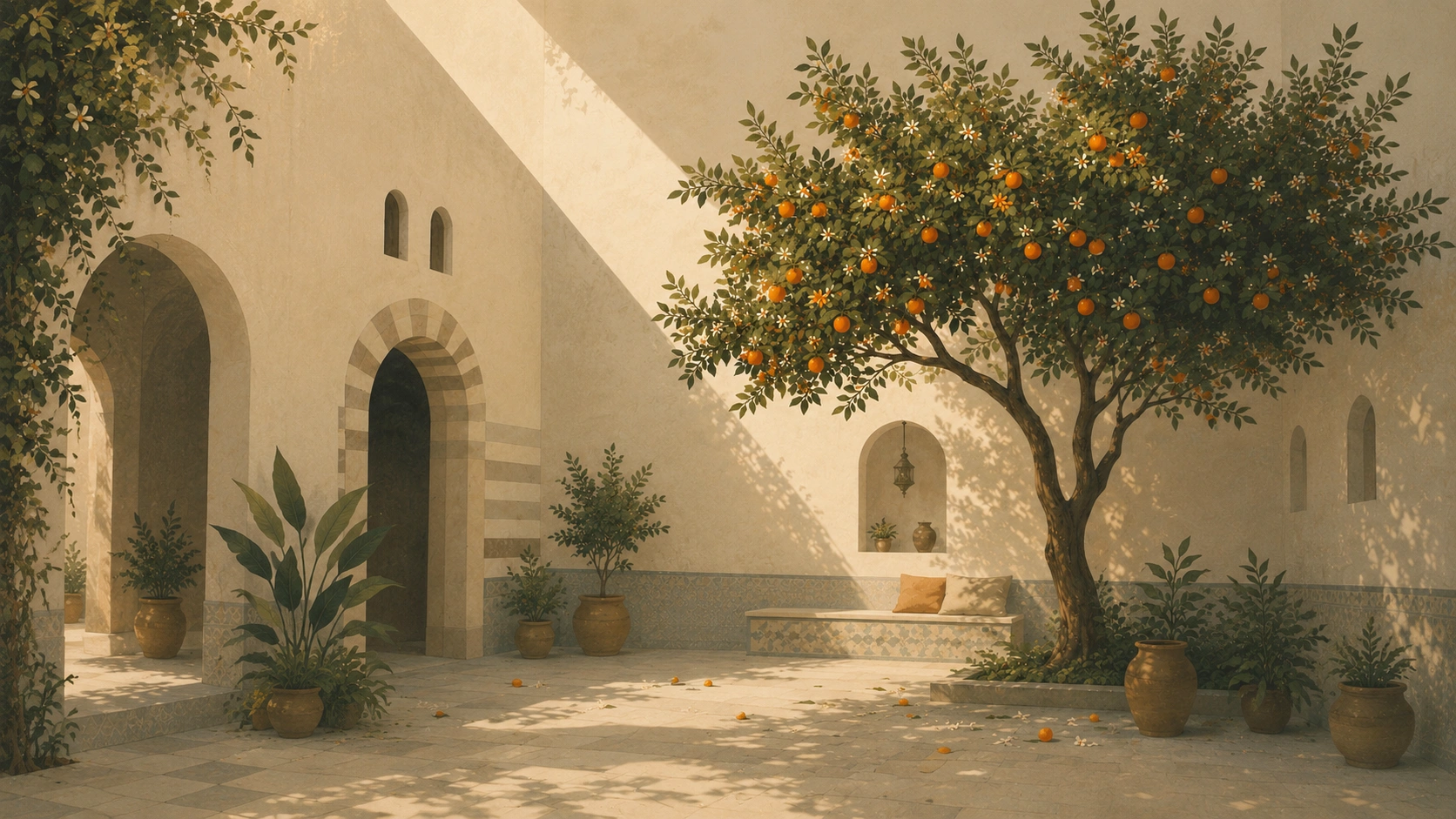
It is hard to imagine an old Damascene house without a bitter orange tree.
In the courtyards of ancient homes, beside stone fountains, beneath the shade of jasmine and wooden mashrabiyas, this tree was always there — as though it were an authentic part of Damascene architecture itself, not a passing botanical detail.
Yet the paradox many do not know is that the bitter orange (narinj) is most likely not native to Damascus.
Most historical and agricultural studies trace its origins to Southeast Asia and China, before it traveled through Persia into the Arab world via the ancient trade routes that connected the East to the Arab region for centuries. With the spread of Islamic civilization, citrus gradually moved into the cities of the Levant, and from there to the Mediterranean basin and al-Andalus.
But what happened in Damascus, specifically, was unlike any other city.
While elsewhere citrus remained simply fruit, Damascus reshaped its relationship with the narinj into something deeper and more human. The tree did not enter the city merely as a crop — it slipped into the textures of daily life until it became part of the visual and emotional sense of the Damascene home.
In traditional Damascene architecture, the narinj tree was not a decorative element but part of the very composition of place. Its presence at the center of the courtyard created a visual and spiritual balance between water, stone, scent, and shade. The fountain in the heart of the house was never just geometry, and the tree was never just a plant. The old Damascene home was designed to produce an inner sense of calm — and the narinj tree was part of that delicate architectural philosophy.
In spring especially, the scent of orange blossoms filled the old alleys, becoming over time a sensory memory bound to Damascus itself. Perhaps that is why Damascenes do not remember the narinj only as a tree, but as a whole feeling — a morning scent through a window, a soft shadow moving across stone tiles, an invisible mark of the changing seasons.
Because Damascus is a city that has always turned everyday things into cultural ones, the narinj did not remain in the visual realm alone. It entered the kitchen, social rituals, and even popular language. From its blossom came orange-blossom water, one of the most essential elements of Damascene cooking — used in sweets like ma'mul and mabroumeh, in jams, in coffee, in drinks and home perfumes, and in old folk remedies.
Over time, orange-blossom water was no longer simply a flavor; it became part of the “Damascene taste” itself — a taste hard to explain through measurements alone, because it is bound to memory, home, childhood, and old scents.
Even in Damascene literature and popular song, the narinj appears as a symbol of tenderness, longing, and home. The image of the Shami house in the Arab imagination is often inseparable from narinj, jasmine, and the courtyard fountain — three elements that together form the city's visual and emotional identity.
Some historical accounts hold that Arabs carried the narinj from the cities of the Levant, Damascus among them, to al-Andalus during the Islamic era, long before sweet oranges later spread across Europe. For centuries the narinj remained tied to Arab-Islamic gardens in Andalusia and the Mediterranean, becoming part of the civic landscape of cities like Seville, Cordoba, and Granada.
Which makes the question more interesting today:
Did Damascus truly export the narinj to Europe? Or did it export something deeper than the tree itself?
Cities do not export products alone; they export their way of seeing the world. And Damascus, across long centuries, was never simply a city that received cultures — it was a city that reshaped them and gave them a different soul.
Perhaps this is precisely where the singularity of Damascus lies.
The city did not merely receive things from the world; it redefined them in its own way. Much of what passed through Damascus became something else inside it — more poetic, closer to the human, more bound to memory.
And so, though the narinj was not born in Damascus, few trees in the world have ever managed to become so completely “Damascene.”
Is this, then, what Damascus truly is? The city that reshapes things… and then makes them part of its soul?