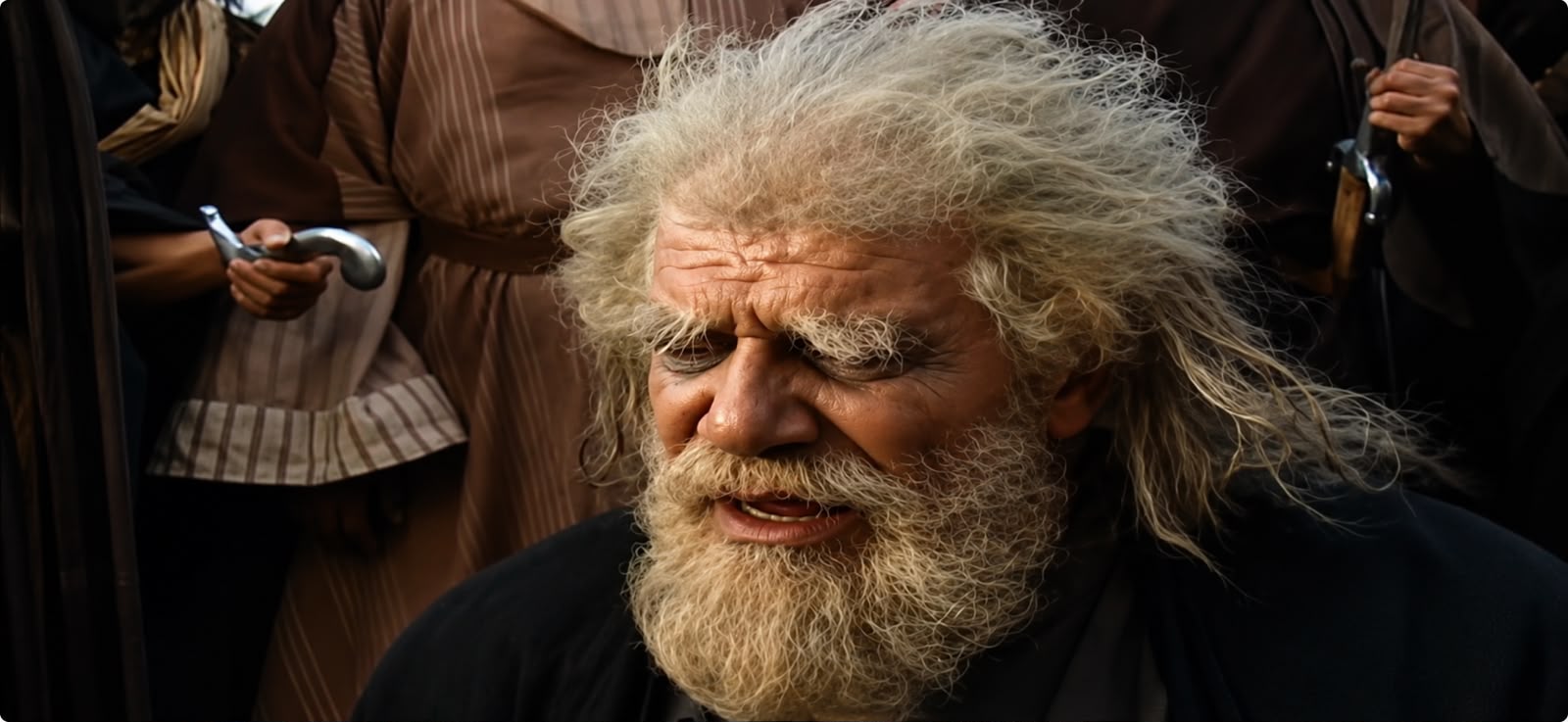
The character of Ibn Abbad still amazes me.
Every time I watch Al-Zeer Salem, I find myself returning to that calm, wise man who seemed as though he had stepped out of the pages of history rather than a television studio. He was not the loudest character, nor the owner of the most famous sword, yet he possessed something else entirely: a presence that was difficult to explain and a dignity that required no display.
Then I move to The Palestinian Exodus (Al-Taghreeba Al-Filistiniya), where I find Abu Ahmad, the simple Palestinian farmer who carried the pain of his people in silence and condensed the tragedy of an entire nation into a glance, a sigh, or a few words spoken with difficulty by a man who knew that life was too harsh to complain about endlessly. And here I always stop and ask myself: Who was this man? How did he make us forget that we were watching an actor? Perhaps because Khaled Taja never merely performed characters. He gave them something of his own soul.
Khaled Taja was born in Damascus in 1939 and lived a childhood that was neither privileged nor easy. He knew poverty, he knew hard work, and he knew the streets of Damascus with all their ordinary people. Perhaps that is why he carried something deeply human throughout his life. He never seemed like a star living far removed from people, nor did he try to create an artificial aura around himself. He resembled those men you meet in life and somehow feel you have known for years.
When he entered the world of acting, he was not searching for stardom in the conventional sense. He did not possess cinematic good looks, nor did he have an overwhelming screen presence. Yet he possessed something far rarer than all of that.
He possessed authenticity.
The kind of authenticity that turns wrinkles into part of the performance, silence into part of the dialogue, and a single glance into a story that pages of writing could never fully tell. It was therefore no surprise that Mahmoud Darwish once described him as “The Arab Anthony Quinn.”
Yet I always felt that Khaled Taja was greater than comparisons. Anthony Quinn never carried that uniquely Eastern sadness. A sadness that did not resemble defeat, but dignity. A sadness you find in the faces of fathers and in the eyes of men who have endured much yet remained standing. Perhaps this is why people loved Khaled Taja. They did not love him because he was a star. They loved him because he was one of them.
He resembled the father we know, the grandfather we cherish, the kind neighbor, and the man who carries his dignity quietly. In Ayyam Shamiyah, Al-Zeer Salem, The Palestinian Exodus, and dozens of other productions, he did not portray distant characters. He portrayed humanity itself—its weakness and strength, its pride and fear, its sorrow and hope. He knew how to make a strong man appear human and a simple man appear great.
And that is a rare gift. Some actors impress you with their skill. Khaled Taja touched something deeper. He awakened memory. Sometimes, while watching him, I feel as though I am not seeing an actor at all. I see old Syria. I see the Damascus known by our parents’ generation. I see men who spoke little, but when they did, the entire room listened. I see a time when simplicity was a virtue, dignity was part of one's character, and sorrow needed no dramatic display to be understood.
That is why, when Khaled Taja passed away in 2012, Syria felt it had lost something greater than an artist. It lost a familiar face. It lost a part of its soul. Some artists leave behind their works. Khaled Taja left behind something else. He left behind that strange feeling that comes over you every time he appears on screen. A feeling that resembles nostalgia.
And to this day, whenever I watch Ibn Abbad in Al-Zeer Salem or Abu Ahmad in The Palestinian Exodus, I ask myself:
How did this man make us believe him so completely?
And I always return to the same answer. Because he was not acting. He was living. And because some people do not merely enter the screen.
They enter memory.
And remain there for a very long time, like a member of the family, a memory from a distant childhood, or a face from a beautiful era we fear losing forever. Perhaps that is why, whenever Khaled Taja disappears from the screen, I feel that something of old Syria disappears with him.
And whenever he returns in an old scene, I feel that something of it returns.