
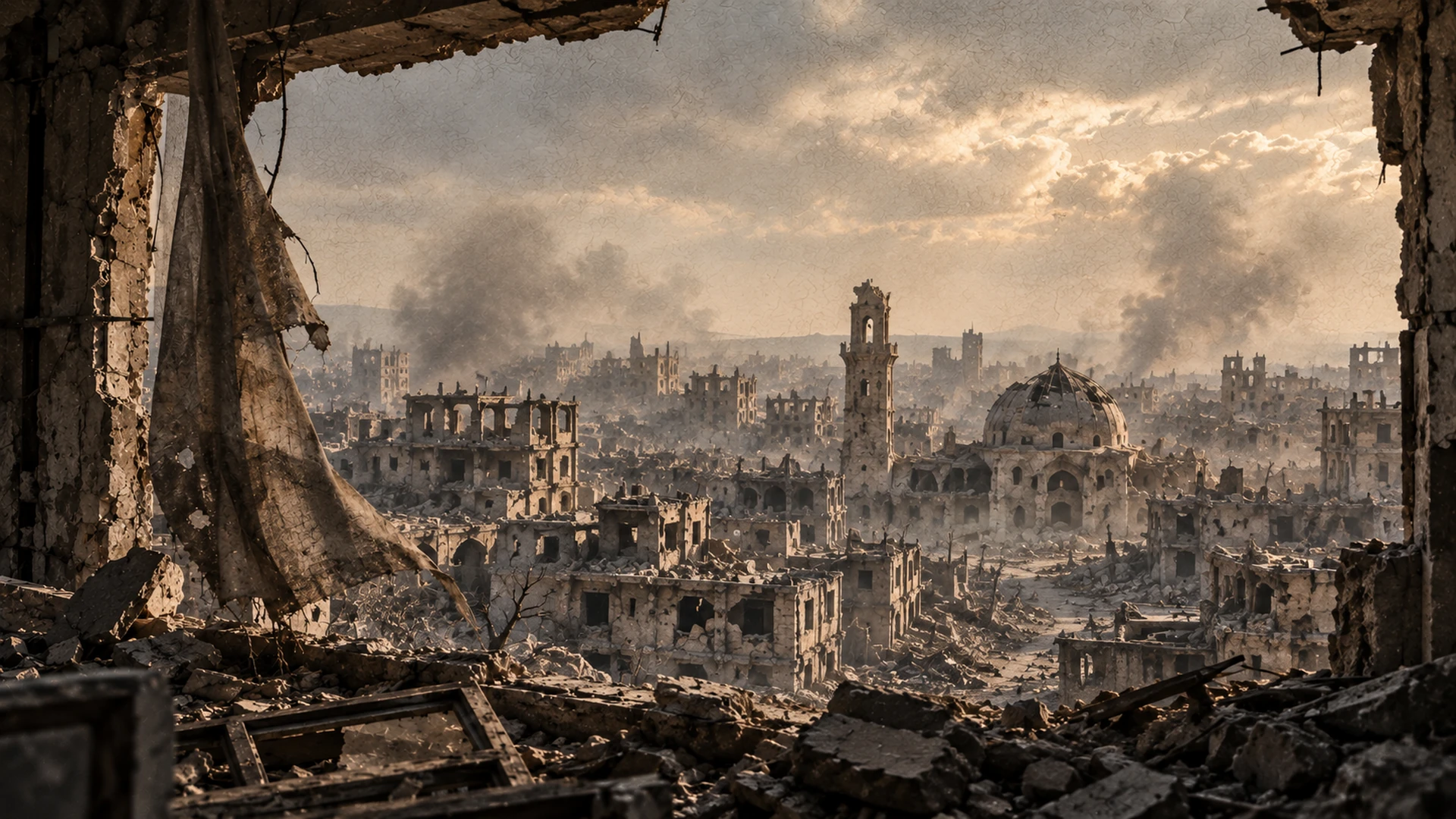
Every time some of the perpetrators accused of committing massacres during the years of the revolution that began in 2011 are arrested, I feel overwhelming happiness. Yet I, like most people from the city of Hama, find myself confronted by an urgent question: Where is the accountability for those remaining perpetrators who committed what I regard as one of the most horrific massacres in Syria’s modern history, the “Hama Massacre,” during which one of Syria’s major urban centers was devastated and large numbers of its inhabitants were killed or displaced?
Does our right to hold perpetrators and killers accountable remain subject to political bargaining, to the point that not a single official investigative committee has yet been formed? Why have many archival and filmed materials that we have been told exist in some state institutions, and which are said to have been recorded during and after the Hama massacre, still not been released? Is everything reduced to commemorating the massacre through events and activities described as “cultural,” while justice remains unrealized, hundreds of Hama families remain without compensation or restored rights, and tens of thousands of political prisoners who lost years of their lives unjustly remain without redress?
We will reject every hollow phrase used by some to reduce a wound that continues to bleed within us, and we believe the time for accountability will come sooner rather than later through every possible path available to obtain rights and compensate victims.
What Happened in Hama According to an Amnesty International Report Published on September 23, 1983
The following section is presented as an Arabic translation of the report cited in the original article.
Amnesty International issued its long-awaited study concerning the Syrian government’s actions in the historic city of Hama in February 1982. It concluded that, “when law and order were re-established, estimates of the number killed on all sides ranged from 10,000 to 20,000.”
The United States Department of State, in its most recent human-rights report on Syria issued earlier that year, did not publish a specific figure. It stated that evidence concerning the number of deaths was limited because the government had restricted access to the city for a period of time and attempted to suppress information about what had happened there. It nevertheless referred to press reports suggesting that several thousand people had been killed.
The Washington Post reported several weeks after the massacre that as many as 20,000 orphans may have been left by the ordeal. On December 9, veteran Middle East correspondent David Hirst of the British newspaper The Guardian cited Muslim Brotherhood sources as saying that as many as 30,000 people might have been killed. The Syrian governor of the region, however, insisted that the death toll on both sides did not exceed 1,200. Hirst added that the physical destruction was the only reliable measure of the scale of the disaster because other aspects, including the number of deaths, remained widely disputed.
At the time of the massacre, the government of Syrian President Hafez al-Assad had sealed Hama off tightly from the outside world, while heavy artillery and aerial bombardment struck positions associated with Assad’s opponents, the Muslim Brotherhood. The group had organized unrest against his rule.
According to the account cited from Amnesty International, approximately 6,000 to 8,000 troops were deployed to the city, including units from the 21st Mechanized Brigade of the Third Armored Division, the independent 47th Armored Brigade, the Defense Companies, and special units or special forces.
The report added that older sections of the city were subjected to aerial and artillery bombardment in order to facilitate the movement of troops and tanks through narrow roads.
It also stated that the old district of Al-Hader was shelled and reportedly leveled by tanks during the first four days of fighting.
On February 15, Syrian Defense Minister Major General Mustafa Tlass announced that the uprising had been suppressed.
“Nevertheless,” Amnesty International continued, “the city remained under siege and completely cut off from the outside world.” Two weeks of house-to-house searches and mass arrests followed, while conflicting reports emerged of atrocities and mass killings of unarmed civilians by security forces.
The organization added that it was difficult to establish with certainty what had happened, but that it had received information alleging, among other things, a mass execution of approximately 70 people outside the municipal hospital on February 19; executions of residents of the Al-Hader district by Syrian forces on the same day; allegations that containers of cyanide gas were brought into the city and connected by rubber pipes to entrances of buildings believed to shelter insurgents, killing those inside; and reports that people were gathered at the military airport, the sports stadium, and military barracks and left outdoors for several days without food or shelter.
The original text also states that the United States National Security Agency (NSA), described as the highly secretive government agency responsible for technical intelligence collection, ordered high-altitude American reconnaissance aircraft and satellites to photograph the Hama area after the first reports of unrest against the Assad government reached Washington.
According to that account, this was described as standard operating procedure for the NSA: whenever unrest appeared somewhere in the world, aircraft and satellites would be tasked with obtaining high-altitude imagery. The text describes the imaging technology as highly advanced and says trained specialists could identify remarkable detail on the ground.
The article states that aircraft and satellites also passed over Hama after the massacre and additional photographs were taken, leaving the U.S. government with two sets of images: “before” and “after.” An unnamed American intelligence official familiar with the images was quoted as describing them as horrifying.
The official reportedly said that the “before” image showed an old Arab city with narrow alleys and streets and a large market. One of Hama’s most prominent features, according to the account, was its large number of mosques, each with a visible minaret from which the call to prayer was made five times a day.
The “after” image was said to show that almost all of those mosques had been leveled during the events. The account attributed this to the authorities’ belief that the Muslim Brotherhood had used the mosques as bases and that destroying them would strike a decisive blow against the organization.
David Hirst was cited as reporting from Hama that a standard tourist guide to the old city had described the Great Mosque as its greatest landmark, spanning at least three civilizations: a mosque developed from a Byzantine church that itself had been built over a Roman temple. According to the cited account, the mosque, like many others in the city, was destroyed by the Syrian army.
Hirst was also quoted as saying that the only structure apparently left deliberately standing amid nearly two acres of destruction was a building of no historical significance: a concrete toilet.
The text goes on to argue that, by its own measure, the Hama massacre surpassed the tragedies of Sabra and Shatila that followed seven months later.
It further argues that the Hama massacre remained one of the least-known events for much of the international community. It attributes the near absence of coverage on American television networks to the Syrian government’s refusal to allow media crews into the area to film the destruction, noting the importance of strong visual material in gaining attention on U.S. evening news broadcasts.
The text then asks whether the Arab League or the Islamic bloc protested the destruction of the mosques, aside from the loss of life, and whether even a formal meeting was held at the United Nations Security Council. It answers these questions in the negative.
Finally, the article states that Israeli Defense Minister Moshe Arens and other influential Israeli officials were visibly affected by what had occurred in Hama. According to the text, their dealings with Assad led them to conclude that he was capable of extreme brutality even toward his own population, noting that those killed in Hama were Syrian citizens, Muslims, and Arabs.