
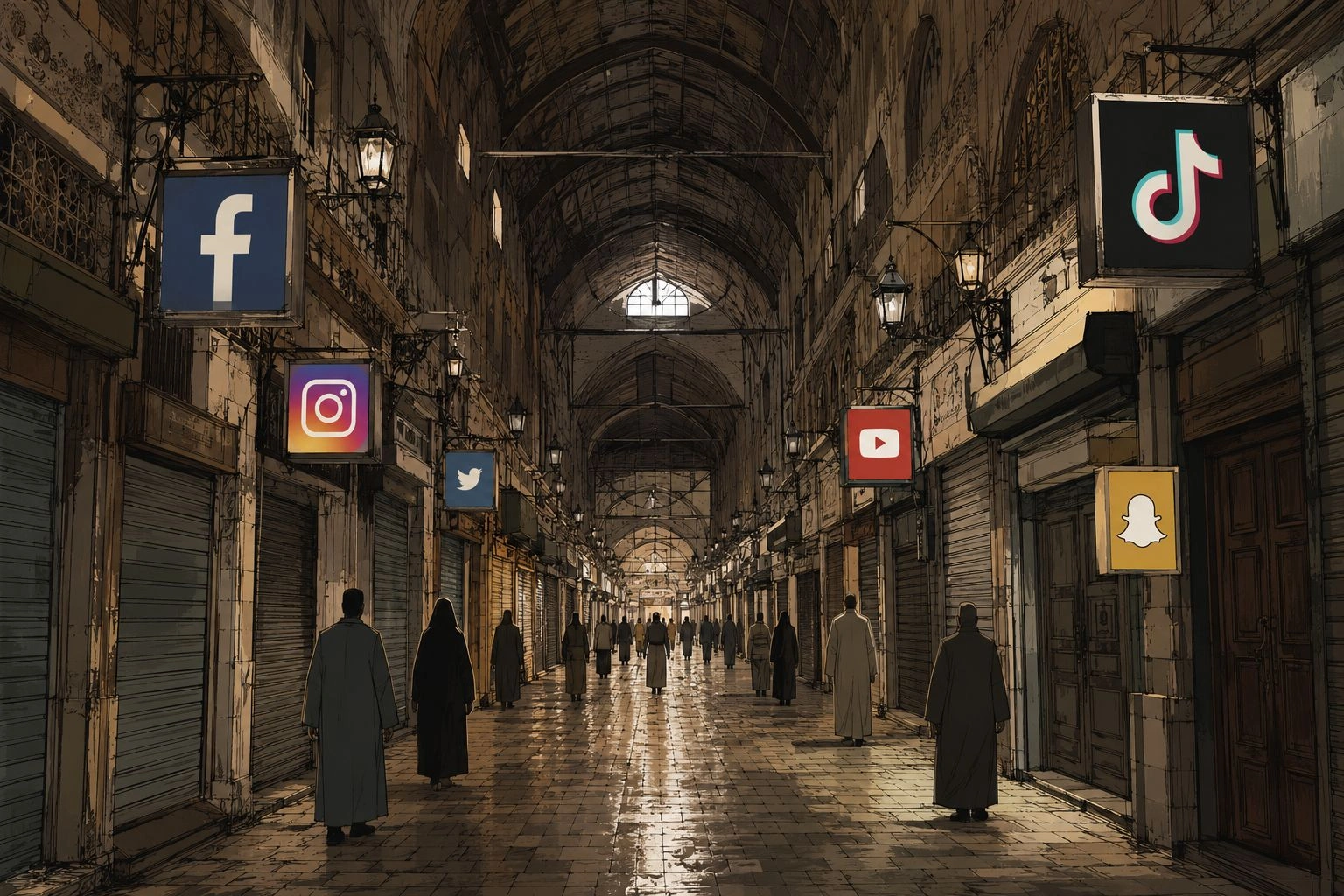
When a visitor enters Souq Al-Hamidiyah in Damascus for the first time, they may believe they are encountering a traditional shopping experience belonging to the past: an old iron roof, closely packed shops, the scents of coffee and spices, and the voices of merchants rising from every direction. But someone viewing the scene through the eyes of marketing does not see merely a historic market. They see a fully integrated system of influence, persuasion, and purchasing-decision creation—a system remarkably similar to what we see today in online stores and digital commerce platforms.
The tools may have changed, but human beings have remained the same. What technology has done in recent decades was not to invent entirely new behaviors, but to digitally reinterpret commercial experiences accumulated over centuries in ancient markets such as those of old Damascus.
Pop-Up Advertising Before the Invention of Pop-up Ads
In modern e-commerce, pop-up advertisements suddenly appear while we browse websites, drawing our attention to an offer, product, or discount. Yet anyone walking through the alleys branching from Souq Al-Hamidiyah will discover that this technique existed in human form long ago.
Some callers would stand at the entrances of smaller markets or side passages, calling out to passersby and informing them about a distinctive shop, rare merchandise, or a special offer inside. Their primary task was to convert the main flow of traffic into secondary traffic, exactly as digital advertisements do today when attempting to draw users away from the page they are viewing toward another page more closely connected to the objective of making a sale.
The Damascene merchant intuitively understood what modern marketing books now call “Attention to Traffic Conversion.”
The Art of the Storefront: The Traditional Version of a Landing Page
In digital marketing, companies spend millions of dollars designing landing pages capable of persuading visitors within a few seconds. In the Damascene market, however, the shopfront was the true landing page.
The arrangement of merchandise, the selection of colors, the display of the most attractive products, the placement of luxury items at eye level, and the highlighting of products in seasonal demand were all practices intended to achieve the same objective: stop the passerby, attract their attention, and encourage them to enter.
Shopkeepers did not know the terminology of user experience (UX) or customer-centered design, but they practiced its essence every day.
Social Recommendation Before Online Reviews
When shopping online today, we look for star ratings, reviews, and the opinions of previous buyers. In the markets of Damascus, however, the intelligent merchant understood that people trust other people more than they trust advertisements.
That is why one would hear expressions such as: “I swear, I buy this for my own home” – “This product is selling nonstop!” – “We sold out yesterday, and a new batch arrived today!”
Some may think these are merely casual sales expressions, but they are actually an early use of what behavioral scientists today call “Social Proof.”
Human beings naturally feel reassured when they know that others made the same decision before them. This is why online stores use phrases such as: “Best Seller” – “3,000 people purchased this product” – “Only two items remaining.” It is almost the same language, expressed through different tools.
Conversational Marketing Before Artificial Intelligence
In our current era, companies are increasingly using chatbots and artificial intelligence to assist customers while shopping. Yet the markets of Damascus knew a warmer and more human form of this concept.
An experienced seller would begin a short conversation with the customer before presenting the product:
“Where are you coming from, brother?” – “Who are you buying it for? Your wife?” – “Is it a gift or for personal use?” – “What budget do you have in mind? How much are you planning to spend?”
These questions were not merely social curiosity. They were a professional data-gathering process that helped the seller understand the customer and personalize the most appropriate offer. In other words, the merchant practiced an early form of “Personalization,” which digital platforms proudly promote today.
Free Samples and Product Experience
Modern stores rely on trials and free samples to encourage purchases. In Levantine markets, this was naturally present. The customer would taste a piece of confectionery, smell a perfume, touch a fabric, try a prayer bead strand, or examine the quality of copper.
It was a complete sensory experience that allowed the customer to build trust before making a decision.
Although e-commerce today attempts to simulate this experience through images, videos, and augmented reality, it is still striving to reach the level of direct sensory experience perfected by traditional markets.
Creating Scarcity: One of the Oldest Tools of Persuasion
One of the most famous modern marketing techniques is creating a sense of scarcity and urgency.
Every day, we read advertisements saying: “The offer ends in two hours” – “Only one room remains” – “Last five items.” But scarcity was not a digital invention. In the old markets, merchants would say:
“Last piece, dear customer” – “The evening sale” – “A one-of-a-kind piece” – “Make your mother-in-law happy with silk and paper.”
Whether the statement was fully accurate or contained some commercial exaggeration, it was based on a deep understanding of human psychology: what becomes scarce becomes more attractive.
Relationship Marketing, Not Transactional Marketing
One of the greatest differences between traditional markets and some modern commercial models is that the Levantine merchant was not always seeking a single transaction, but a long-term relationship.
The merchant knew customers’ names, remembered their preferences, welcomed them with a personal smile, and made them feel that they were not merely buyers.
This is what companies today call “Customer Lifetime Value.” The terminology is modern, but the practice is very old. The Damascene merchant understood that a satisfied customer would not return alone, but would bring family members, friends, and neighbors.
The Market as a Social Platform
Perhaps the most important difference is that the old market was not merely a place for buying and selling. It was a social, cultural, and human space. People came to meet one another just as they came to shop. Trust was built over time rather than through algorithms, and reputation traveled from mouth to mouth rather than from screen to screen.
Today, digital platforms try to reproduce this element through online communities, ratings, reviews, loyalty programs, and user-generated content.
These are modern attempts to restore what once existed naturally in traditional markets.
What Did Technology Learn from Damascus?
When we examine the scene deeply, we realize that the true evolution was not a transition from ignorance to knowledge, but a transition from the physical space to the digital space.
The call became a notification. Reputation became a rating. Recommendation became stars. The storefront became a landing page. Conversation became a chatbot. The loyal customer became a number inside a customer relationship management system.
But the essence of the process remained unchanged: understanding the human being.
The old markets of Damascus succeeded because they understood human psychology before modern marketing emerged in its academic form. They understood that purchasing decisions are not created by prices alone, but by trust, stories, relationships, impressions, and experiences.
Perhaps the greatest lesson those markets offer today is that no matter how far technology develops, it remains only a tool. The essence of genuine marketing will always be the ability to understand people, communicate with them, and persuade them.
Damascus had been teaching this lesson to merchants for centuries, long before the internet was born.