
Syria needs to rebuild what has been destroyed, but it equally needs to build a generation capable of living, competing, and belonging. Roads reconnect cities, while sport reconnects people. It should therefore not be viewed as an activity postponed until after recovery; sport is part of the recovery itself.
One of the first tests is approaching with the Los Angeles 2028 Olympic Games. Syria’s goal should not simply be to arrive with a limited delegation, but to launch a national programme beginning now: identifying the sports in which we have a realistic opportunity, discovering talent inside the country and within the diaspora, and providing athletes with training, support, and qualifying competitions. A medal does not begin at the opening ceremony. It begins years earlier, in the school, the club, and the neighbourhood.
The Ministry of Sports and Youth has established an important foundation on which to build. It has begun preparing the National Youth Strategy 2026–2030 and listening to young people’s aspirations, while working to rehabilitate facilities, activate sports federations, and expand international participation and partnerships. The next step is to bring these efforts together under a clear national objective: healthier young people with greater participation and belonging, and a Syrian sports sector capable of competing.
The success of sports policy should not be measured solely by the number of tournaments or facilities, but by who can access them, what talent they discover, and how they change people’s lives and Syria’s image.
Some will say that a country emerging from a long war has more urgent priorities. But Syria did not wait until its technological and banking infrastructure was complete before beginning digital transformation, because the transformation itself helps create readiness. The same logic applies to sport: weak infrastructure is not an argument for postponement, but a reason to set priorities and begin with what is available. Quality of life is not a reward that comes after recovery; it is one of the conditions for recovery.
This vision can be translated into three clear pathways: Sport for All, by activating schools, facilities, and public spaces; a Road to 2028, focused on identifying talent and supporting priority sports; and Syria Gets Acquainted, bringing together young people from different governorates through teams, camps, sports programmes, and volunteer initiatives.
These pathways should operate within a safe environment that respects society’s values and earns the trust of families. They should also be accompanied by publicly announced indicators measuring participation, equitable distribution across governorates, talent development, and international results.
For this reason, placing “youth” first in the ministry’s name so that it becomes the Ministry of Youth and Sports would not merely be a linguistic adjustment. It would signal a change in philosophy: from managing sporting activity to leading a national youth-building policy in which sport becomes a tool for health, belonging, and skills.
This is not a theoretical vision. Since moving to Riyadh in 2023, I have seen how sport can shift from being an activity to becoming public policy. The Riyadh Marathon brings the city together, major sporting events stimulate the economy, and Saudi Arabia is preparing to host the AFC Asian Cup in 2027, followed by the Asian Games and the FIFA World Cup in 2034. Behind these events is a vision that makes quality of life part of state-building.
There are also lessons closer to us. Morocco did not reach the semi-finals of the 2022 FIFA World Cup by chance; it invested in youth development, coaches, and diaspora talent. Egypt, meanwhile, built a broad network of youth centres and connected sport with volunteering and skills development. The common lesson is clear: there is no elite sport without a community base, and achievement cannot be built through seasonal decisions.
Syria does not need to copy anyone else’s experience. It needs to learn from these lessons and build its own model. The question today is not when Syria can afford to invest in sport, but how much it will lose if it delays.
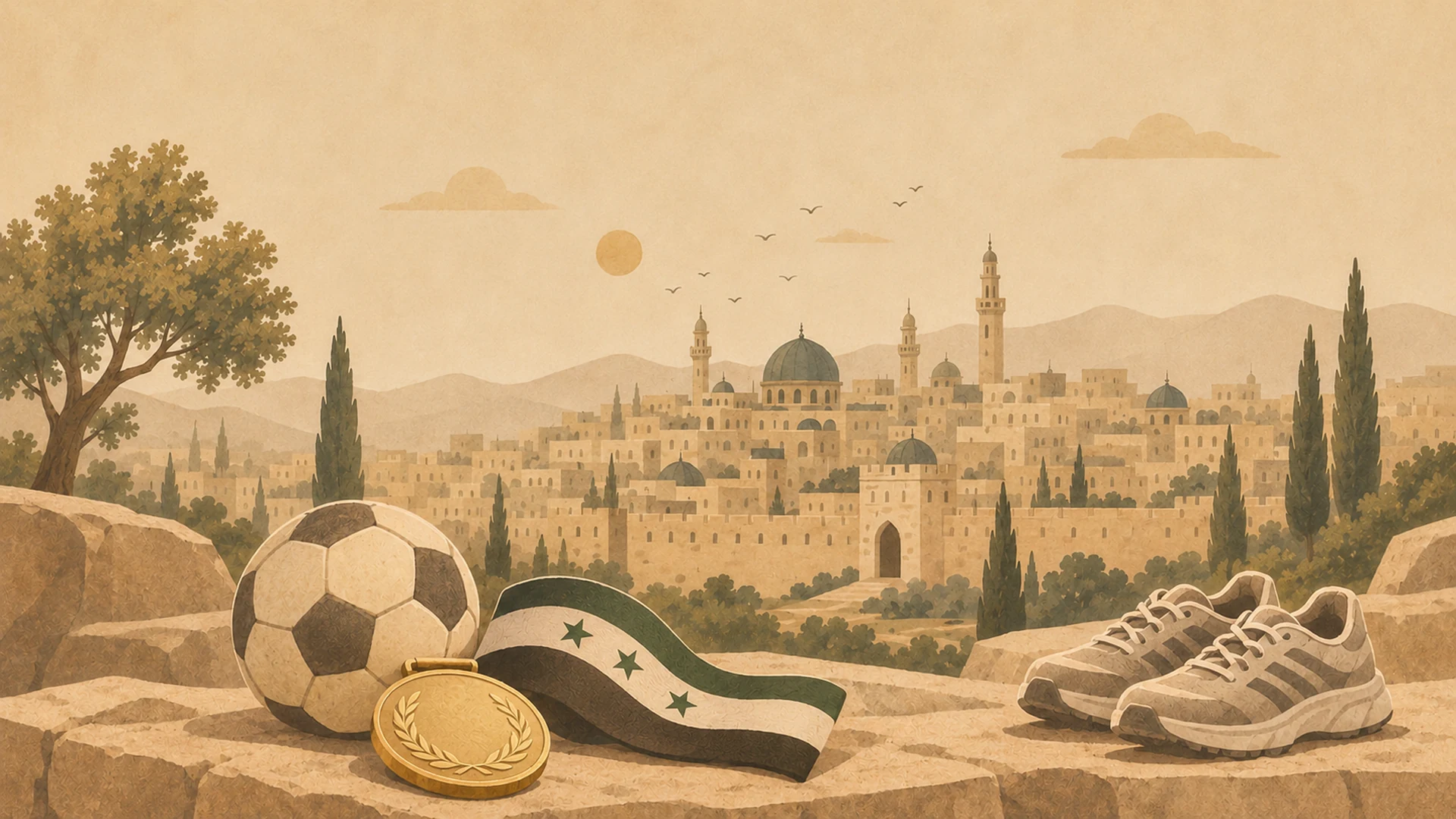
Before the Medal… How Can Syria Build Its Champions?
A vision for the role of sport in rebuilding Syrian society, beginning with wider participation and talent identification and extending to a national programme preparing for the Los Angeles 2028 Olympic Games while placing young people at the heart of recovery.
Rawan Mohammad Amer Al-Rujoula