Imagine yourself riding in an Oldsmobile, and after an exciting tour through the streets of Damascus, you stop at the Socony-Vacuum station on Al-Baramkeh Street to refuel. Then you park your car at the gate of your palace, on which the first letter of your name and title has been engraved. You rest for a while, then consider going to the golf course or the basketball court located where you live, before spending your evening in a gathering with men of politics and economy in one of the palaces. Now set your imagination aside and come with me on a journey to Al-Halabouni neighborhood.
Al-Halabouni neighborhood is located in Damascus on land once known during the Mamluk period as Bustan Al-A‘ajim. It included Mahallat Al-Khalkhal, one of Damascus’s vanished gardens, and a water spring called Al-Munaybi‘. Both were mentioned by Abu Al-Baqa Al-Badri in his book Nuzhat Al-Anam fi Mahasin Al-Sham: “Among the beauties of Al-Sham are the two districts of Al-Khalkhal and Al-Munaybi‘. Mahallat Al-Khalkhal has a small market, shops, an oven, and a bathhouse. It is the residence of the Turks and contains the two zawiyas of Al-Adhamiyyah and Al-Hadud.”
The neighborhood borders the Hejaz Station, and its last known name was “Zuqaq Al-Mulla” until Hassan Effendi Al-Halabouni purchased it, built his palace there, then built a mosque beside it. The neighborhood was then named Al-Halabouni after him. So who was Hassan Al-Halabouni?
The Founding Family...
Hajj Hassan ibn Adeeb ibn Ahmad Al-Halabouni was named after the town of Halboun, one of the villages of Al-Qalamoun. He lived in Istanbul, then moved to the Mutasarrifate of Beirut and worked in the textile trade. He personally funded the reconstruction of the Dome of the Eagle in the Umayyad Mosque after the fire of 1893, and he was among the contributors to the construction of the Hejaz Railway, until he received the title of Pasha from Sultan Abdul Hamid II.
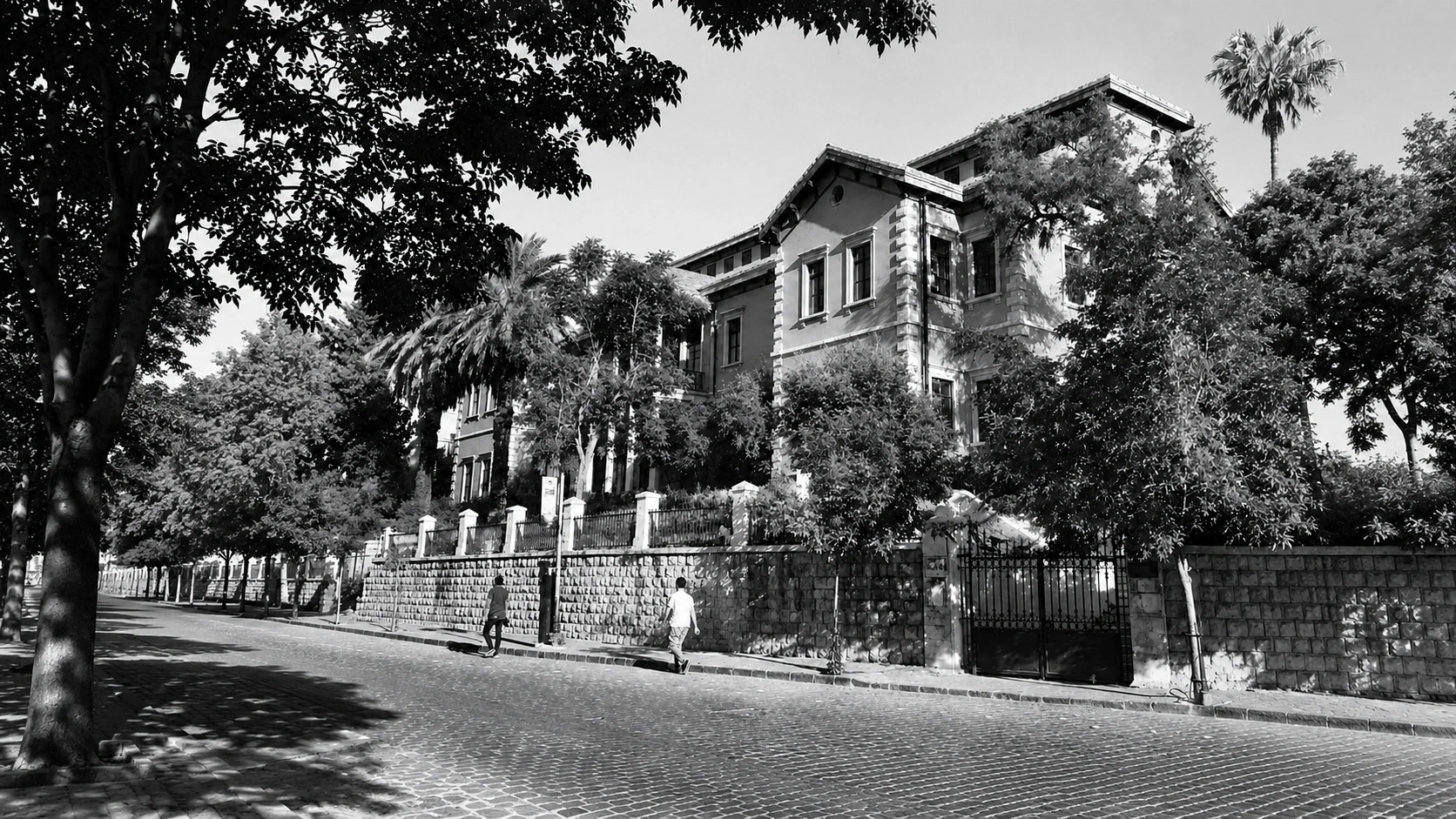
Researcher Imad Al-Armashi mentions that the palace of Hassan Pasha Al-Halabouni was built between 1908 and 1913. The palace later became Asaad Abdullah Secondary School / Al-Tajhiz Al-Thani after it was rented by the Syrian Ministry of Education.
Among his sons was Aref Al-Halabouni, one of the greatest textile merchants and president of the Damascus Chamber of Commerce between 1922 and 1936. During his presidency, he submitted a petition in the name of the merchants of Damascus to the French High Commissioner Henri Gouraud, objecting to the withdrawal of Syrian gold to Paris, the printing of paper currency in France, and then forcing Syrians to use it.
Together with the national leader Lutfi Al-Haffar, he also founded a joint-stock company for the project of bringing the water of Ain Al-Fijeh from Wadi Barada to Damascus during the presidency of Muhammad Ali Al-Abid.
Damascus’s Aristocrats and the Palaces of Al-Halabouni...
The uniqueness of Al-Halabouni neighborhood is reflected in its location near the center of the capital, the abundance of its facilities, and its largely unified architectural identity. These elements contributed to its special character and made it a preferred place for the aristocrats of Al-Qanawat in particular, and the people of Damascus in general, to build their homes there at the beginning of the twentieth century.
The neighborhood contained the building of the British Consulate after the First World War and until the late 1950s. Its headquarters were on Muslim Al-Baroudi Street, and it included a beautiful garden where English dance parties were held, along with events for displaying purebred horses. It also contained the first golf course in Damascus. The neighborhood also had a basketball court belonging to the Fityan Badr Club, where the Fityan Sports Club held its training sessions in the 1940s.
The palace style dominated the architectural identity of the neighborhood. Alongside Hassan Al-Halabouni’s palace, there were two palaces belonging to his sons Aref and Bashir Al-Halabouni, in addition to the palace of Hisham Jabri, the palace of Sheikh Taj Al-Din Al-Hasani, and others.
This palace design helped reduce the high temperatures during summer, while it also contributed to the coldness of the houses in winter. Researcher Imad Al-Armashi notes in Encyclopedia of Damascus Al-Sham that one of the branches of the Qanawat River passed beneath the houses of Al-Halabouni, which caused cold seepage and moisture in their walls during winter.
The Stage of Adaptation and the Struggle of Years...
Al-Halabouni neighborhood is no longer what it once was. The years have left their marks on it, and Damascus later came to know modern neighborhoods toward which its admirers moved. Yet this neighborhood, whose residents know one another by heart, succeeded where most neighborhoods of the capital failed. It preserved its social fabric and chose books as the profession of its community.
It turned the commercial invasion of residential neighborhoods into a feature, investing it to increase its distinctiveness, as though it wanted the scent of books to blend with the dew of its old walls and the fragrance of its leafy trees, giving Damascus a unique perfume that passersby call “the scent of Al-Halabouni.”
References
Lutfi Al-Haffar (1954). My Memories.
Hassan Al-Hakim (1965). My Memoirs.
Lutfi Al-Haffar (1954). My Memories.
Nuzhat Al-Anam fi Mahasin Al-Sham by Abu Al-Baqa Al-Badri.
Encyclopedia of Damascus Al-Sham by researcher Imad Al-Armashi.