Before borders were drawn and before nations existed in the form we know today. Back then, human communities moved constantly in search of water, food, and safety. During those long journeys, people discovered this land called Syria.
It was not entirely by coincidence.
This region possessed something extremely rare in the ancient world: water, fertility, and location. The presence of the Barada River and the Ghouta surrounding Damascus, the Mediterranean coastline, and Syria’s proximity to ancient trade routes made it an ideal place for early human settlement. That is why one of the world’s oldest civilizations emerged here, along with some of humanity’s earliest attempts at organized life, agriculture, writing, and exchange.
In Syria, the alphabet appeared in Ugarit, and the oldest known written musical composition in history was born here. Across this land passed dozens of civilizations that did not merely pass through, but left behind roads, markets, traditions, and entire cultures of trade and craftsmanship.
“For Syrians, trade was never just a profession. It was part of a story that began thousands of years ago.”
So when we ask today,
“Why are Syrians traders?”
we are not speaking about a recently developed social characteristic, but about a very long accumulation of geography, history, and the nature of the land itself.
Since the Kingdom of Mari, Syria served as a meeting point between East and West. Caravans from Anatolia, goods heading toward Egypt, and trade routes crossing toward Arabia and the Mediterranean all passed through here. Then came Ugarit, the coastal city that understood early on the meaning of the sea and how ports could become gateways to the world.
At that stage, the people of the region were not merely trade intermediaries. They produced, cultivated, and exported. Ugarit became famous for timber, metals, textiles, and dyes extracted from seashells. Agriculture also formed a major part of the region’s economy: olives, wheat, barley, and olive oil production were not simply local products, but goods traveling across the sea to distant lands.
Then the Phoenicians expanded this concept even further, extending Syrian coastal trade toward North Africa, Spain, and places unimaginably distant for that era.
Yet Syria’s geography gave its people more than the opportunity to sell. It gave them the opportunity to understand the world. When your country becomes a permanent crossing point for caravans, merchants, and travelers, you exchange not only goods, but ideas, dialects, customs, and different ways of life.
That is why trade became part of the region’s very identity.
With the rise of the Islamic era, the commercial importance of Greater Syria increased even more. The Qur’an itself refers to the “winter and summer journeys,” one of the clearest historical references to import and export activity in the Arab world. Quraysh caravans traveled annually to the Levant, bringing back goods and crops to the Arabian Peninsula.
Later, Damascus became the capital of the Umayyad Caliphate and one of the most important political, commercial, and cultural cities of the Islamic world. During both the Abbasid and Ottoman periods, Syria remained a central trade hub, especially with the Syrian Hajj route passing through it and generating massive economic activity, markets, inns, and caravanserais.
Walk through Old Damascus today, and you quickly realize the city was not built only for living, but for commerce as well. Dozens of specialized markets still survive: the spice market, the silk market, the copper market, the gold market, the wooden clogs market — almost every profession once had its own dedicated souq.
“Old Damascus operated like a global commercial center centuries before the modern world invented the term.”
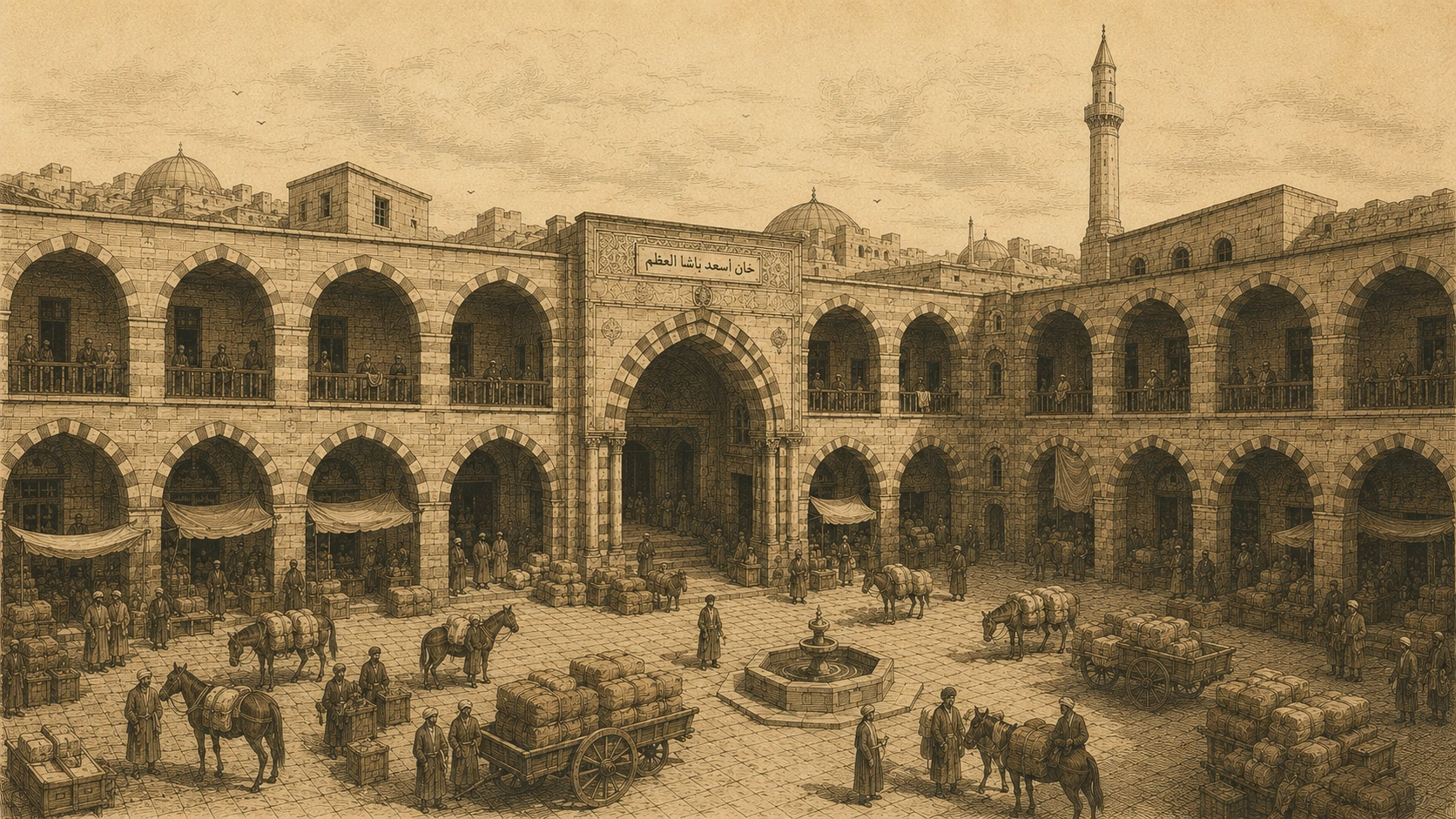
At the center of these markets stood the khans, functioning simultaneously as hotels, warehouses, and business centers. Khan As’ad Pasha Al-Azm and Khan Suleiman Pasha Al-Azm were not merely beautiful buildings, but essential parts of the city’s economic infrastructure.
Over time, trade ceased to be merely an economic activity for Syrians and became part of the social culture itself. A person’s value was often tied to “the craft in his hands,” and professions themselves transformed into family names.
Al-Haddad, Al-Sayegh, Al-Jazmati, Al-Sioufi…
Each of these names carries behind it an entire craft and a long history of labor and production.
Even Syrian proverbs reflected the mentality of markets and commerce.
“Buy and sell… but never let your name lose its value.”
Yet perhaps the most important part of the Syrian trading personality was shaped not only by ancient history, but by modern hardship as well.
For decades, many Syrians lived within unstable or informal economic systems, forcing people to seek multiple sources of income and become more willing to take risks and rely on individual initiative.
This is where the Syrian economic survival instinct was truly formed.
That is why Syrians often possess the ability to quickly launch a small business, learn a new profession, or enter trade even under the harshest circumstances.
They may open a restaurant, a sweets shop, a small workshop, a tech company,
or even a tiny street stand in a distant city.
But the same idea always remains present:
the ability to start from anywhere, understand people, sell, adapt, and survive.
Because for Syrians, trade was never merely a profession.
It was part of a very long story that began thousands of years ago.