"You were born here and you still don't have citizenship?"
It seems like a simple question. Yet it is one of those questions that require a lifetime to answer. Every time I am asked this question, I hesitate for a moment. How do I explain a story that has no clear logical explanation? How do I explain that my father, who spent more than sixty years of his life here, had several opportunities to give us a different future, yet never took them?
For many years, I blamed him. I often asked myself: Why did he let that opportunity slip away? Why were the laws not fairer to people who had spent their entire lives in the same place? But the question that always followed me was: Why, Father?
And when I finally asked him, I found no convincing answer. His answer sounded exactly like the answers of thousands of expatriates before him: "We thought it would only be a few years, and then we'd return."
A few years... A small phrase that swallowed entire lifetimes. A few years became decades. And decades became an entire life. A life spent struggling with identity. Yet many continued living as temporary guests, even while burying their parents and their dreams in the countries where they had built their lives.
One day, while trying to gather the scattered pieces of my identity spread across more than one place, I searched for an excuse that could soften the blame I had carried toward my father for so many years. And suddenly, I found it. In the image of a child who left home too young. In a young man separated from his mother, his siblings, and the alleys of his childhood. In a man afraid of cutting the last thread connecting him to the place where it all began.
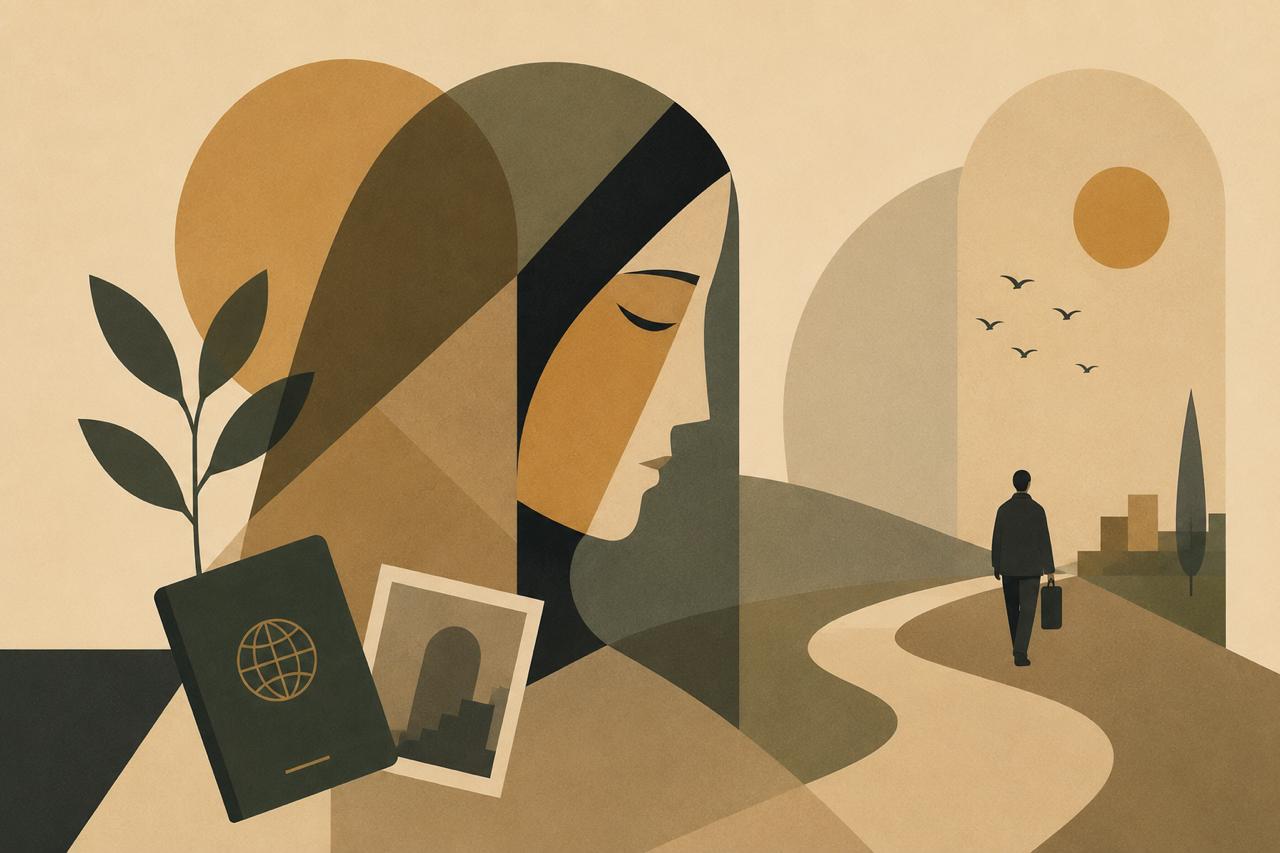
Perhaps documents were never just papers to him. Perhaps they were the last proof that he still belonged there. The last evidence that the road remained open. The final promise of return.
As the late Palestinian writer Mahmoud Darwish once said: "Longing is a pain that does not long for another pain." Perhaps that is why expatriates cling to things others cannot understand: An old passport. An expired document. A faded photograph. A house key for a home that no longer exists.
As the Syrian singer Assala Nasri once sang: "In my closet there is a box I've kept for years... inside it are photographs, buttons, and stories... I want to open it, and I don't want to... afraid it may awaken the tears and silence the laughter."
Because these things do not represent the past alone. They represent the possibility of return. Even if that return is impossible.
The French philosopher Gaston Bachelard once wrote that people do not merely inhabit places—places inhabit people as well.
And perhaps this is the heart of the dilemma. The expatriate never truly leaves home. He carries it with him. In his accent. In his food. In his songs. In the names of his children. The homeland becomes part of his psychological makeup more than a geographical location.
We, the children of those postponed dreams, grew up. We grew up to discover that our parents lived between two worlds. A world in which they built their lives. And another world they carried in their hearts. They planted their roots here. But their eyes remained fixed on somewhere else.
I often think of Fairuz's song: "Returning, O love, returning."
And sometimes I feel that an entire generation lived inside that song. They did not sing it as a song. They lived it as a life plan. A personal promise. A postponed project.
And because some journeys never end with return, but instead become an idea, a dream, and a permanent emotional state... I am no longer angry with my father. I think I finally understand him.
He did not miss the opportunity because it did not matter. Perhaps he was simply afraid of losing the last thing that connected him to the dream. The final silk thread stretching between him and the place he left as a child.
Perhaps that passport was, for him, a small box of longing. Whenever homesickness overwhelmed him, he opened it. Whenever he felt lost in exile, he reminded himself that he could still return. Even if he never did.