
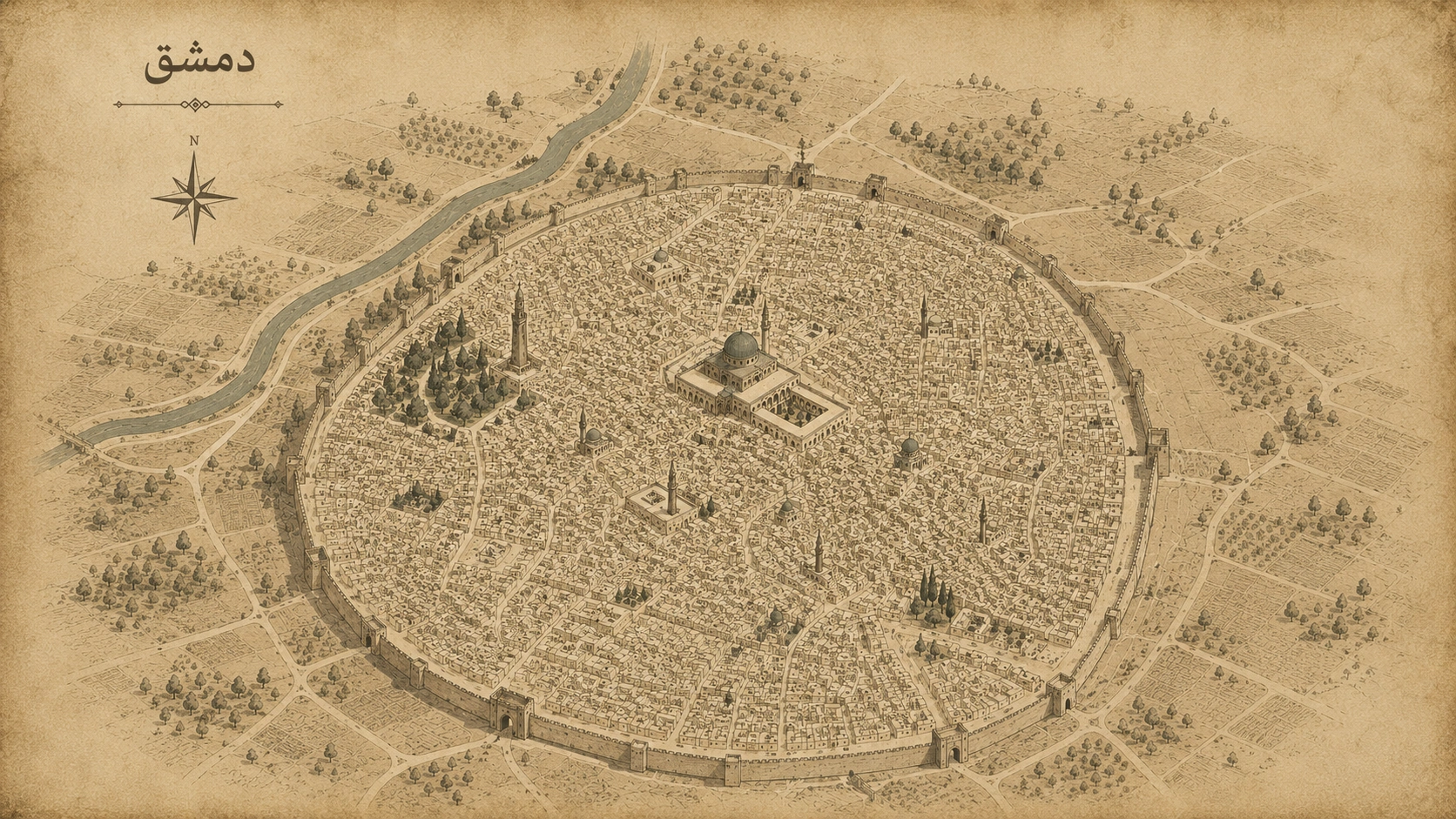
For thousands of years, this city has never stopped producing them; stories of travelers, merchants, scholars, exiles, lovers, and strangers who entered through its seven gates and left carrying something of it forever.
That is why, when Ibn Asakir wrote his famous book The History of Damascus, he was not simply documenting a city. He was trying to rescue it from oblivion. Perhaps more than many of his contemporaries, he understood that cities do not truly die when their walls collapse, but when their memory disappears.
If Ibn Asakir returned today, nearly nine centuries later, and walked beneath the arches of Souq Al-Hamidiyah, he might no longer recognize the faces, the voices, or even the scent of time itself. He would find a city exhausted by wars, worn down by loss, and burdened with enough grief to silence entire civilizations. Yet he would likely notice something else too: Damascus still resists in the same old way it always has.
He would sit in a small café near the Umayyad Mosque, observing people with the silence of a historian. He would see a young man carrying a smartphone instead of paper manuscripts, yet chasing the very same dream pursued by ancient merchants who once passed through these streets. He would overhear conversations about business, travel, economics, and lost opportunities, and perhaps realize that the city still produces ideas even while it struggles to survive.
And perhaps he would be surprised to discover that the caravans never truly disappeared. Damascus, once a station on the Silk Road, remains a passage for precious things. Only the goods have changed. The caravans no longer carry silk and spices, but ideas, images, music, content, and stories carried by Syrians toward the world.
If Ibn Asakir wished to write The History of Damascus today, manuscripts alone would no longer be enough. He would need an archive of voices, cameras preserving people’s expressions, and perhaps even a long podcast where the city’s inhabitants speak about their quiet losses, postponed dreams, and that mysterious ability Damascus possesses to return to life no matter how many times it fades.
Because history, in truth, is not merely the history of sultans. Real history lives within the coffee seller who opens his shop every morning despite his losses, within the woman planting jasmine on her balcony as though war never passed through here, and within the young man trying to build a small project in a city exhausted from waiting.
Perhaps this is exactly why The History of Damascus still feels extraordinary today. Ibn Asakir did not write about a perfect city. He wrote about a living one — a city filled with human beings, their flaws, dreams, disagreements, and daily conversations. That is why his work survived through centuries, not merely as a historical reference, but as a complete memory of a city that knew how to listen to its people.
Ibn Asakir spent years collecting stories, names, and accounts until his work expanded into dozens of volumes, resembling another city built entirely from paper. He likely never imagined that what he created would become one of the greatest civilizational archives ever written about a city in Islamic history.
And today, when we look at modern Damascus, the question feels more urgent than ever: who writes the memory of cities now? And who preserves the voices of ordinary people before they are swallowed by the overwhelming speed of this world?
The tools may have changed, but humanity’s need for storytelling never has. From the first caravan that crossed Damascus to the latest post written about it online, people have always tried to do the same thing: leave behind a small trace proving they were here.
And perhaps that is precisely why, if Ibn Asakir returned today, he would not begin his book with the gates of Damascus or its markets, but with its people. Because he would discover, just as he did nine hundred years ago, that great cities are nothing more than reflections of the people who inhabit them.