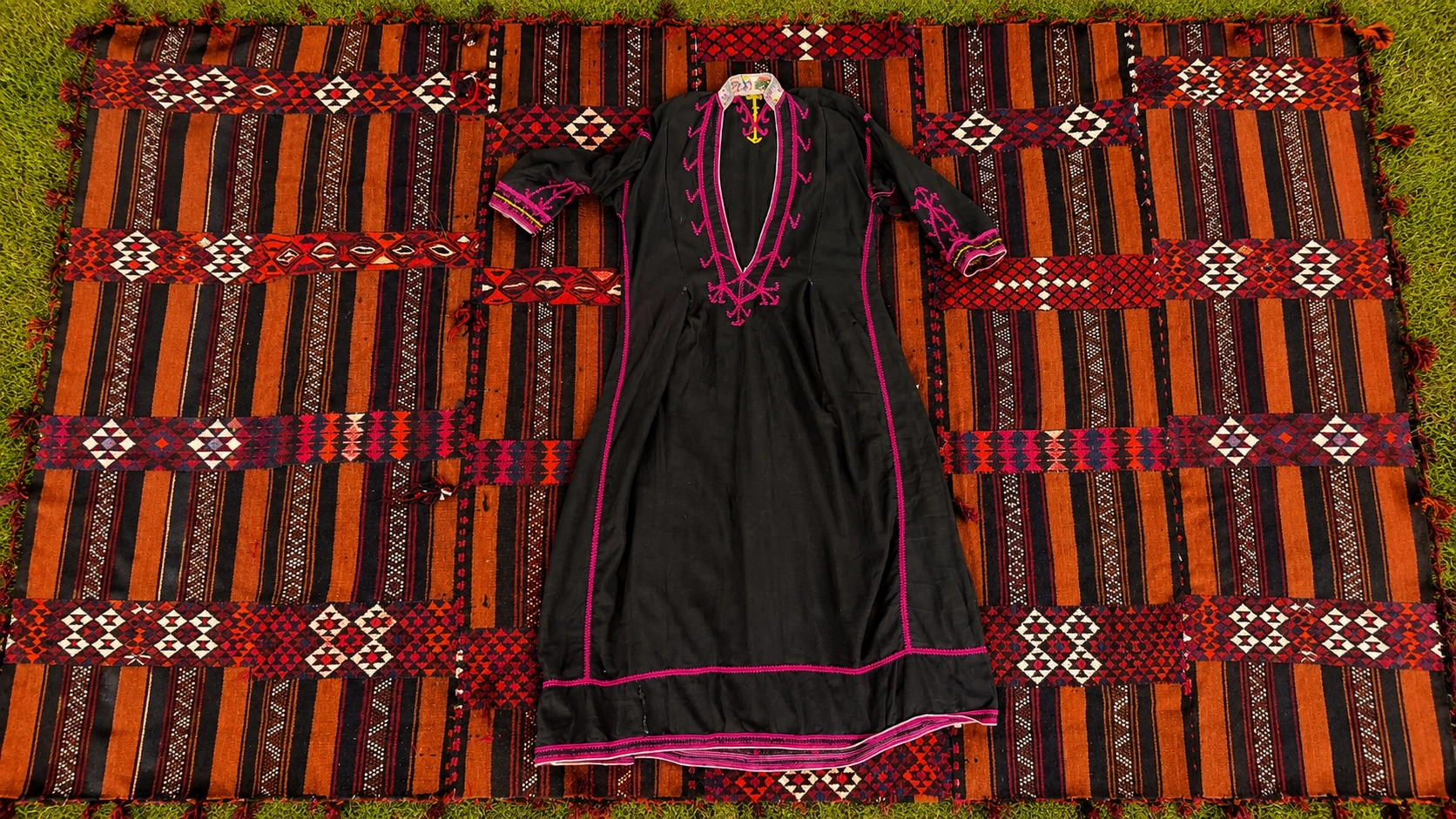
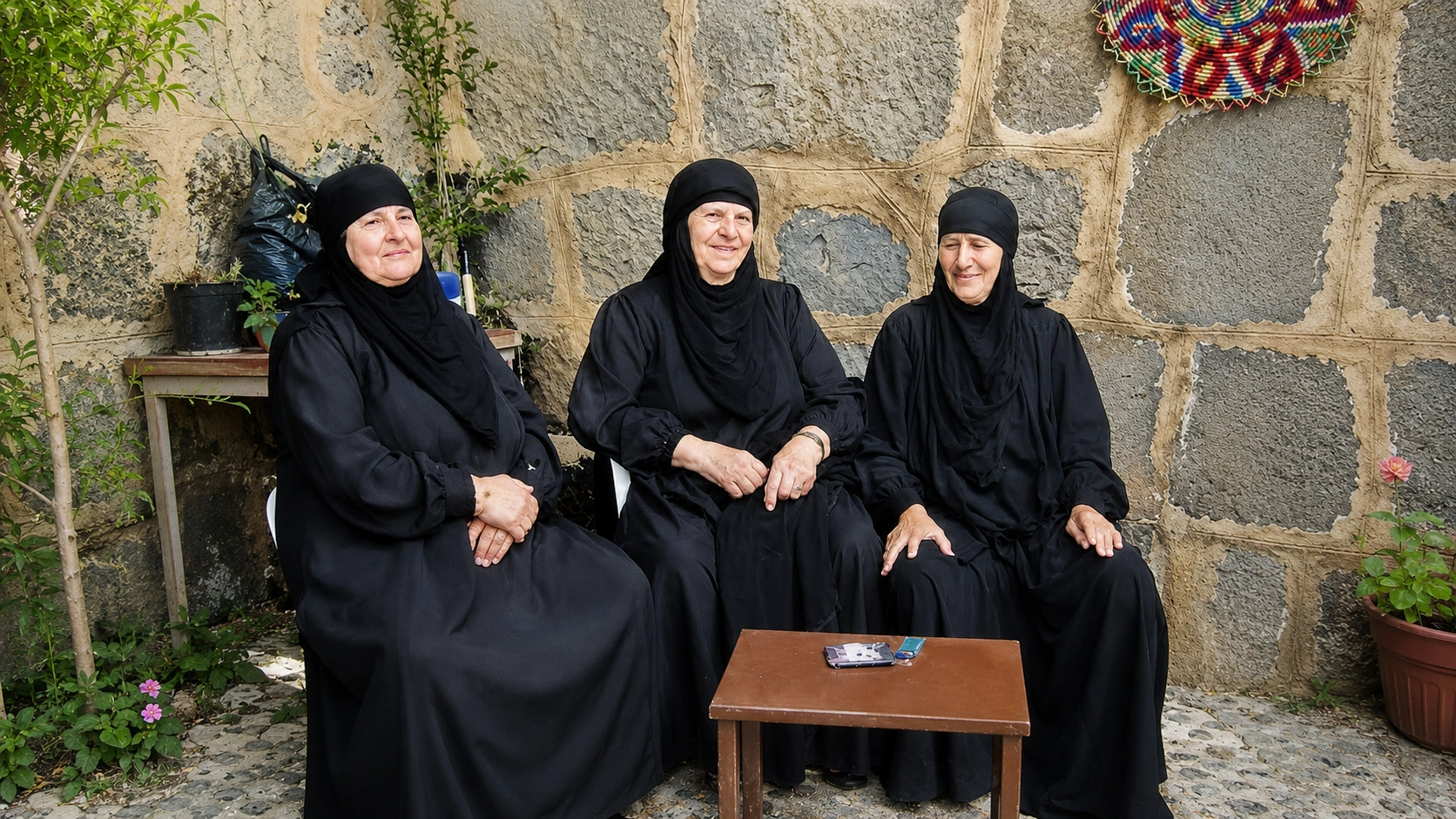
This photograph could have hung for years on the wall of an old house in Hauran without anyone noticing what it quietly carried inside.
Three grandmothers from Azraa in 1999 — two Christian women and one Muslim woman — sitting together in similar black garments, carrying the features of a shared memory.
The image is filled with stillness.
And with a dense sense of time moving slowly through the gatherings of women.
“Here, clothing feels like a living memory moving among the people.”
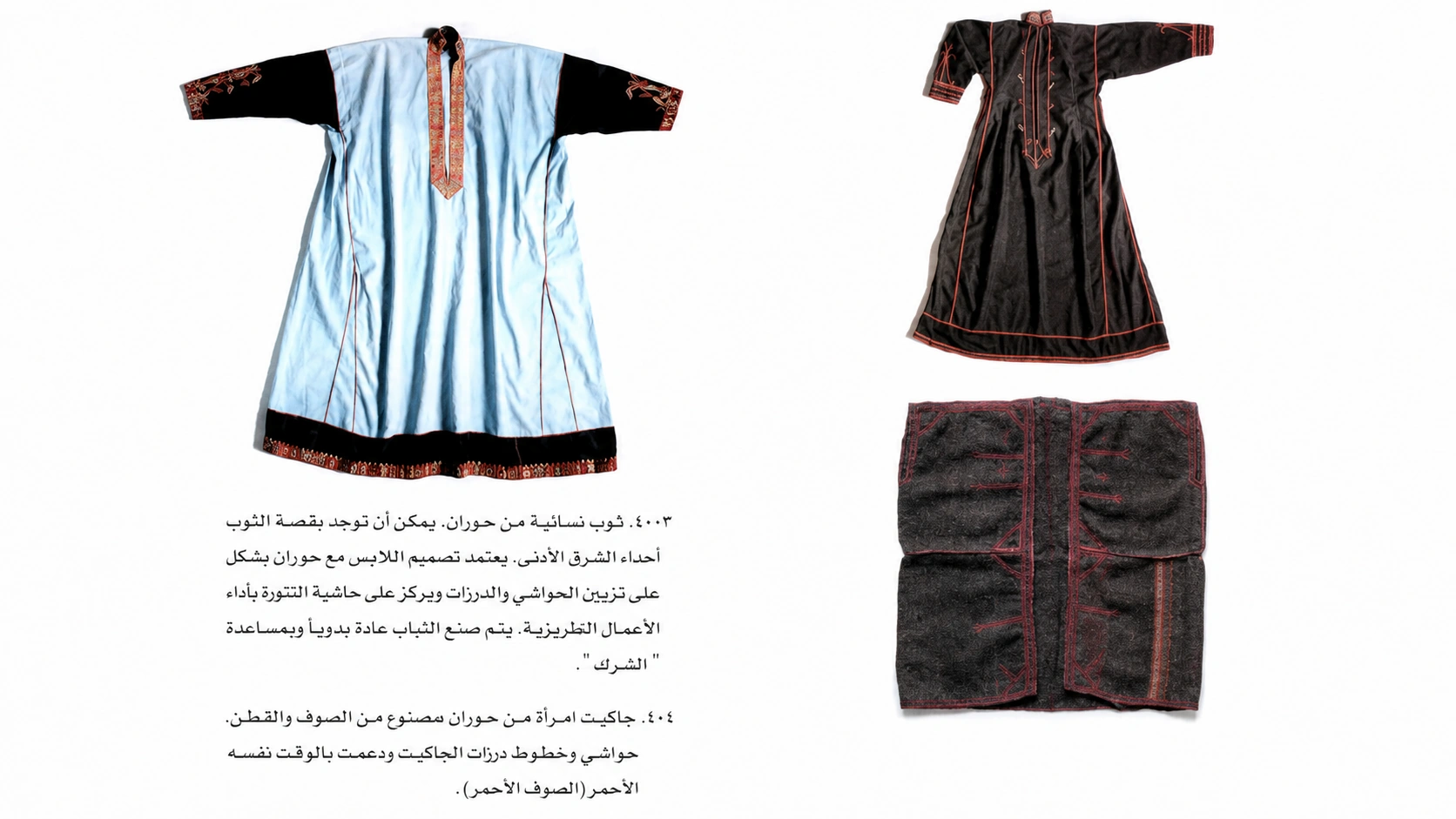
The more one contemplates the Haurani dress, the more its deep historical weight becomes visible.
It carries within it traces of civilizations and religions that eventually settled into this long flowing garment with its calm rural dignity.
The silver jewelry glimmers with stories passed down through generations, while the head covering surrounds the woman with a sense of dignity that resembles history itself.
In Hauran, women carried history upon their shoulders… often without realizing it.
Hauran… A Land Crossed by Civilizations
Historically, Hauran formed one of the most important regions of southern Bilad Al-Sham.
It experienced successive religious and civilizational transformations throughout history, while preserving traces of those changes within everyday life itself.
This accumulation naturally shaped the dress, the way it was worn, and the identity of the Haurani woman herself.
In ancient agricultural societies tied to fertility, nature, and protection, clothing carried deep spiritual and social meanings.
The long flowing garments harmonized with the land, agricultural life, and religious rituals surrounding the community.
Even the smallest decorations were never merely decorative.
Plant motifs, geometric patterns, and stars all carried symbols associated with blessing, protection, and the earth itself.
“The Haurani dress tells a story of the land one woven from memory, belief, and life.”
From Byzantium to Islam… Memory Woven into Fabric
Eastern Christianity later passed through this region, leaving a profound visual influence behind.
Byzantine mosaics and paintings across the Levant often portrayed women in wide garments and head coverings symbolizing modesty, dignity, and social status.
These same visual elements survived for centuries inside traditional Haurani clothing.
Then Islam arrived in Bilad Al-Sham, absorbing and reshaping this visual heritage within a new cultural framework.
The long dress, head covering, and local embroidery remained central elements of the Haurani woman’s image, associated with dignity and social respect.
Over time, these details settled quietly into daily life until they became inseparable from the identity of the region itself.
Silver Jewelry… Another Layer of Memory
Even the silver jewelry hanging across the chest and head carries traces of ancient Eastern customs that survived for centuries throughout Levantine societies.
Coins, heavy ornaments, and shining metallic pieces were historically associated with protection, blessing, and social status.
Eventually, they became deeply rooted in the popular traditions of southern Syria.
In the Levant, clothing was never separated from religion, architecture, music, or daily life itself.
That is why the Haurani dress feels today like a silent visual archive carrying traces of every civilization and religion that once crossed the region.
“Within the threads of the Haurani dress lives a Byzantine trace, a Levantine soul, and an Islamic continuity woven into a single identity.”
An Identity That Endured Through Change
Perhaps the uniqueness of the Haurani dress lies in its ability to preserve this long historical accumulation without losing its local identity.
Within its threads blend traces of ancient agricultural societies, Levantine spirit, and religious history, forming the quiet garment passed from one generation of women to the next with a confidence resembling the continuity of life itself.
And perhaps this is why, when we look at photographs of Haurani grandmothers, we feel as though we are not looking only at people…
But at an entire history that sat briefly before the camera, then disappeared quietly into black fabric, silver jewelry, and the wrinkles of faces that remember every story.