
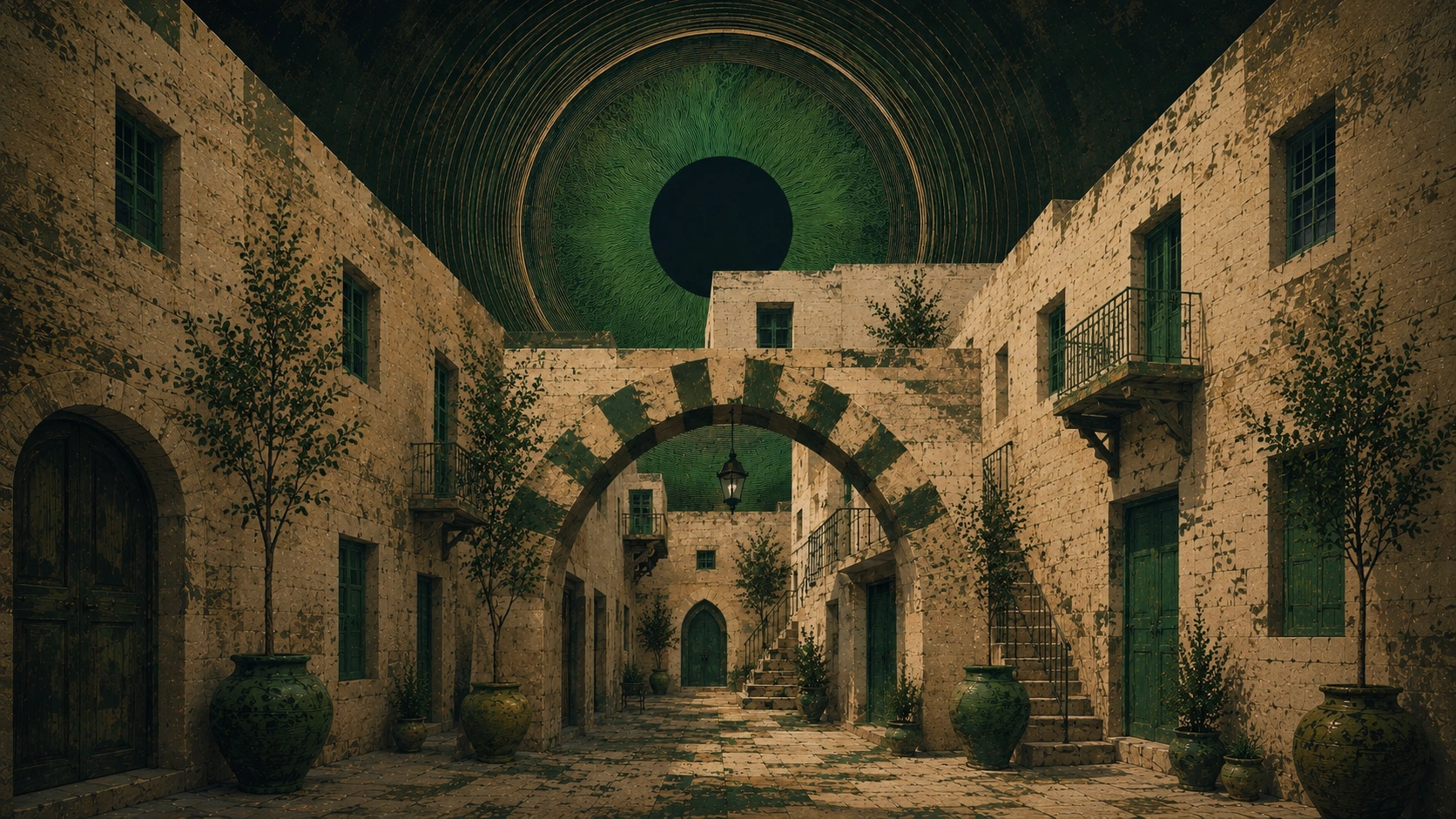
In our strange Syrian condition, I sometimes feel that one of the greatest things we lost over the long years… was our ability to truly see what we already possessed.
We grew up surrounded by extraordinary places without ever realizing they were extraordinary.
I often return in memory to our old Damascene house.
I remember the adults constantly speaking about restrictions on restoration and reconstruction, and about the “heritage preservation sign” attached to the building.
As a child, I heard those words with complete indifference.
All I cared about was:
Why can’t we fix the wall?
And why does the house sometimes feel exhausted despite its beauty?
Only later did I understand.
That house we lived in so naturally… resembled the kinds of places people travel across the world to see.
The arches.
The stone floors.
The old wood.
The light entering through the courtyard.
The smell of jasmine mixed with humidity and ancient stone.
All of it passed before our eyes as nothing more than ordinary daily life.
“We were living inside memory itself… without realizing it.”
And perhaps this is not only the story of our house.
Perhaps it is the story of Syrians with their entire country.
In Damascus, for example, you can walk for five minutes and move across entire centuries of history.
A Roman gate.
Above it, an Ottoman trace.
Beside it, a Mamluk alleyway.
And at the end of the road, a mosque, a church, or a house hundreds of years old.
Meanwhile, people walk past all of it preoccupied with survival, daily burdens, and the heaviness of ordinary life.
As though we became so used to the miracle… that it lost its power to astonish us.
When Beauty Becomes Familiar
Sometimes I wonder how foreigners see this country.
How they stop for long moments before a small stone, a wooden window, or an old arch… while the people of the place itself pass by without noticing.
Perhaps because when human beings live too long inside beauty… they eventually stop seeing it.
For decades, Syrians lived exhausted more than contemplative.
Life was too heavy to leave much room for wonder.
People thought about survival, continuity, and making it through the next day far more than they thought about the immense value this country already carried within it.
And so we began treating extraordinary things as ordinary details.
How many times did we sit inside an old Damascene house without realizing it held the memory of an entire city?
How many times did we walk through a centuries-old market as though it were merely a crowded street?
How many times did we smell Damascene jasmine without pausing long enough to realize that entire cities around the world try to build identities resembling these tiny details?
“The flute of one’s own neighborhood never charms.”
Perhaps no phrase describes our relationship with our surroundings more accurately.
Cities That Understand the Value of Their Memory
The places that felt ordinary to us… were complete dreams for others.
When you travel, you see cities building their entire identity around a single old street, a historical window, or a tiny fragment of their past.
Meanwhile, we lived surrounded by astonishing layers of civilization… without truly looking at them.
Long exhaustion numbs people toward the things closest to them.
And that is, to a large extent, what happened to us.
But perhaps the time today feels slightly different.
Perhaps it is finally time to look at this country with new eyes.
To see Damascus as more than simply a city we live in.
To see Aleppo as more than a wounded city.
To understand that these arches, doors, markets, and ancient stones were never merely remains of the past…
But a living spirit still breathing among us.
“Perhaps Syria never needed anything from us except one simple thing… to truly see it.”
Listening Again to the Voice of Place
Sometimes I feel Syria needed from us only something incredibly simple all along:
To look at it the way a stranger looks at a city for the first time.
To walk through its neighborhoods with genuine wonder.
To listen carefully to the voice of place before it disappears from memory.
Some blessings remain with us so long… that we stop feeling them entirely.
And perhaps after everything that happened…
It is finally time to listen once again to the flute of our own neighborhood… and let ourselves be moved by it.
“Some cities do not need to be rebuilt… they only need to be seen again.”