
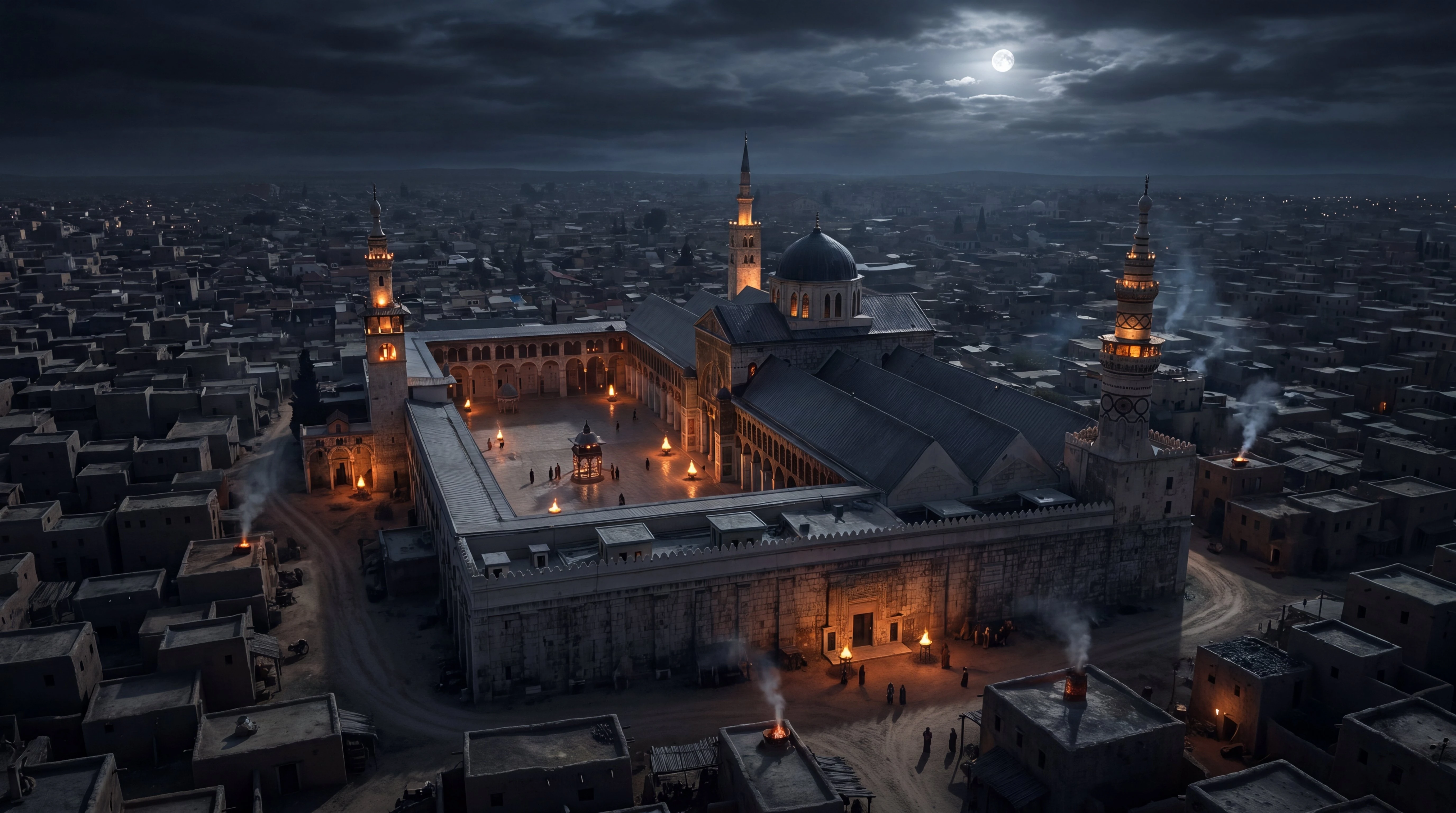
How a sacred site in the heart of Damascus evolved from an Aramean temple into one of the greatest Islamic landmarks — becoming a living memory of the city itself across thousands of years.
At the heart of Damascus stands the Great Umayyad Mosque, one of the most important historical and religious landmarks in the Islamic world.
Yet the mosque transcends the idea of a traditional religious structure. It represents a condensed summary of Damascus itself and the many civilizational transformations the city experienced across thousands of years.
“The Umayyad Mosque is not merely a mosque… but layers of Damascus history gathered within a single structure.”
The site on which the mosque stands today did not originate during the Umayyad era alone.
Its roots stretch much further back.
Historical studies suggest that the location originally housed an Aramean temple dedicated to Hadad, the storm and rain god worshipped when Damascus served as the center of the Aramean Kingdom of Damascus.
With the arrival of the Greeks, the local deity merged with Hellenistic religious symbolism, transforming the temple into “Zeus-Hadad” — an attempt to blend Eastern heritage with new Greek influence.
Later, the Romans completely reshaped the site, constructing a massive temple dedicated to Jupiter and turning the area into the religious and political heart of the city.
With the spread of Christianity, the temple eventually became the Church of Saint John the Baptist — known in Islamic tradition as Prophet Yahya.
The Great Transformation
Following the Islamic conquest of Damascus in 14 AH, the Christian character of the site was not immediately erased.
Instead, Muslims and Christians shared the building for more than seventy years, using different sections of the same complex for worship in one of the most remarkable examples of coexistence in the city’s history.
When Damascus became the capital of the Umayyad Caliphate, Caliph Al-Walid ibn Abd al-Malik launched an ambitious project to build a grand mosque reflecting the power and influence of the new Islamic state.
But the goal was not merely to build a mosque.
It was to create an architectural statement positioning Damascus as the center of the Islamic world.
“The project was not only about building a mosque… but about shaping a new image of Damascus itself.”
The project faced complex political and religious negotiations, especially regarding the Church of Saint John and previous agreements with the city’s inhabitants.
Historical sources recount that Christian clergy warned Al-Walid that anyone who demolished the church would lose his mind.
Yet the caliph reportedly stepped forward himself and began the demolition with his own hands — a moment that remained deeply embedded in Damascus memory.
The Architectural Icon
The new structure combined Roman and Byzantine architectural heritage with the emerging Islamic spirit, making the Umayyad Mosque one of the greatest architectural masterpieces in Islamic history.
The mosque became famous for its vast courtyard, monumental arcades, iconic dome, and minarets that later influenced Islamic architecture across the world.
But perhaps its most remarkable element remained the famous mosaics covering large sections of its walls.
Crafted with gold and colored glass, they depicted gardens, rivers, palaces, and landscapes in what became one of the most celebrated visual achievements of the Umayyad era.
Despite centuries of fires and destruction, parts of these mosaics still survive today after some sections were rediscovered beneath layers of plaster during restoration works.
“Within the mosaics of the Umayyad Mosque… Damascus attempted to paint paradise on earth.”
The Mosque That Survived Fire
Artisans and workers from Damascus, Egypt, Mesopotamia, and the Euphrates region participated in constructing the mosque.
Historical documents also reveal the existence of sophisticated administrative and engineering systems managing wages, transportation of materials, and construction operations.
Yet the mosque repeatedly suffered destruction.
It endured major fires and acts of devastation, especially during Timur’s invasion of Damascus and the catastrophic fire of 1893 that destroyed large sections of the roof and dome.
Still, the mosque continuously returned to life through repeated restorations.
And perhaps this is why it became a symbol of Damascus itself — a city constantly rebuilding despite catastrophe.
A Visual and Sonic Memory of Damascus
The presence of the Umayyad Mosque extends beyond architecture and history into the sonic memory of the city itself.
Most famously through the Damascene “group adhan,” where multiple muezzins harmonize together in a collective call to prayer that became part of the auditory identity of old Damascus.
In this context, the documentary film:
“The Umayyad Mosque Through the Ages | Spirit of Damascus”
emerges as a contemporary visual attempt to reinterpret the mosque’s long historical transformations using historical narration, archival research, visual reconstruction, and cinematic storytelling.
The film draws heavily from the research of Syrian historian Tayseer Khalaf, one of the leading scholars documenting the history of Damascus and the Umayyad Mosque.
It also relies extensively on artificial intelligence technologies to recreate the mosque’s different historical eras, with more than 80% of its visual scenes produced using AI-based reconstruction tools.
The goal is to revive vanished eras visually and offer audiences a closer understanding of how the site evolved across centuries.
“The Umayyad Mosque did not merely witness the history of Damascus… it became part of the way the city remembers itself.”