
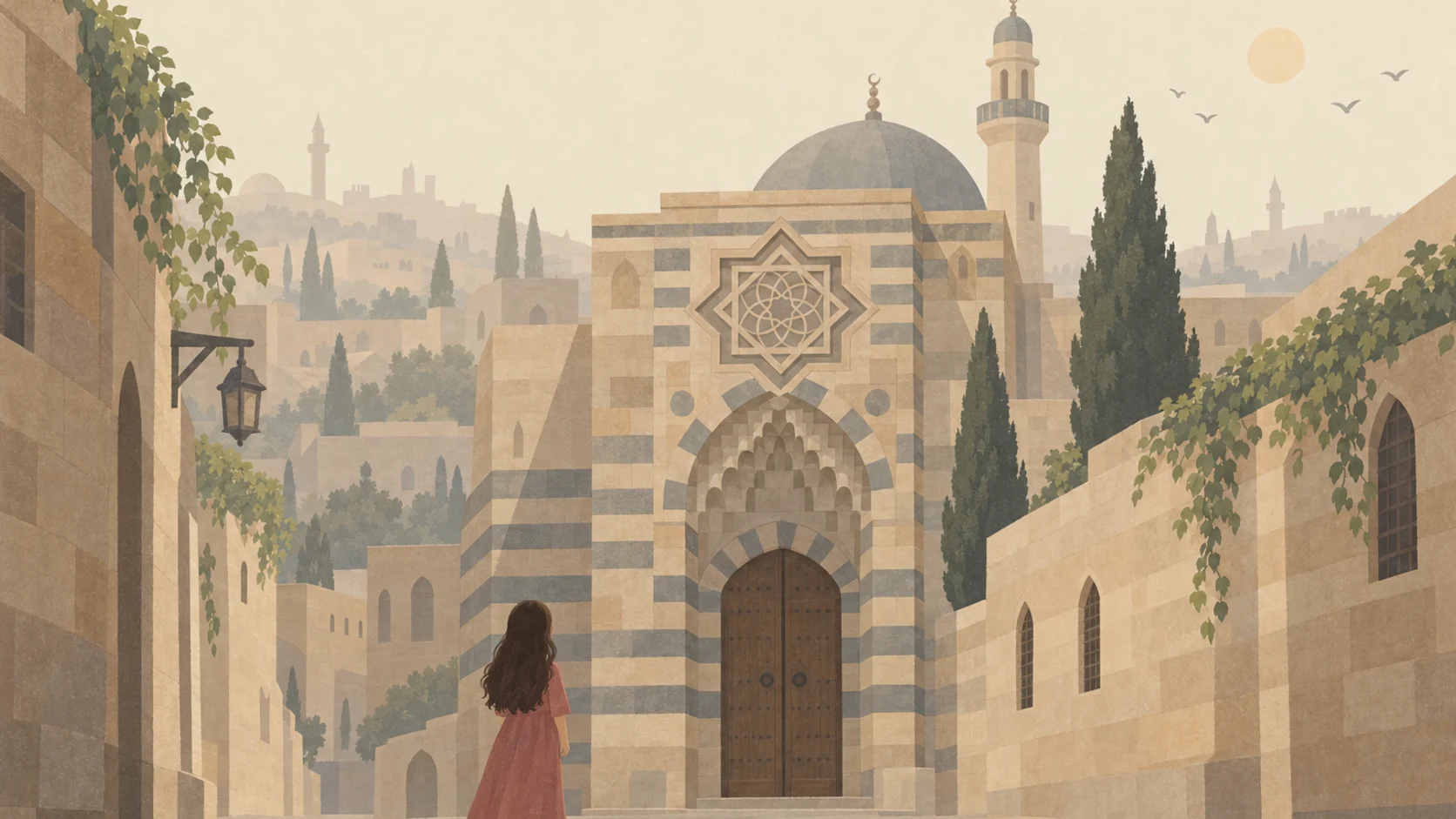
When you wander the alleys of Old Damascus, or raise your eyes to the majestic domes of Aleppo and the ancient minarets of Cairo, all the way to the arcades of the mosques of Istanbul and Samarkand, you will inevitably be captivated by that enchanting geometric composition: an intricate eight-pointed star whose lines interlace with mathematical fluidity to create a visual sense of infinity.
Tour guides, and even a wide range of academic curricula and popular books, will hasten to present this shape to you as the "Seljuk star", or treat it as a pure expression of "Turkish and Persian ornament". But did the Levant really import this art, or are we standing before one of the greatest acts of historical erasure, bearing an Orientalist signature?
When we place this geometric form under the microscope of archaeological inquiry and dust off its ready-made labels, we discover that the architectural "octagon" and the eight-pointed star did not arrive on the backs of Seljuk horses. They are the heirs of a long and deep evolutionary chain that began in the basin of the ancient Near East and matured in Syria over thousands of years, gradually becoming a visual and spiritual identity for Islamic architecture as a whole. Tracing the path of this symbol reveals an architectural epic in which myth intertwined with geometry, and politics with theology.
1. From "Ishtar" to the "Temple of Bel".. Geometry Born of Myth
The eight-pointed star cannot be understood without returning to its roots, sunk deep in the clay of the civilisations of Mesopotamia and the Levant. Some believe that Islamic geometric ornament started from zero, or was borrowed wholesale from abroad.
Yet archaeological records and the study of signs confirm that the eight-pointed star was, in the beginning, a purely "symbolic technique". In the civilisations of the Euphrates Jazira, between the Levant and Mesopotamia, this star represented the goddess "Ishtar", or "Inanna", goddess of love, war and fertility. At the same time it symbolised the planet Venus and absolute dominion over the eight directions of the cosmos, and it was also used as a sovereign seal that lent cosmic legitimacy to the earthly power of kings.
Over time, this sacred symbol moved from seals and jewellery to permeate the visual consciousness of the Levant, and of the Canaanites in particular. If you want to see the early Syrian geometric genius that carried this symbol from its flat, two-dimensional form into three-dimensional space, you need only examine the ruins of Palmyra.
There, in the famous "Temple of Bel", Palmyrene builders devised a stone ceiling ahead of its time, in which squares intersect skilfully to produce octagons of astonishing precision. The octagon was not mere decoration or visual luxury; it was a structural, mechanical solution devised by Syrian engineers as a safe transition for raising a circular dome over a square temple base.
As for the "eight-petalled rosette" at the centre of Palmyrene funerary sculpture, it is the direct archaeological ancestor of what Islamic art would later know as the "Rub el Hizb" motif.
2. With the Rise of Christianity in Syria
The octagon did not disappear; it took on new theological dimensions that reflect the flexibility of this symbol. In the "Forgotten Cities", and specifically at the Church of Saint Simeon Stylites (one of the most important early Christian monuments), the courtyard around the column was designed as a vast octagon. This choice was no accident: in early Christian thought, the number 8 represented the "eighth day", the day of resurrection, eternity and spiritual renewal. This vast accumulated heritage was spreading across the Levant, awaiting a new civilisational spark to launch it onto the world stage.
3. The Octagon Embraces the Sky in Jerusalem and Damascus
In the late seventh century CE, the Umayyad Caliph Abd al-Malik ibn Marwan faced an unprecedented visual and political challenge: how to build an Islamic monument that would surpass the great Byzantine churches of Jerusalem in majesty and splendour, while embodying the monotheistic identity of the rising new faith? The answer did not come from importing engineers from the far reaches of the East, but from drawing on accumulated local Syrian expertise, steeped in inherited building traditions.
The result was the Dome of the Rock, considered the oldest and greatest surviving Islamic architectural monument to this day. The eminent historian of Islamic art Oleg Grabar argues that the Umayyads' adoption of an "octagonal plan" for the Dome of the Rock was no coincidence. It was a functional and symbolic continuation of the tradition of Byzantine martyrs' shrines in the Levant, emptied of its Christian content and refilled with Islamic monotheistic meaning. The Umayyad architects, of various faiths, turned the octagon from a mere ground plan into a complete architectural philosophy.
This inclination towards the octagon recurred in many forms in Umayyad and Abbasid buildings. In the courtyard of the Umayyad Mosque in Damascus stands the "Treasury" (Khaznat Bayt al-Mal), raised on columns with Roman capitals and taking an unmistakably octagonal form. The pioneering historians Ernst Herzfeld and K. A. C. Creswell documented these monuments as the peak of maturity in early Islam's adaptation of the Syrian and Byzantine architectural heritage. In this way, Umayyad architecture in the Levant established the octagon as a gold standard and a structural foundation from which Islamic architecture would draw for centuries to come.
4. Syria Spreads the Octagon Across the World
Here we reach the moment at which many people become confused. Under the Seljuks and the Zengids, and thanks to the flourishing of algebra in Aleppo and Damascus, the octagon was transformed from a simple shape into a mathematical miracle. At the Nur al-Din Bimaristan in Damascus, for example, we see muqarnas domes built on an octagonal base that defy time, and at the Madrasa al-Shadhbakhtiyya in Aleppo we find an astonishing interlacing of stone that evokes infinity.
Some argue that the presence of this shape as a repeated ornamental pattern in the madrasas and hospitals visited every year by thousands of strangers, such as merchants, Orientalists and students, during the period when Europe was rising from its Dark Ages towards the Renaissance, as well as by local visitors, is what gave artistic and scholarly weight to fixing the Seljuk and Mamluk label on this authentically Syrian form.
5. Did the Seljuks and the Turks Seize the Syrian Identity?
If the star and the octagon are Syrian in origin and temperament, with roots reaching back through the region's successive civilisations, why do we today call these patterns the "Seljuk star"? Are we facing collusion by art historians, or is there a missing link in the chain of development?
The story here involves a scholarly debate far deeper than narrow national classifications. With the arrival of the Seljuks and the Zengids, followed by the Ayyubids, in the eleventh and twelfth centuries CE, the Levant and Iraq witnessed what has historically been known in the West as the "Sunni Revival". In this era, thanks to institutional patronage of mathematics and algebra, the Seljuks and the Persians did not steal the Syrian star; rather, they took the simple octagonal form and subjected it to a rigorous and highly complex process of "mathematisation".
In his pioneering study "The Transformation of Islamic Art During the Sunni Revival", the Syrian scholar Yasser Tabbaa puts forward a pivotal thesis that unravels this puzzle. He argues that this era saw the invention of arabesque systems and geometric networks (known as Girih) and stone muqarnas, as a direct response to theological shifts.
The eight-pointed star was no longer a single frame or an architectural plan; it became the nucleus of an infinite network of precise mathematical interlacing that spread across the façades of madrasas, bimaristans and mausoleums.
Tabbaa links this sweeping inclination towards geometric abstraction and infinite repetition to the rise of an Islamic philosophy that rejects the idea of the material permanence of things. This view of the cosmos was reflected visually in geometric patterns that are born from a central point (the star) and extend without end, refusing to frame or fix creation in a static form. This shift is what explains the enormous leap from the structural Umayyad octagon to Seljuk and Ayyubid lattice ornament.
Cities such as Aleppo and Damascus eventually became a stage for displaying this geometric and mathematical genius, where we find an astonishing interlacing of stone, and muqarnas domes built on octagonal foundations that defy time.
The art historian Terry Allen affirms, in his studies of Ayyubid architecture, that this period in Syria and northern Mesopotamia witnessed what might be called a "classical revival", in which inherited classical ornament was merged with new and highly complex geometric systems, expressing the continuity of local art within a universal Islamic identity.
This helped carry the star and the octagon from the majestic façades of mosques and shrines into the heart of everyday social life: the "Damascene house". Here the octagon was not used merely as a luxurious decorative touch; it was tied to precise environmental and engineering functions.
In the Damascene courtyard, shaded by citrus and Damascene mulberry trees, the central water fountain, the "bahra", is often designed as an octagon. And the use of the "Rub el Hizb" (two interlaced stars) as the centre for arranging the decorative panels of "Ajami woodwork" on the walls of reception halls created a central visual movement that expands to cover surfaces without leaving gaps (tessellation), reflecting the idea of unity and continuity latent in the subconscious of the Damascene craftsman, who rejects random empty space.
6. What Happened Was Not an Orientalist "Theft"
Rather, it was a qualitative leap. The Seljuks, Ayyubids and Mamluks, who ruled vast territories, used this composite ornament (the ancient Syrian heritage combined with Abbasid and Seljuk mathematical complexity) as a sovereign mark (Sovereign Brand) and a visual identity unified from Anatolia to Egypt.
Because of the sheer abundance of building in their era, and the many madrasas and caravanserais that drew thousands of pilgrims, travellers and Orientalists, the name of this complex ornament became attached to them, and its early Levantine origins faded into the crowd of written history.
7. Towards Restoring a Balanced Historical Narrative
In the end, reducing the "eight-pointed star" to passing labels such as "Seljuk" or "Mamluk" art, or, conversely, confining it as a closed "Syrian genetic fingerprint", is a crime against a complex civilisational heritage thousands of years old.
This symbol did not descend from the sky of Central Asia. It sprouted in the clay of Mesopotamia, was polished by the temple builders of Palmyra, blessed by the monks of Byzantium, and raised towards the sky by the Umayyad architects in Damascus and Jerusalem, before engineers of the Seljuk and Ayyubid eras made it intricate with the laws of mathematics and the depth of Islamic philosophy.
Great arts do not carry narrow nationalities; they are always the fruit of long cross-pollination and cultural exchange. Yet historical and academic fairness requires that the dictionaries of art be rewritten to give the Syrian heritage its due as the first cradle, the womb in which the formative features of that star took shape: the star that lit, and still lights, the night of Islamic and human architecture across the whole world.
Sources on Islamic Architecture and the History of the Eight-Pointed Star:
- The article "The Eight-Pointed Star: A Symbolic Technique Across Civilisations" on the Al-Bukhari website. Link: https://albukhari.com/86616/
- The academic study "The Evolution of the Eight-Pointed Star: From Ancient Symbolism to the Modern Era" on the Zenodo platform. Link: https://zenodo.org/records/19307740
- Yasser Tabbaa's book "The Transformation of Islamic Art During the Sunni Revival". Link: https://humanitieshub.sdsu.edu/omeka/items/show/1156 or: https://www.researchgate.net/publication/346162414_The_Transformation_of_Islamic_Art_during_the_Sunni_Revival
- Terry Allen's studies of Ayyubid architecture, "Ayyubid Architecture". Link: http://www.sonic.net/~tallen/palmtree/ayyarch/
- Oleg Grabar's study of the Umayyad Dome of the Rock, "The Umayyad Dome of the Rock in Jerusalem". Link: https://www.archnet.org/publications/5039
- The Ernst Herzfeld archive and his documentation of architecture at the Metropolitan Museum. Link: https://www.metmuseum.org/perspectives/ernst-herzfeld-papers
- The study "Geometry in Islamic Art". Link: https://www.academia.edu/38465042/Geometry_in_Islamic_Art
Books:
- Abd al-Rahman al-Muzayyin, "Palestine Through History", p. 28.
- Henri Focillon, "The Gifts of Islamic Art: Aesthetic Values in Islamic Architecture", Tharwat Okasha, Dar al-Maaref, Egypt, p. 39.
- Hussein Mohammed Youssef and Hassan Hammouda al-Qadi, "The Art of Creating Decorative Forms and Their Practical Applications", Ibn Sina Publishing, Cairo, p. 27.
- Ahmed Amin Selim, "History of the Ancient Near East", Dar al-Nahda al-Arabiya, Beirut, 1989, p. 290.
- Moataz Inad Ghazwan, "The Intellectual and Symbolic Connotations of Islamic Art in Contemporary Design", Journal of the College of Arts, University of Baghdad, issue 101, p. 521.