
For ten thousand years, Damascus has been inhabited.
This is not poetic exaggeration, but a fact supported by UNESCO, which classified Old Damascus as a World Heritage Site in 1979.
Its records trace settlement back to at least the third millennium BCE, while archaeological discoveries suggest human presence long before that.
Throughout those centuries, Damascus was rarely left in peace.
Occupations and empires arrived one after another like endless waves striking a steadfast rock.
The Arameans established their kingdom there during the second millennium BCE, followed by the Assyrians, Babylonians, and Persians.
In 333 BCE, Alexander the Great entered the city, followed by the Seleucids and later the Romans, who transformed Damascus into a major city during the first century CE.
Then came the Byzantines, followed by the Islamic conquest in 635 CE, which turned Damascus into the capital of the Umayyad Empire and the heart of the Islamic world.
Yet Damascus possessed a unique genius:
it absorbed every wave and transformed it into part of its own identity.
It neither surrendered nor froze itself within a single era.
Instead, it accomplished something far deeper:
it melted the conqueror into its own fabric and turned every invasion into another layer of living memory.
“Damascus did not resist civilizations… it melted them like a blacksmith waiting patiently for iron to liquefy.”
When Civilization Became Metal Perhaps this extraordinary ability to absorb and reshape was embedded within Damascene consciousness long before it became wisdom.
And perhaps this was exactly what led Damascus toward the most legendary metal craft in history.
The story of Damascus steel is another example of how Damascus took the finest achievements of civilizations and reshaped them into something entirely its own.
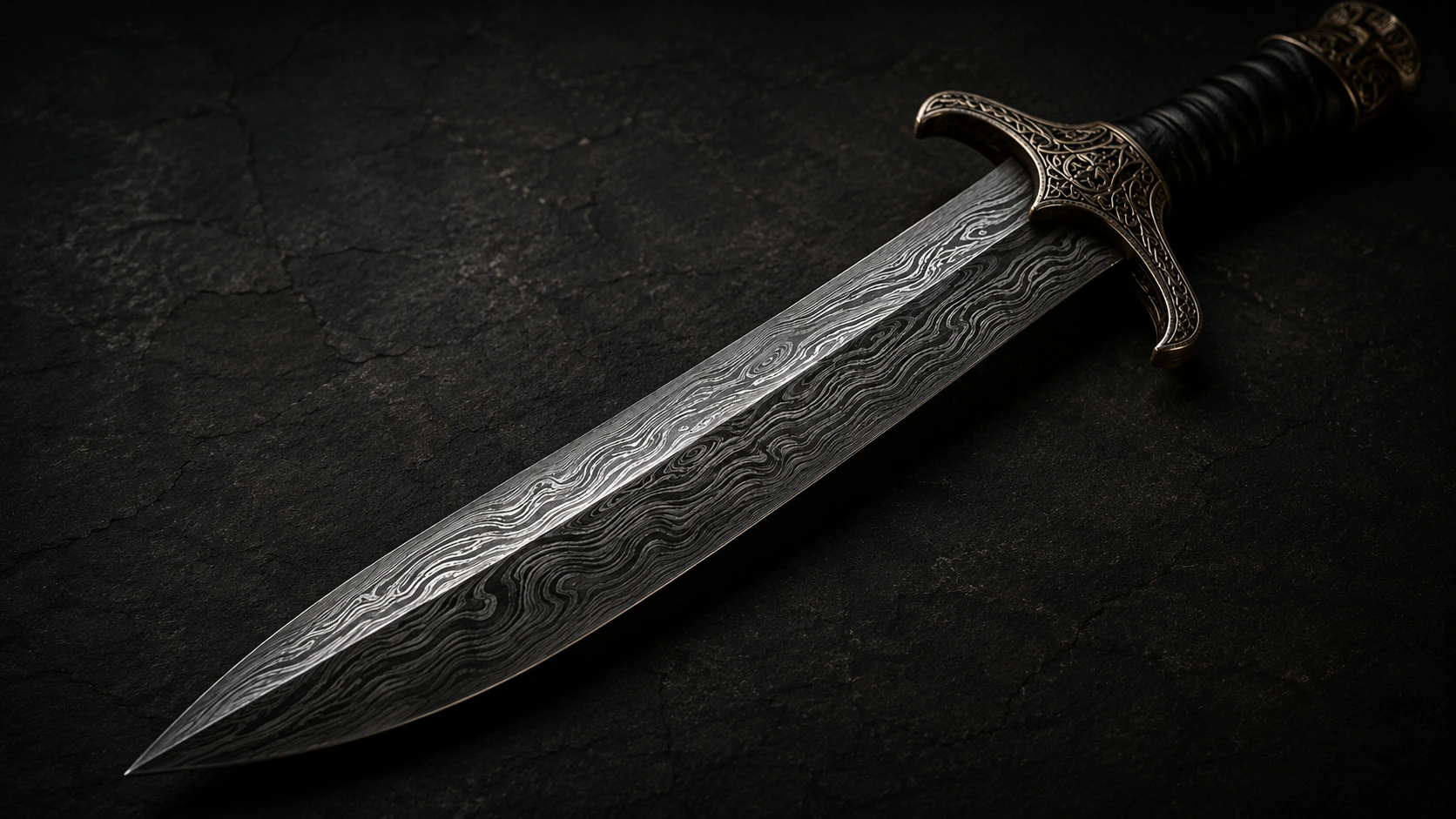
As early as the third century BCE, Indian blacksmiths produced what became known as Wootz steel — a high-carbon steel forged inside sealed crucibles, superior to almost anything known in the ancient world.
Through Arab trade routes and maritime exchanges, Wootz ingots arrived in the Middle East.
Pre-Islamic Arab poets praised Indian swords and referred to them as “Muhannad,” meaning swords from India.
But when these ingots reached Damascus, the Damascene blacksmith saw them only as raw material.
What happened next…
was what Damascus had always done best: taking raw substance and reshaping it through experience, memory, patience, and fire until it became something entirely different. Something only Damascus truly understood.
The Folding of Fire and Patience
Damascene blacksmiths folded layers of steel repeatedly through an incredibly long and complicated process.
They cut, reforged, reheated, cooled, and hammered the metal over and over again.
One single piece of Indian Wootz steel passed through endless transformations before emerging from the hands of a Damascene craftsman as something entirely new.
LightYet strong Hard Yet flexible Shock-absorbing Almost impossible to break Rare Impossible to imitate Impossible to forget
These were nearly impossible equations solved not by chemistry books, but by the intuition of a Damascene blacksmith who understood — perhaps instinctively more than scientifically that experience itself was the only path. He possessed no laboratories or equations.
Only the memory of Damascus shaped through his hands, his patience with fire, and a wisdom that understood beauty requires time.
And few cities mastered the shaping of time like Damascus.
The Sword That Astonished the World When Crusaders first encountered Damascus steel on the battlefields of the twelfth century, some chroniclers claimed that Muslim swords could split a silk scarf floating in the air. Perhaps it was an exaggeration. But steel like this never truly required exaggeration.
“Civilization lives first in human hands… before it lives in stone.”
When the Secret Was Taken to Samarkand Then came Timur in 1400 CE.
He invaded Damascus, burned the city, massacred tens of thousands, and ordered its greatest craftsmen, blacksmiths, and architects to be taken as captives to Samarkand.
He was one of history’s cleverest tyrants. He understood that civilization lives in the hands of people before it lives inside cities. So he took the hands… and left the stones to burn. The Secret That Died with the Last Masters The craft did not disappear overnight. Blacksmiths continued after Timur, though with incomplete knowledge and fragmented secrets. But by the mid-eighteenth century, true Damascus steel vanished.
Supplies of Indian Wootz steel disappeared after the British East India Company destroyed traditional Indian steel production systems.
At the same time, the oral chain of knowledge passed from master to apprentice slowly came to an end.
And when the last masters died… the secret died with them. Because secrets like these are never written.
Only memory worthy of carrying a Damascene secret could preserve them.
Instinctive Genius Under the Microscope After two and a half centuries of disappearance, researchers from Dresden University in Germany, led by physicist Peter Paufler, examined a seventeenth-century Damascus blade under a high-resolution electron microscope in 2006.
Their findings, later published in Nature, revealed: carbon nanotubes and cementite nanowires.
Microscopic structures only scientifically discovered in the twentieth century…
yet forged centuries earlier by a Damascene blacksmith through fire, instinct, and inherited experience.
It almost feels as though the blacksmith, while folding steel…
was unconsciously imitating Damascus itself.
A city that folded civilizations together, melted them into one invisible crucible, and reshaped them into something impossible to classify.
Was it Arab?
Aramean?
Hellenistic?
Islamic?
“It was Damascene… and that alone explains everything.”