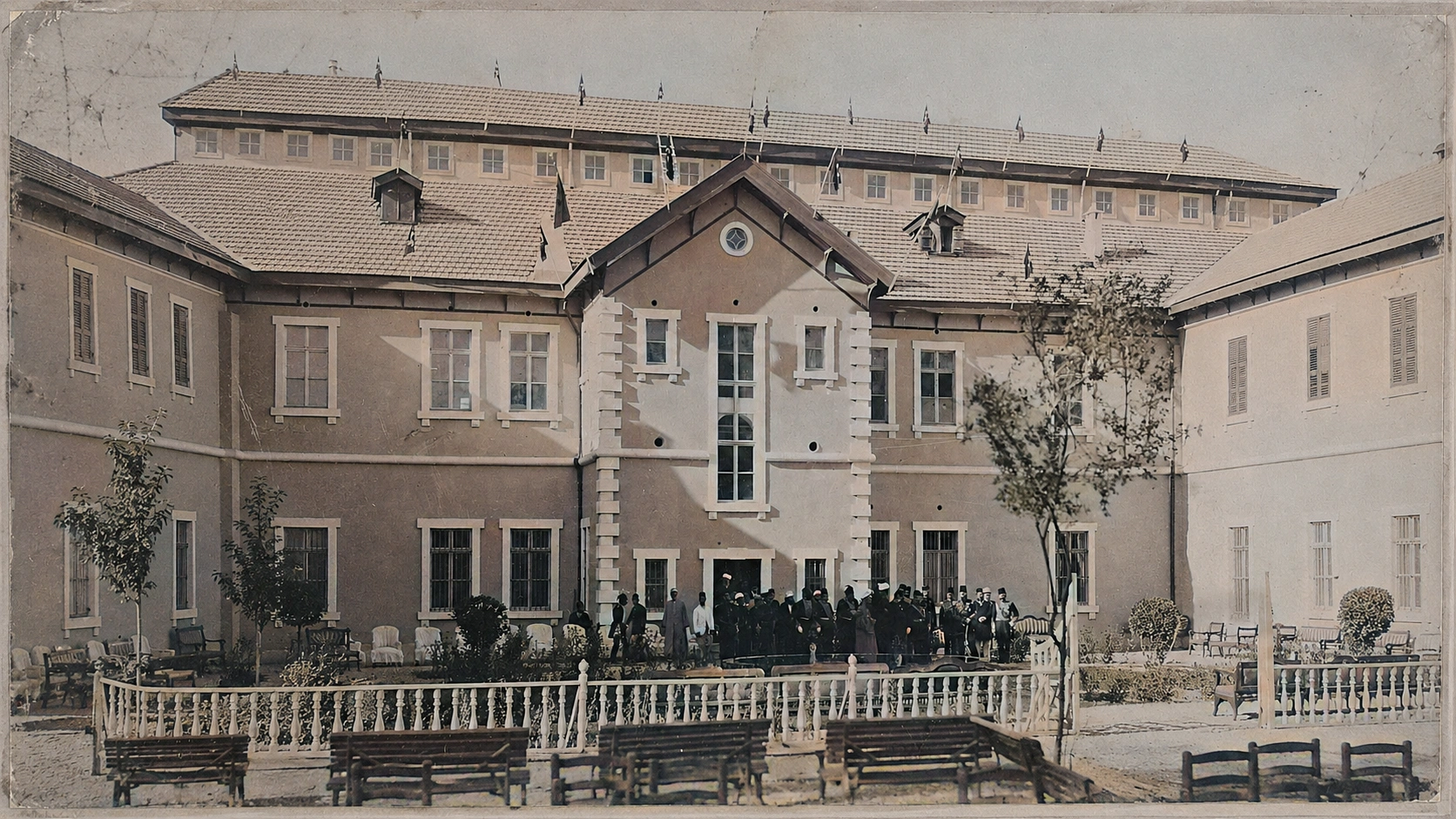
In the heart of old Damascus, where stone still carries the scent of jasmine, memory, and blood, stands a place that tells far more than the history of medicine.
Its corridors hold the story of an entire nation.
Built upon the ruins of the ancient Nur al-Din Bimaristan, the hospital officially opened on March 18, 1899, carrying from its very beginning a rare humanitarian purpose.
By order of Ottoman Sultan Abdul Hamid II, “The Hamidiyeh Hospital of Strangers” was founded to become exactly what its name implied: a shelter for strangers, a refuge for the sick, and a place of free treatment for patients arriving from Jerusalem, Beirut, Aleppo, and Deir ez-Zor.
“The Hospital of Strangers was never merely a medical institution… it was an early image of the homeland itself.”
Within those walls — where the cries of patients and stories of travelers lingered — Syrian memory itself was quietly being shaped.
A Scalpel Ahead of Its Time
The hospital quickly evolved into one of the region’s most advanced medical centers of its era.
It introduced some of the most modern medical equipment available at the time and witnessed highly complex surgeries, including brain abscess operations, performed by pioneering surgeons working at a moment when surgery itself was still battling pain and uncertainty.
This medical renaissance reached its peak in 1903 with the establishment of:
“The Imperial Civil Medical School”
the first Ottoman medical college outside Istanbul.
The institution became a miniature medical city filled with kitchens, laundries, wards, and even a mental health treatment wing considered remarkably progressive for its time.
The Graveyard of Doctors
Then came World War I.
The catastrophe of the Safarbarlik swept through the streets of Damascus, bringing famine, exhaustion, typhus, and cholera.
Hospital beds overflowed with soldiers and civilians alike, while the corridors became scenes of unbearable human suffering.
During those dark years, one of the noblest chapters of medical honor was written.
Doctors and medical students knew that approaching infected patients could easily mean death.
And yet… they never abandoned their posts.
They stood before disease the way soldiers stand before bullets, falling one after another like autumn leaves in a sorrowful Damascene season.
“Here, doctors did not die only from disease… but from loyalty to duty itself.”
It was from this tragedy that Damascenes began calling the hospital:
“The Graveyard of Doctors.”
A chilling name that reflected the scale of sacrifice made in the service of medicine and humanity.
Blood in the Cell… A Hospital That Saved a President
Behind the curtain of medicine, politics was writing some of its bloodiest chapters.
Between 1916 and 1917, parts of the hospital secretly became resistance cells, where doctors smuggled anti-Ottoman pamphlets hidden inside medical bandages.
One night in 1917, a young man arrived at the hospital drenched in blood after cutting his own wrists rather than confessing the names of fellow revolutionaries under torture.
The doctors saved his life.
That young man would later become:
Shukri al-Quwatli
the future President of Syria.
The Night Damascus Fell… and Hippocrates Won
In October 1918, Damascus lived through one of the most chaotic nights in its history.
Ottoman and German forces withdrew. Arab revolutionary forces entered the city. Looting and disorder spread everywhere.
Amid the collapse, the doctors of Hamidiyeh stood as human shields protecting their patients.
That night, the Hippocratic Oath appeared in its purest form.
The halls filled with retreating Ottoman soldiers, wounded German officers, and victorious Arab fighters.
And inside the hospital, enmity dissolved before pain itself.
“Inside the hospital, military identities disappeared… and only humanity remained.”
Everyone was treated equally — without distinction of language, race, or uniform.
From Maysalun to Ghouta… Medicine in the Resistance Trenches
Before the wounds of World War I had healed, the hospital opened its doors again in 1920 to receive the wounded and martyrs of the Battle of Maysalun, including the companions of Yusuf al-Azma.
When the French Mandate entered Syria, the hospital was seized and forcibly renamed:
“The French Hospital.”
But changing the sign could not erase the spirit of the place.
Syrian doctors remained a constant source of resistance.
And during the Great Syrian Revolt of 1925, when Damascus was bombarded, the hospital transformed into a revolutionary medical cell.
Doctors secretly treated resistance fighters and smuggled medicines and surgical tools into the Ghouta under cover of darkness.
That was when the scalpel proved it had a place beside the rifle in liberation struggles.
Independence… and the Return of the Soul
Time continued to turn.
Nearly fifty years after the hospital’s foundation, Syria celebrated independence in April 1946.
The Syrian flag rose, the occupiers departed, and the institution returned to its people carrying its most beloved name:
“The National Hospital.”
For half a century, these walls witnessed the birth of a nation through suffering, the collapse of empires, and countless stories of pain and hope.
Today, the restored stones still stand proudly, telling a story larger than medicine itself:
How one place can heal bodies, preserve dignity, and guard the soul of a city.
“Here… Damascus bandaged its wounds.”