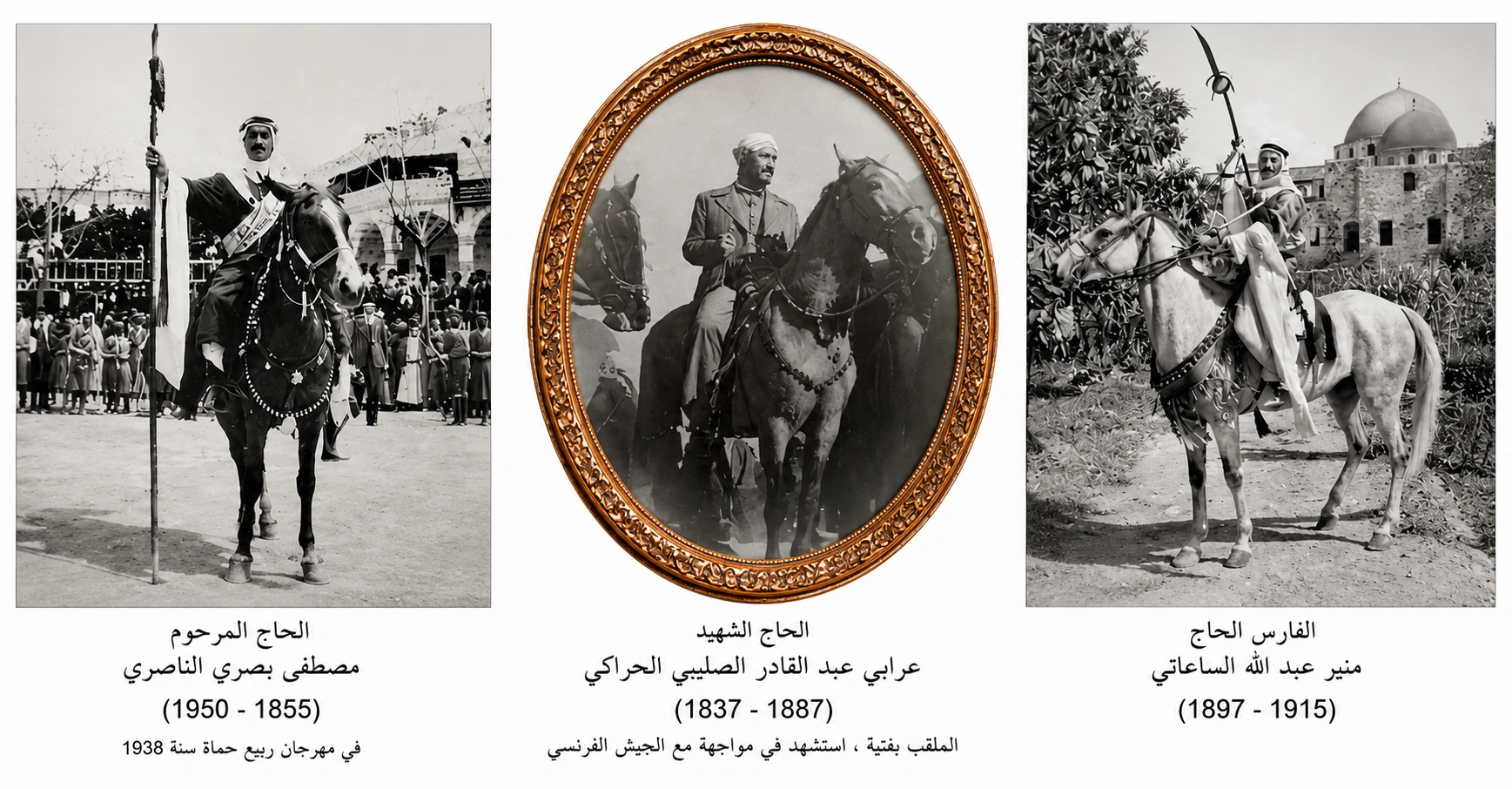
The people of Hama were deeply passionate about breeding purebred Arabian horses. Its stables were filled with rare breeds and bloodlines of Arabian horses whose breeding became associated with the courage, chivalry, horsemanship, and readiness of Hama’s people to defend their lands and confront danger.
The prominent families of Hama were committed to raising horsemen and cavalrymen because of their need to establish strength, prestige, and authority when confronting foreign aggression and destructive esoteric movements. The princes of Hama also devoted great attention to strengthening, training, and exercising racehorses, as well as practicing horsemanship and spear play, until the care of horses reached an exceptional level.
The horses and horsemen of Hama played a major role in decisive battles such as Hattin, Shaqhab, and Ain Jalut. The prices of Hama’s horses consequently exceeded those of comparable horses because of the quality of their training and breeding.
One manifestation of this reputation was the fame of the Arabian horses bred by the Al Fadl and Al Muhanna families in the steppe of Hama. Their reputation prompted the Mamluk Sultan Al-Nasir Muhammad ibn Qalawun to grant them a large number of villages for breeding horses of various strains, including Kuhaylan, Saqlawiyah, Abiyah, Karush, and others.
The prices of purebred mares ranged between sixty and seventy thousand dirhams, while some reached one hundred thousand dirhams, as the historian Imam Taqi Al-Din Al-Maqrizi stated in his book Al-Suluk li-Ma‘rifat Duwal Al-Muluk (1):
“Al-Sultan Al-Nasir was also passionately fond of horses, so they were brought to him from different lands, especially the Arabian horses of the families of Muhanna and Fadl. He preferred them over other horses. For this reason, the Sultan honored the Arabs, offered them desirable rewards for their horses, and paid exceptionally high prices for them.”
Al-Maqrizi continued:
“Among the horses of Muhanna and his sons were horses whose prices reached sixty thousand and seventy thousand dirhams. Among the mares in their possession were some valued at eighty thousand, ninety thousand, and one hundred thousand dirhams. The daughter of Al-Karta, brought by Muhammad ibn Isa, brother of Emir Muhanna, to the Sultan in the year 715 AH, was valued at one hundred thousand dirhams, in addition to an estate worth eighty thousand dirhams. Sultan Al-Nasir also granted the Arabs of Al Muhanna and Al Fadl several villages in the territories of Hama and Aleppo because of their horses, in addition to paying their prices.”
He then said:
“The Arabs of Al Muhanna, Al Fadl, and Al Murra gained prominence during his reign. Their prosperity increased, and their circumstances expanded through wealth and estates. Their favored position encouraged them to request from Sultan Al-Nasir the lands of the emirs of Aleppo, Hama, and Damascus. He granted those lands to them and compensated the emirs, until the tribes became so numerous and powerful that all other Arabs feared them.”
The horses of Hama were among the finest gifts offered to kings and princes. The princes and rulers of Hama presented purebred and noble horses to the rulers of Egypt, Damascus, Aleppo, and Baghdad.
Among the historical accounts of this practice is what Abu Al-Fida Imad Al-Din Al-Ayyubi, King of Hama (d. 732 AH), mentioned in the events of 712 AH regarding his gifts to Al-Nasir Muhammad ibn Qalawun, Sultan of Egypt and Syria (d. 741 AH) (2):
“I appeared before him in protected Damascus on Thursday, the thirteenth of Muharram of that year, corresponding to the tenth of May. I congratulated him on his arrival in his kingdom and among his servants, and I presented the horses, fabrics, and crafted objects I had brought, which he received with acceptance.”
Abu Al-Fida similarly mentioned, in the events of 718 AH, the gifts presented by Emir Fadl ibn Isa Al-Hamawi, leader of the Al Muhanna tribes in the steppe of Hama, to the prominent figures of Baghdad (3):
“Then the year 718 began. At the beginning of that year, Fadl ibn Isa traveled to Ibn Kharbanda and Chupan in Baghdad and met with them. He presented them with a gift of Arabian horses. Chupan received him favorably and granted Fadl the city of Basra, while his estates in Syria remained in his possession together with Basra.”
Horses were also among the most beloved gifts presented to the princes of Hama. Al-Maqrizi stated in Al-Suluk that Sultan Al-Zahir Baybars (d. 676 AH) bestowed noble horses upon the ruler of Hama, Al-Mansur II Muhammad ibn Mahmud Al-Ayyubi (d. 683 AH) (4):
“The ruler of Hama returned to his kingdom after the Sultan had bestowed upon him many horses, funds, and robes of honor.”
Because of the intense interest of the people of Hama in horses, their histories, and their pedigrees, the city’s historians and rulers recorded important incidents concerning them.
In the events of 703 AH, Abu Al-Fida Imad Al-Din Ismail Al-Ayyubi, King of Hama (d. 732 AH), stated (5):
“In that year, death became widespread among the horses, and countless numbers perished, until most of the stables of the princes and soldiers were emptied.”
Hama also had a thriving horse market, which later became known as Souq Al-Mawqif, located in today’s Al-Murabit neighborhood. It was given this name because the procession of the prince of Hama would stop there.
Al-Qalqashandi (d. 821 AH) mentioned this in Subh Al-A‘sha, as did Ibn Kannan Al-Salihi Al-Dimashqi (d. 1153 AH), who wrote when describing the customs of the governors of Hama (6):
“The deputy governor would ride from the government residence on Thursdays and Mondays, accompanied by the army, princes, and cavalry soldiers. The procession would travel south of the city until it reached a village called Naqrin, located near the city. It would then return until the deputy stopped briefly at the horse market, after which he proceeded to the government residence.
The soldiers would enter through the gate known as Bab Al-Ma‘arra (7). The people would then dismount according to their rank, and no one would remain mounted except the deputy governor. He would remain on horseback until he reached the seat in the government residence prepared for judgments.
There he would dismount and sit, with the four judges seated beside him behind the window: the Shafi‘i judge on his right, followed by the Hanafi judge, while the Maliki judge sat on his left, followed by the Hanbali judge.”
The reputation of Hama’s people for their knowledge of horses became so widespread that people from across Bilad Al-Sham sought their assistance in identifying horse origins and testifying to the authenticity of their pedigrees.
They were deeply devoted to maintaining the purity of their horses’ bloodlines and memorizing their origins. They would never allow a purebred mare to breed except with a purebred stallion under strict conditions. The owners and certified witnesses would attend the birth.
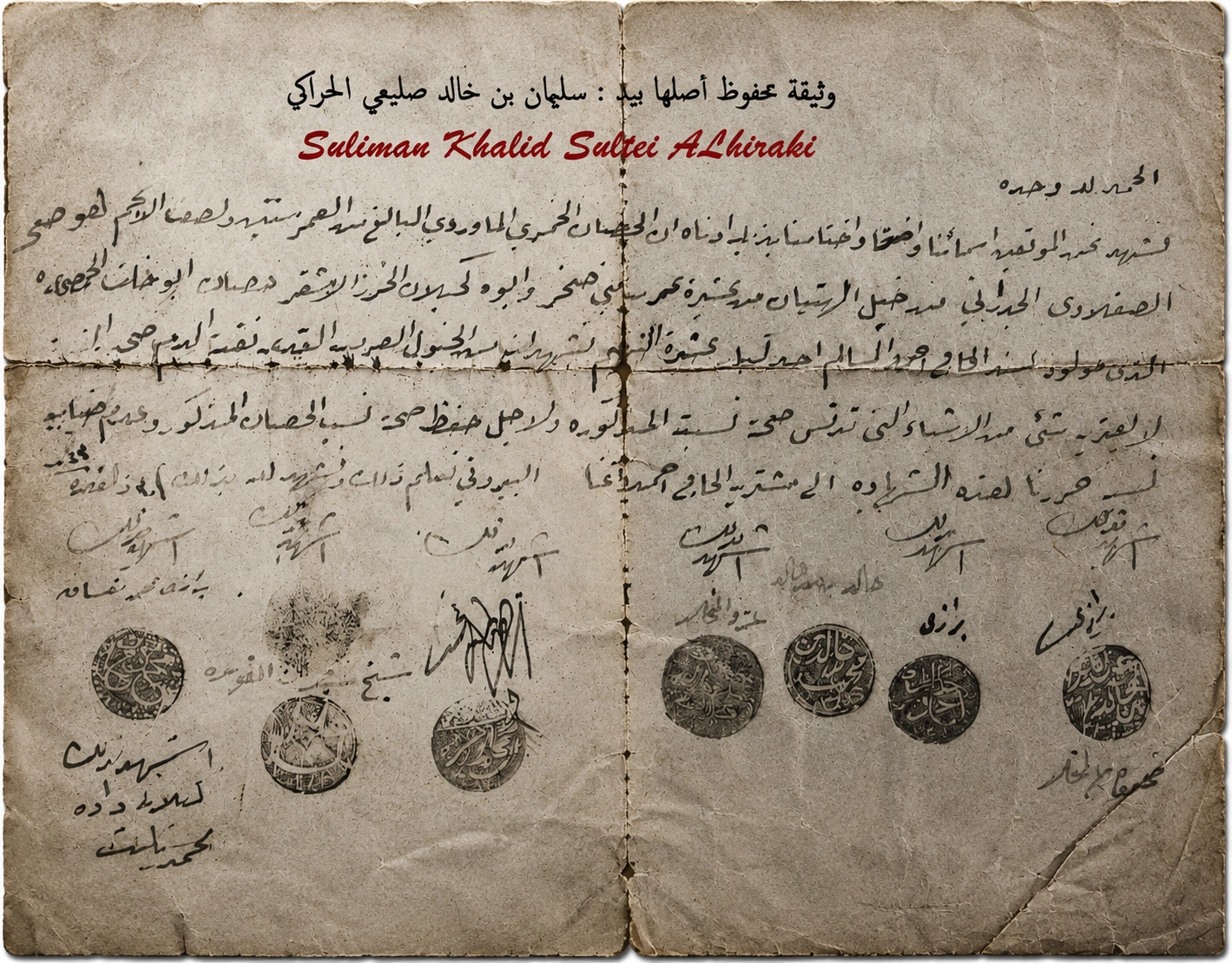
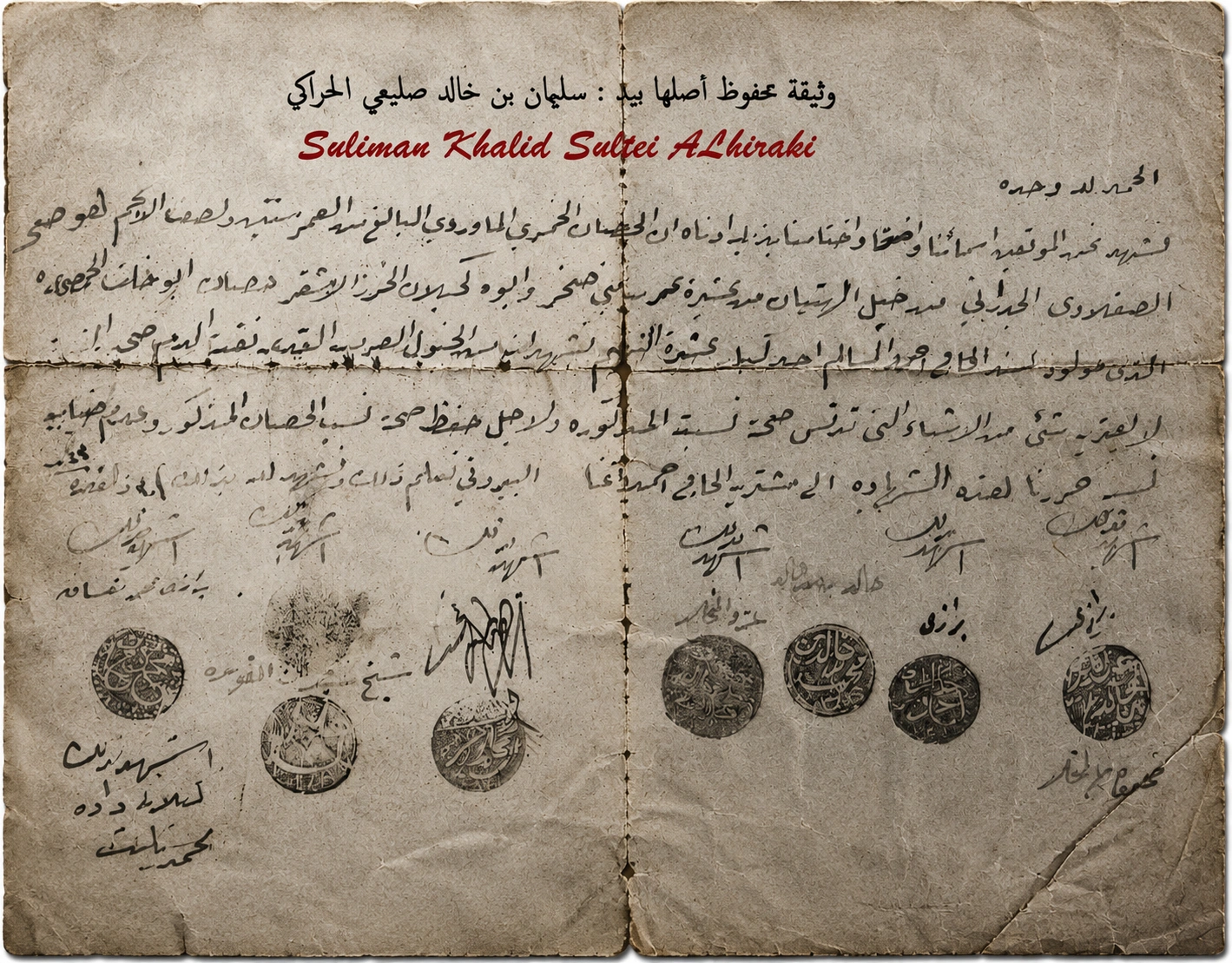
My manuscript documentary library contains a collection of original and rare legal documents dating to the Ottoman period concerning horses in Hama. Among them is a remarkable document in which a group of men from Hama testified to the authenticity and purity of the lineage of a Saqlawi horse that had entered the possession of Bani Sakhr and was purchased by Hajj Ahmad Agha Al-Beiruti.
A group of Hama’s horsemen testified to the validity of its lineage. The document reads as follows (8):
“Praise be to God alone...
We, whose names and seals appear below, testify that the dark rose-colored stallion, aged two and a half years, is a Saqlawi Jadrani from the horses of Al-Hitan of the Umar branch of Bani Sakhr.
Its father is the chestnut Kuhaylan Al-Khars, the stallion of Abu Khalaf Al-Homsi, born in the possession of Hajj Ahmad Al-Salim, one of the leading men of the Al-Naim tribe.
We testify that it is descended from ancient Arabian horses, pure of blood and sound in lineage, with nothing that could compromise the validity of its stated pedigree.
To preserve the authenticity of this horse’s lineage and prevent its pedigree from being lost, we have written this testimony for its purchaser, Hajj Ahmad Agha Al-Beiruti. We know this and testify to it on 30 Dhu Al-Qi‘dah 1343 AH.
Testified by Abdul Karim ibn Khalid Al-Barazi, 1336.
Testified by Khalid ibn Ahmad Al-Barazi, 1333.
Testified by Khalid ibn Muhammad Al-Khalid, 1342.
Testified by Izzu Al-Khalid.
Testified by Sayyid Najib ibn Sayyid Muhammad Al-Zahrawi, 1340.
Testified by: the seal is unclear.
Testified by Khalil Al-Salama, sheikh of the Al-Fawa‘ira tribe.
Testified by Muhammad Na‘san Al-Barazi, 1342.
Testified by Muhammad Thabit.”
References
Al-Suluk li-Ma‘rifat Duwal Al-Muluk by Al-Maqrizi (Vol. 3, pp. 303–305).
Al-Mukhtasar fi Akhbar Al-Bashar by King Abu Al-Fida Al-Ayyubi Al-Hamawi (Vol. 4, p. 71).
Al-Mukhtasar fi Akhbar Al-Bashar by King Abu Al-Fida Al-Ayyubi Al-Hamawi (Vol. 4, p. 83).
Al-Suluk li-Ma‘rifat Duwal Al-Muluk by Al-Maqrizi (Vol. 2, p. 38).
Al-Mukhtasar fi Akhbar Al-Bashar by King Abu Al-Fida Al-Ayyubi Al-Hamawi (Vol. 4, p. 51).
Al-Mawakib Al-Islamiyyah fi Al-Mamalik wa Al-Mahasin Al-Shamiyyah by Ibn Kannan Al-Salihi Al-Dimashqi (Vol. 2, pp. 104–112); Subh Al-A‘sha by Al-Qalqashandi (Vol. 4, p. 239).
The correct name is Bab Al-Usra, as stated in Subh Al-A‘sha (Vol. 4, p. 239). In Al-Daw’ Al-Lami‘ by Al-Sakhawi, it appears as Bab Al-Izza, while the correct name is Bab Al-Usra.
A document preserved by its writer, Suleiman, who seeks the forgiveness of his Lord.
Attachments
An image of the document dated 30 Dhu Al-Qi‘dah 1343 AH, corresponding to 22 June 1925.
A photograph featuring three horsemen from Hama: Hajj Mustafa Al-Masri (d. 1950), the martyred horseman Urabi Al-Sulai‘i Al-Haraki (d. 1931), and the horseman Munir Al-Sa‘ati (d. 1997).