
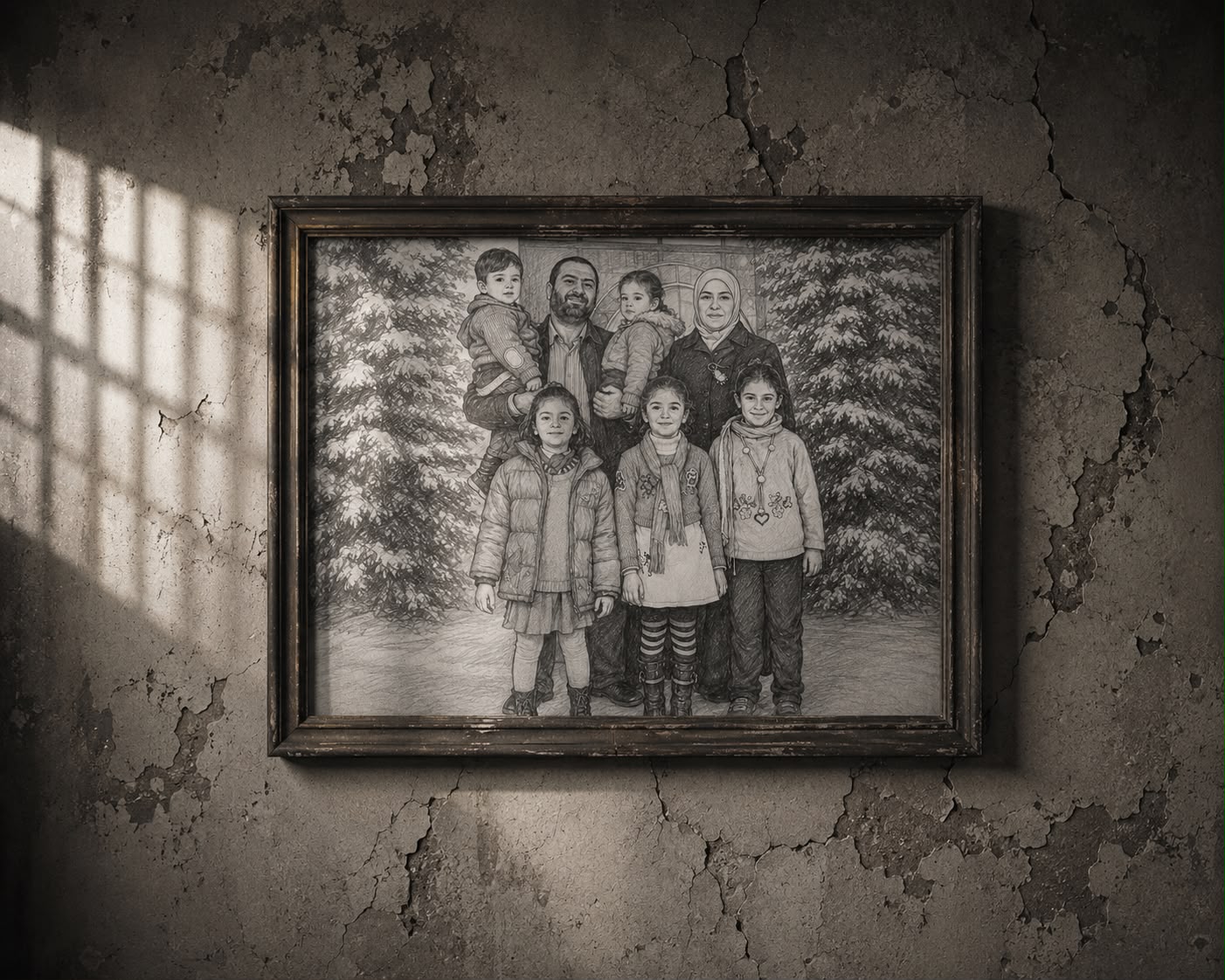
The Story of Abdulrahman Yassin and Rania Al-Abbasi Reopens Syria’s Deepest Wounds
What is most frightening about the story of Rania Al-Abbasi is that her name reached us. We saw her face, learned the names of her children, and came to know something about their fate. But behind this story stand thousands of families who disappeared without a trace, and thousands of women and children whose voices never reached anyone.
For this reason, the case of Abdulrahman Yassin and Rania Al-Abbasi’s family has become an icon of enforced disappearance in Syria, and a symbol for thousands of families swallowed by prisons, detention centers, and unknown mass graves, their stories absent from the light.
“The case of Rania Al-Abbasi and her children became an icon of the enforced disappearance of Syrian families.”
And every time a new testimony appears, the same question returns: How does a person reach the point of suffocating innocent children and filming the act? How can someone speak about it with confidence? How can they carry such a story for years? How do they feel safe enough to tell others about it? And how do they find people around them willing to listen, justify, and applaud?
The answer begins with the Assadist culture that was built over decades.
“Behind every executioner stands a system that convinced him, a narrative that justified him, and an environment that gave his actions room to exist.”
A culture nurtured by Assad through educational, social, and media institutions. A culture that manufactured fear, tied the nation to authority, tied safety to the survival of the regime, and portrayed the Syrian “other” as a permanent threat.
Decades of indoctrination produced a one-sided narrative, then flooded Syrians with it from every direction: in schools and universities, in news broadcasts, in television dramas, in religious and official discourse, and through intellectuals and media figures presented as representatives of thought, culture, and public opinion.
For this reason, pro-regime intellectuals and media figures played a major role in reinforcing this narrative, reproducing it, and granting it moral and cultural legitimacy until it settled deeply into the consciousness of generations of Syrians.
“Decades of manufacturing fear succeeded in rooting the Assadist narrative within the collective public consciousness.”
When fear dominates awareness, the moral compass gradually shifts. The humanity of the victim fades, while justifications move to the forefront. Over time, injustice becomes part of the familiar landscape, cruelty is dressed in the language of necessity, and excuses surrounding the executioner multiply while the voices of victims are drowned out.
What happened in Syria was therefore a long-term project aimed at reshaping Syrian consciousness and redefining fear, loyalty, and the enemy in the minds of entire generations. This was achieved by linking the homeland to one person or one family, tying the nation’s fate to the fate of authority, and planting a Baathist-Assadist narrative that infiltrated schools, universities, media, art, and public discourse until it became embedded within the assumptions with which generations grew up.
Over time, people carried this narrative within their consciousness, passed it on to their children, and reproduced it through their conversations, attitudes, and perceptions of those around them.
“When fear succeeds in occupying consciousness, the humanity of the victim retreats while justifications take center stage.”
This is where the danger of culture and its political dimension lies; it shapes the lens through which people see the world and judge truth and falsehood, fear and safety, victim and executioner.
Today, the Ministry of Culture carries a historic responsibility:
Protecting the narrative of victims, the disappeared, detainees, displaced people, and martyrs from loss and erasure.
Examining the impact of Assadist culture, which still remains present in Syrian consciousness, with courage and clarity.
Preparing the ground for a new Syrian cultural narrative rooted in truth, dignity, and justice, while empowering organizations and cultural initiatives to participate in shaping it.
“Culture creates consciousness, and from this consciousness emerge the forms of expression found in art, media, and the stories carried across generations.”
Culture shapes awareness, directs thought, and forms emotions and mental images. From this awareness emerge the arts, media, and narratives that accompany generations and shape how they see both their homeland and themselves.