
In Damascus, seasons are recognized by scent.
The smell of salted eggplants drying on rooftops, okra threaded like green beads in an emerald necklace, and dried molokhia preserving the memory of summer through the coldest days of winter.
Long before the world invented the word “sustainability” and turned it into a slogan on corporate facades, Damascene grandmothers were practicing it silently in their kitchens, with certainty that needed no name.
“Before sustainability became a modern slogan… mouneh was daily wisdom inside Damascene homes.”
A Land Like No Other
Syria stretches across a rare geography.
Mountains, desert, sea, plains, and valleys exist within a single landscape.
But what makes it truly exceptional is not only the shape of its land — but what that land produces: an agricultural and animal diversity rarely found together in one place.
Four clear seasons, each with its own personality.
Snow in winter, and a warm, generous summer.
Citrus fruits ripening as the earth freezes, and apricots glowing at the height of heat.
This beautiful contradiction was never an obstacle for Damascenes.
It became raw material for a deep understanding of their environment.
The Rhythm of Seasons
Damascenes learned to harmonize with their surroundings until they became part of them.
They understood the rhythm of seasons and learned how to preserve what the land offered in times of abundance for moments of scarcity.
A Damascene, deep down, resists craving a dish of fava beans in the heart of winter without eating what spring produced.
In their mind, that would feel like a betrayal of the season… perhaps even of the beans themselves.
This understanding did not come from nowhere.
As one of the oldest continuously inhabited cities in the world, Damascus allowed its people to accumulate a kind of wisdom that only experience, repetition, and generations can create.
“Mouneh is not a food recipe… it is a way of understanding time.”
A System, Not Just a Recipe
Mouneh is not merely a method of preserving food.
It is a complete system, moving between drying, fermentation, pickling, boiling, frying, and storage.
In every Damascene season, there is a mouneh ritual.
Qawarma is prepared when a sheep is slaughtered in winter, then preserved in its own fat to feed the family for months.
Apricot jam is born at the height of summer, waiting patiently on the shelf until a cold day longs for it.
Okra is dried as though becoming a bridge between two seasons.
Molokhia loses its water… only to preserve its soul.
All these different methods share one wisdom:
“Nothing is wasted.”
Makdous… When a Dish Becomes an Event
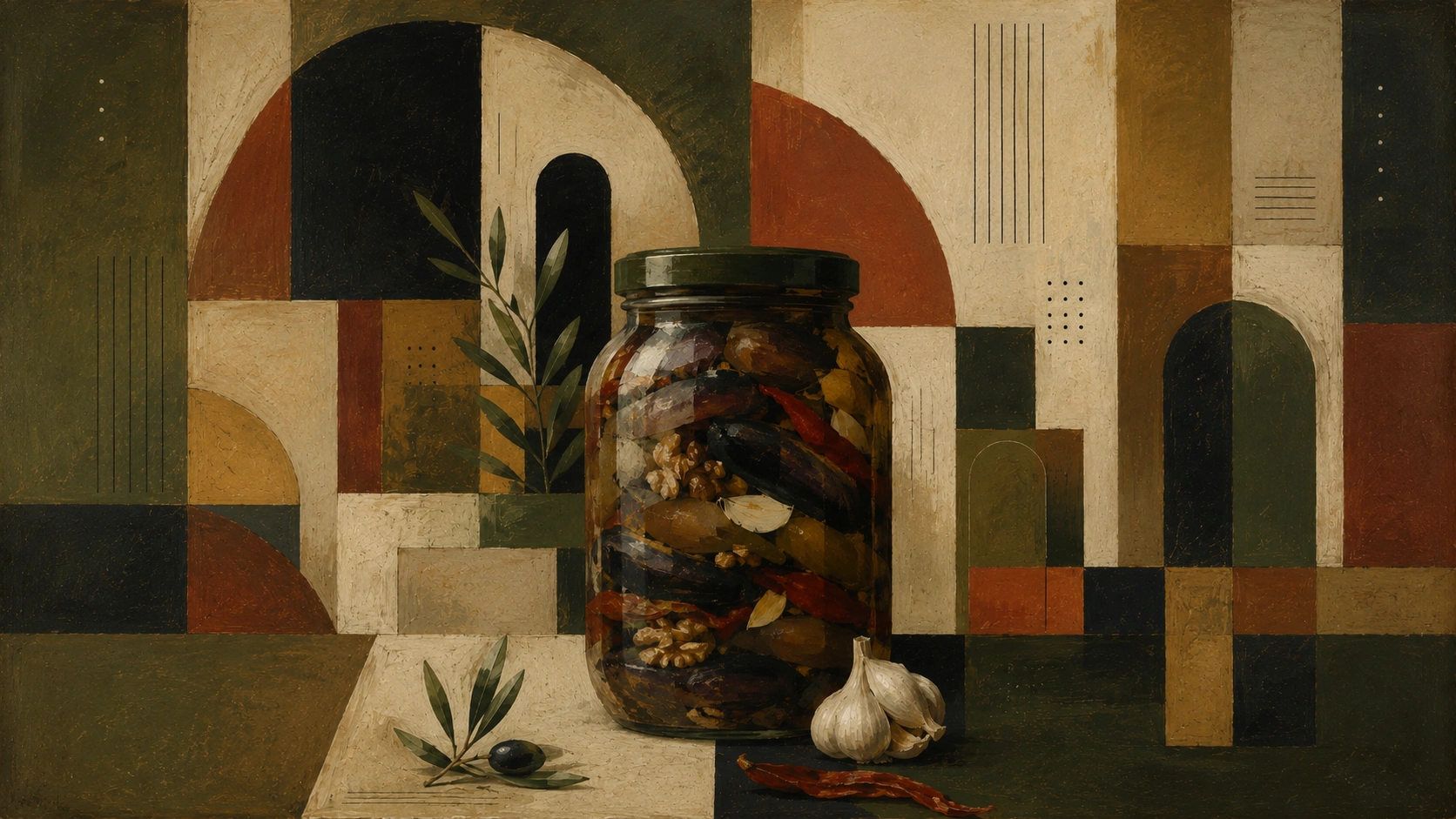
Take makdous as an example.
Complex in preparation, yet deeply simple in composition.
It captures the Syrian ability to combine and choose with instinctive precision — ingredients that suit one another astonishingly well, while the recipe keeps its original simplicity no matter whose hands prepare it.
But makdous is not merely a dish eaten outside its season.
It is, in truth, a social event.
When its season arrives, girls gather from neighboring houses, mothers take charge with their expertise, and above them all stand the grandmothers — the advisory council that cannot be replaced, carrying in memory what no written recipe can contain.
Inside these gatherings, which appear on the surface to be about food, lies a deeper cultural dimension:
Old stories,
traditional songs,
engagements being arranged,
neighborhood matters discussed,
and wisdom transmitted without anyone feeling they are being taught.
“During makdous season, it is not only eggplants that are preserved… stories are preserved too.”
Before Shiny Terminology
Mouneh was never merely a human need for food.
It was an early understanding of sustainability — before the concept became academic language or an item on climate conference agendas.
It was the art of adapting conditions in favor of human life, and a quiet affirmation of a simple truth:
When people understand their environment, they no longer fear it… they turn it into a partner.
In Damascus, scent still arrives before the season.
And the Damascene mother knew this long before it was written in books.
“Mouneh is the memory of summer… learning how to live inside winter.”