
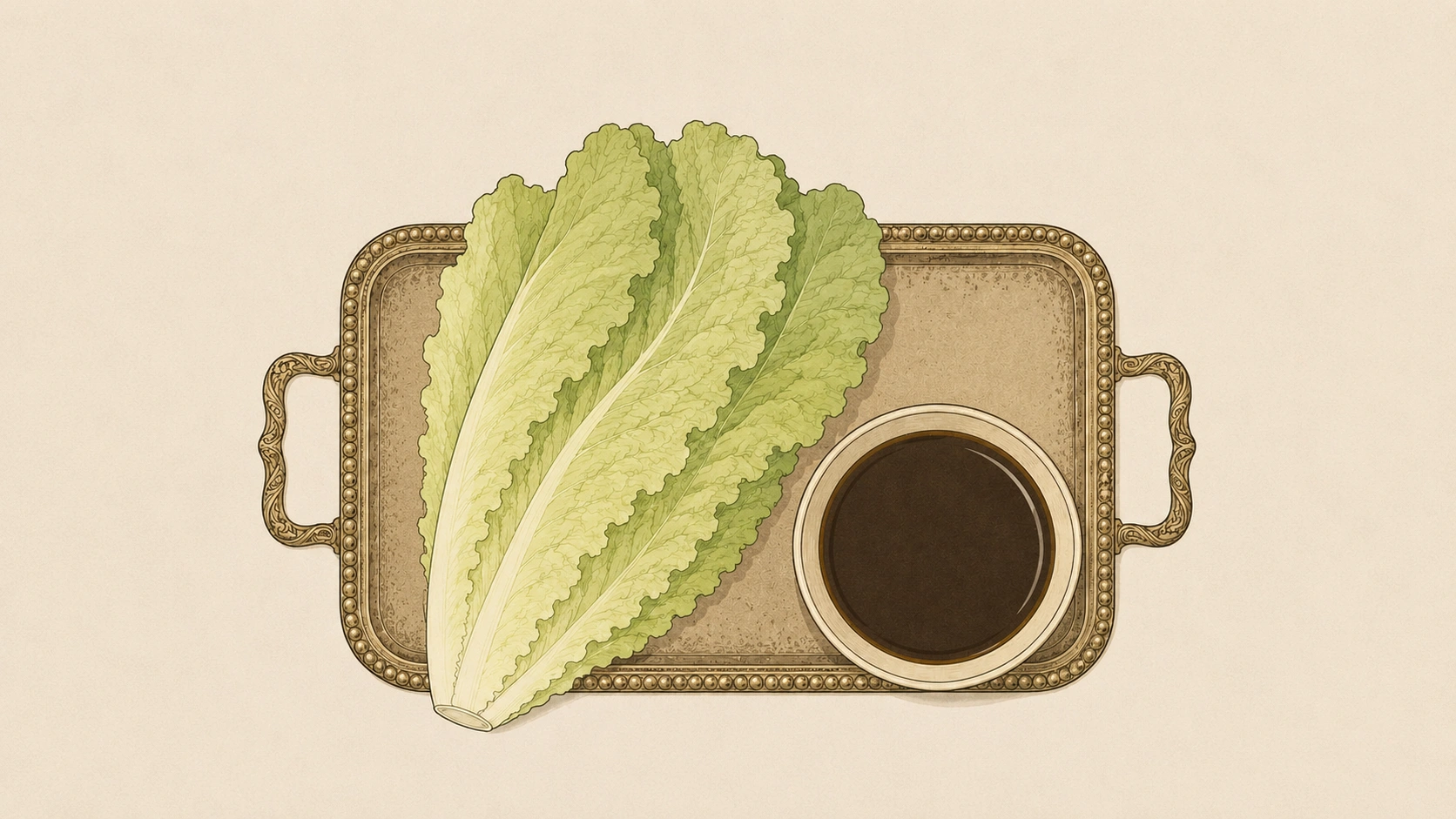
Some dishes are capable of summarizing an entire city.
Not because they are luxurious, complicated, or rare — but precisely because they are so simple that explaining them to outsiders becomes difficult. And perhaps no Damascene dish captures everyday life more perfectly than “lettuce and molasses.”
This dish barely even requires a recipe.
Fresh lettuce, grape molasses — sometimes date molasses — and perhaps a piece of bread on the side. No cooking, no fire, no spices, no performance. Just cold, quick, seemingly modest ingredients… carrying something far deeper than their simplicity suggests.
“Lettuce and molasses was never just food… it was a way of life.”
In old Damascene homes, especially during summer, this dish often appeared around midday, when the heat became too heavy for rich meals. Something light, quick, slightly sweet, and refreshing. It was not prepared as a formal meal, but rather as a small pause within the day itself.
And this is exactly where its uniqueness lies.
Cities are not remembered only through their grand dishes served in restaurants, but also through their “marginal” foods — the meals people never think to document. The dishes eaten in small kitchens, at the edges of tables, or quickly between daily routines.
That is why “lettuce and molasses” feels closer to a social memory than a recipe.
This simplicity is not uniquely Syrian. Many world cuisines contain remarkably similar dishes — not in ingredients, but in spirit. Foods born directly from everyday life that later became part of people’s identities.
In Italy, dishes like Bruschetta rely only on bread, olive oil, and tomatoes, originally created as simple food for farmers and workers. In Spain, Pan con tomate became a cultural symbol despite being little more than bread, tomato, and olive oil. In Japan, entire comfort meals are built around rice, pickles, or light soup, tied deeply to ideas of home, calmness, and daily comfort.
All of these foods share one thing:
They are not trying to impress anyone.
They emerged from necessity, from the rhythm of real life, and from people’s direct relationship with the ingredients of their land.
“Cities are remembered not only by their grand meals… but by the small dishes that preserve memory.”
And that is exactly what “lettuce and molasses” does within Damascene memory.
Lettuce itself was never foreign to Damascus; the Ghouta surrounding the city was once among the richest agricultural environments in the region, and fresh vegetables were part of everyday life. Molasses too belongs to the land, to the seasons, and to the old idea of preserving natural sweetness for winter and difficult days ahead.
And when the two come together, a beautiful Damascene contradiction appears:
Sweetness with coolness,
simplicity with richness,
apparent poverty with genuine abundance.
Perhaps this is why it is difficult for a Damascene person to explain this dish to someone who never lived it. Because the meaning is not only in the taste, but in the feeling attached to it — the feeling of home, summer, old kitchens, comfort, and the ability to create something beautiful from the simplest possible things.
And perhaps that is one of the things that resembles Damascus most.
Throughout its long history, the city was never a place of spectacle as much as it was a city of quiet details. A city that understood subtle beauty, and understood how something incredibly simple could remain in memory for decades.
That is why “lettuce and molasses” no longer feels like merely an old traditional dish.
It feels more like a reflection of the way Damascenes lived for generations:
creating warmth and completeness… from the simplest things imaginable.