When Syria Was Searching for Its Image
Every city has voices that preserve its memory. Every nation has its writers, poets, and musicians who tell its story across generations. But there is another group, often less visible, whose influence quietly shapes daily life: those who create the visual image through which societies see themselves.
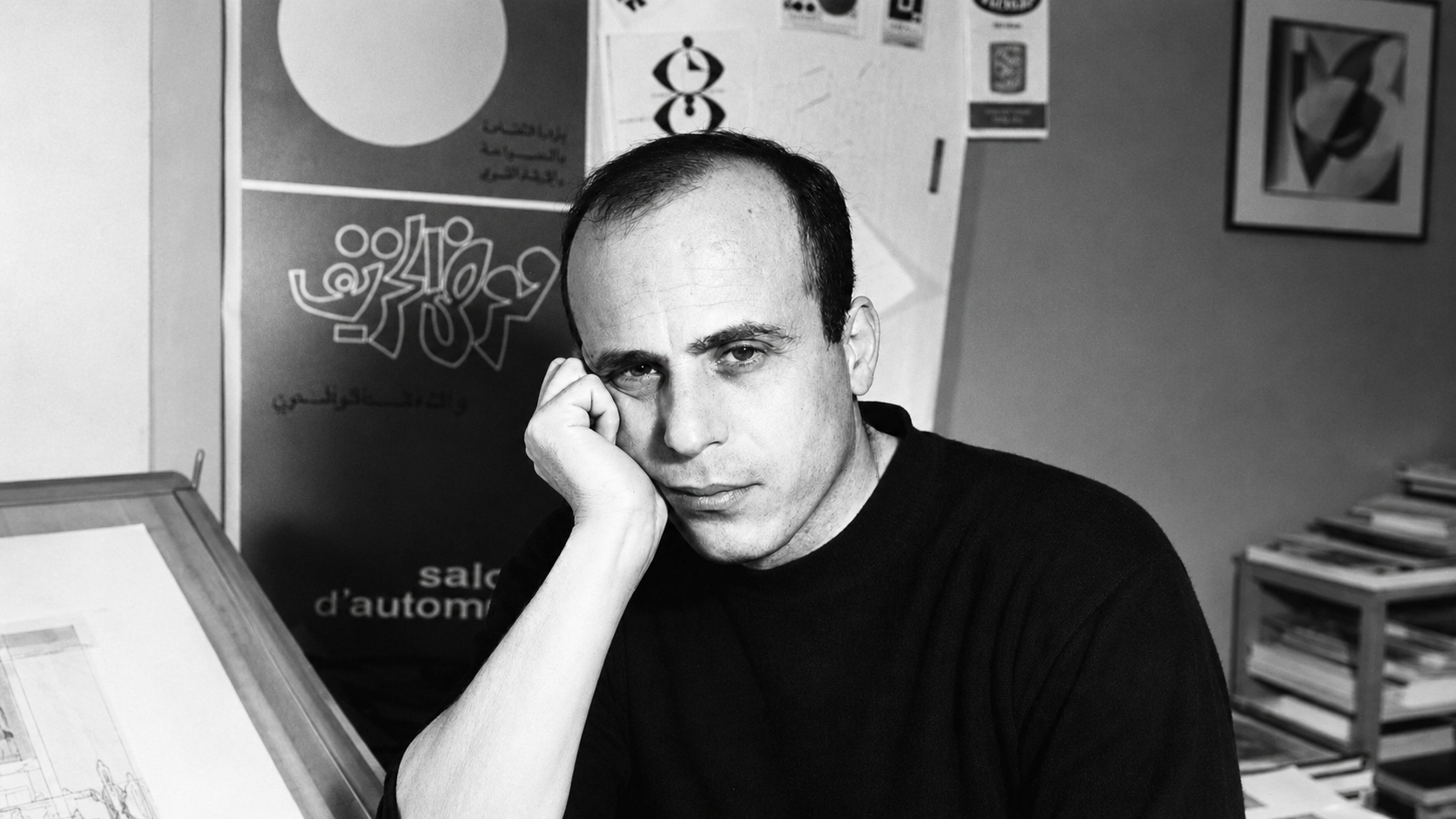
In Syria, Abdul Qader Arnaout was one of the most important among them.
Known today as one of the pioneers of Arab graphic design, Arnaout was never merely a poster designer, painter, or gifted calligrapher. He belonged to an entire cultural moment in twentieth-century Syria, when the country was trying to define its modern image after decades of political and social transformation.
“Some artists do not simply create images… they shape the way nations see themselves.”
Born in Damascus in 1936, Arnaout grew up in a city that was not merely a place to live, but an open school of art, history, and beauty.
From childhood, he was surrounded by an extraordinary visual world: the ornaments of the Umayyad Mosque, the arches of Damascene houses, Arabic inscriptions carved into walls and doors, the colors of old markets, and the subtle details that formed the city’s deep visual fabric. In Damascus, heritage was not confined to museums. It was part of everyday life. A child could walk down one street and encounter Roman, Mamluk, Ottoman, and Umayyad traces side by side without leaving the neighborhood.
This layered civilization profoundly shaped Arnaout’s artistic vision and his search for a new relationship between past and present.
From Posters to Identity Building
During the 1950s and 1960s, many Arab countries were attempting to build modern institutions, while much of the dominant visual language remained imported from Europe and America.At the heart of this cultural moment stood an unspoken question: How can we become modern without losing ourselves?
For Abdul Qader Arnaout, the answer was neither copying Western experiences nor reproducing heritage in a rigid folkloric form.
He believed that true modernity begins with understanding the self, and that civilizations carrying thousands of years of history do not need to borrow their identity from others. From this idea emerged his unique artistic approach. He treated Arabic letters, Islamic ornamentation, Syrian historical symbols, and the Ugaritic alphabet as living elements capable of being reshaped into a contemporary visual language. He did not see heritage as a finished past, but as a renewable source of ideas and imagination.
That is why his work carried a unique feeling: modern and contemporary in appearance, yet deeply rooted in the cultural memory of this land.
Arnaout succeeded in achieving a difficult balance: to be universal without losing locality, and contemporary without severing ties to heritage.
“For him, modernity was never the escape from identity… but the rediscovery of it.”
The Man Who Turned History into Visual Language
One of the clearest examples of this vision appeared in his designs for the 1987 Mediterranean Games held in Latakia.
Instead of relying on ordinary sports symbols, Arnaout turned toward the Ugaritic alphabet — one of humanity’s oldest known alphabets — and transformed it into the visual foundation of the project. The idea went far beyond historical inspiration.
It became a cultural statement declaring that modern Syria does not begin from zero, and that its ancient civilizational roots are capable of producing a contemporary visual language equal to any design school in the world. The same philosophy appeared in his long association with the Damascus International Fair.
Those posters were never merely promotional material for economic events. They reflected the image of a country trying to present itself as a meeting point between culture, economy, art, and civilization. Over time, many of these posters became visual documents preserving the memory of an entire phase of modern Syrian history.
Arnaout was also fascinated by visual metaphor — the ability to compress complex ideas into a single simple image.
In one of his most famous works, he depicted an hourglass where Latin letters gradually transformed into Arabic letters, addressing language, identity, and cultural transformation through one visual concept.
This ability to transform abstract ideas into powerful imagery became one of the defining features of his artistic legacy.
“For Arnaout, design was never decoration… it was a way of thinking.”
A Legacy Beyond Art
When speaking about Abdul Qader Arnaout, it is easy to reduce him to a successful designer or talented artist.
But his true influence extended far beyond that. He helped shape the visual consciousness of an entire generation of Syrians and Arabs, while reinforcing the idea that design is not merely aesthetic luxury, but a cultural tool capable of expressing identity, memory, and collective ambition.
Even decades later, many of his works still feel alive and contemporary. That is because they were never tied to temporary trends or passing styles.
They were built upon deep ideas and a clear cultural vision. Arnaout understood early that images are not simply beautiful forms.
They are instruments for preserving collective memory and shaping the relationship between people, place, and history. Today, when we look at his legacy, we do not merely see the career of a remarkable artist. We see the story of a man who dedicated his life to searching for Syria’s image during a time when the country itself was searching for its identity. Through his work, he left behind a visual archive that does more than document history. It reminds us that nations are built not only through words, music, and books… but also through the images that reflect their spirit to the world. Perhaps that is why Abdul Qader Arnaout’s name still remains alive today — not simply as a designer of beautiful posters, but as one of the people who helped draw the visual memory of modern Syria itself.
“Some people leave behind books or buildings… others leave behind the way an entire nation sees itself.”