
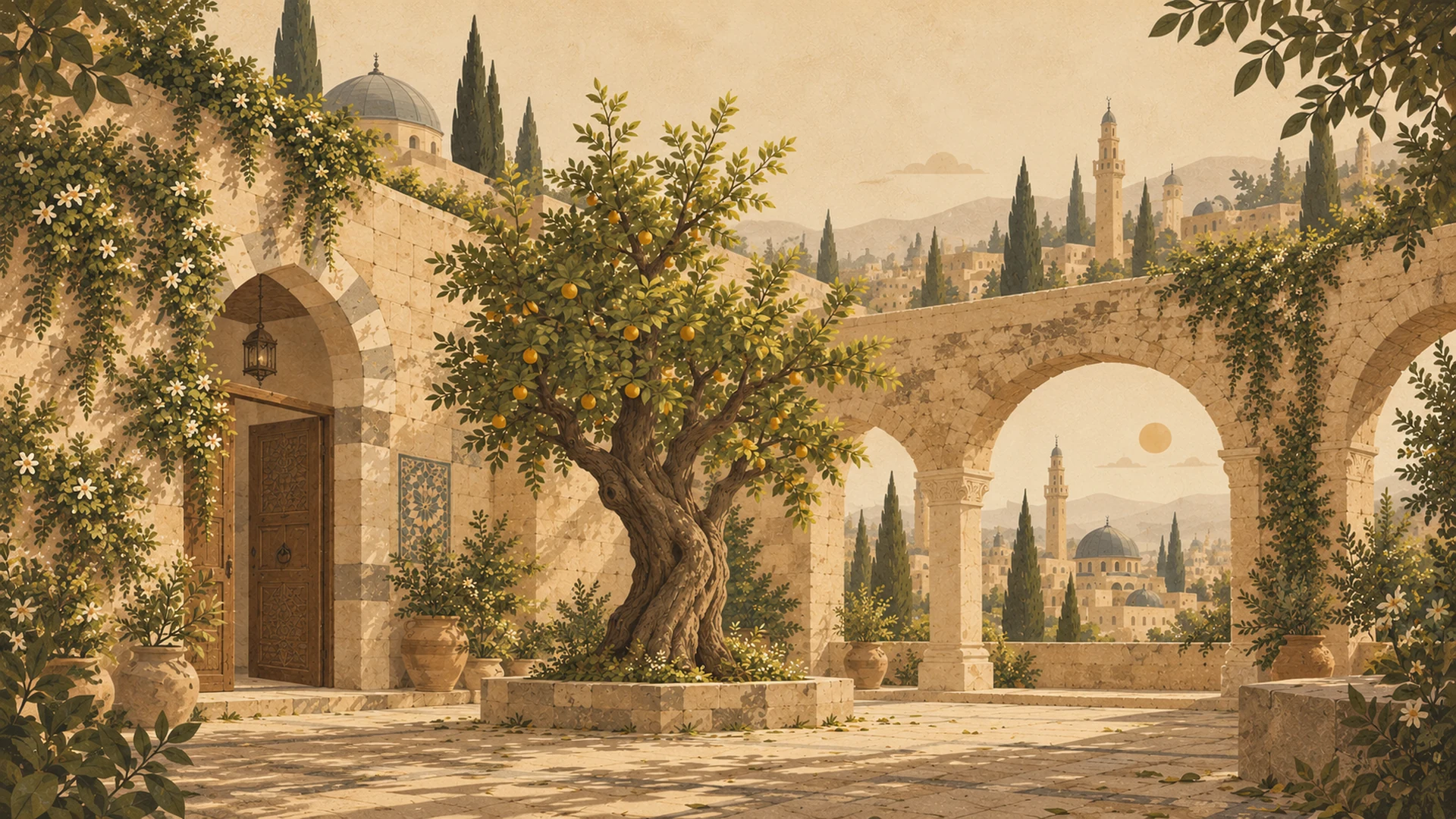
To accompany change, and walk alongside it… this is what I learned from Damascus and its people.
How can we change without losing ourselves?
Perhaps we find the answer in a city that has lived for thousands of years, and witnessed enough transformation to erase its features time and again — yet it remained Damascus.
We may return to a neighborhood we once knew, and find a shop transformed, a familiar face gone, a house that no longer resembles the image we kept of it. We search for the old place within its new details, and wonder what has changed in it, before realizing that we are seeing it through different eyes.
In Damascus, this feeling expands to carry the history of an entire city.
From Al-Hamidiyah Souq to the alleys surrounding the Umayyad Mosque, the traces of civilizations sit side by side with the details of daily life. People pass through these places to work, to buy, to meet, adding their small stories to its memory. What we see today as heritage was once simply life, made by people, like us, preoccupied with their next day.
Civilizations and rulers succeeded one another in Damascus, and faces and eras changed. Wars and fires altered its features; what was destroyed was rebuilt; the functions of buildings and the character of neighborhoods shifted; customs were born and others faded away.
With every transformation, Damascus was no longer what it had been — yet it never stopped being Damascus.
Each era added a layer to its memory and character, until it became like a living museum, where the past lives within the present, renewing itself through the people who use it and relate to it.
But this continuity carries a cost that the word "resilience" alone cannot capture.
Much of what we describe as the Damascenes' ability to adapt began as arduous attempts to continue living under circumstances they did not choose. Behind the restoration of an ordinary day's details lie losses unseen by the passerby, and effort that does not show in the city's image once it regains its rhythm.
The continuity of Damascus was not free of losses, nor were all its transformations a choice made by its people. It carried its scars, and life went on within it through whatever people were able to save, renew, and pass on to those who came after them.
They returned to their work whenever they could, taught their children their crafts, cared for their homes, and passed their customs and stories on to a new generation. In these daily acts, their relationship with the city kept finding a way to endure.
This is what I sensed in Damascus and its people: the ability to accompany transformation, to carry memory forward, and to preserve the sense of identity and belonging amid all that changes.
Change may give identity new reasons to continue, when people find ways suited to their time to express what they believe is worth holding onto.
And here, the story of Damascus touches a question that concerns all of us: how can we change without losing ourselves?
We sometimes fear leaving behind what we are used to, fear drifting from who we once were, so we cling to old versions of ourselves — even when they no longer have room for who we have become.
The familiar gives us a sense of safety. We know our place in a job we have mastered, in relationships we are accustomed to, among convictions through which we have arranged our understanding of the world. When these things shake, it becomes hard to distinguish between what we are losing of our habits and what we are losing of ourselves.
We treat our identity as if it were a finished structure, and any change to it a threat to its existence. We forget that much of what we believe defines us was shaped in our earliest environment, before we ever had the chance to test it or choose it.
We took from that environment its language, its perceptions, its fears — then experience came to broaden our knowledge, and to question some of what we had inherited. With time, we may discover that staying true to ourselves requires reexamining what we once believed defined us.
But what if identity is closer to a changing city than to a frozen statue? A city that keeps the traces of those who passed through it, while also making room for a life it has never known before?
We may change our profession and carry into the new work our dedication to doing it well. We may leave our city and find other ways to preserve our bond with its people and its memory. We may abandon an old opinion because experience has made us more capable of understanding and being fair to people.
Through these transformations, the values we want to keep become clearer, as do the habits we can let go of. We become more capable of choosing, and less in need of defending every past version of ourselves.
Maturity becomes the ability to discern: what deserves to be carried with us? And what is it time to change?
Damascus helped me see this meaning. A craft needs someone to learn it, and a place for it in people's lives. A house needs care that allows life to continue within it. And so does what we love in ourselves: it needs practice that renews its meaning, and space in which to grow.
We can carry memory without dwelling in it, and give the past its place without letting it alone determine our future. The experiences that shaped us give us knowledge to rely on, while other experiences still lie ahead, ones that may broaden our understanding of ourselves and the world.
And yet, flexibility requires discernment. Some changes we choose, some are imposed on us, and some deserve to be resisted. Holding onto a position may be loyalty to a value we believe in, just as changing it may be the fruit of a deeper understanding.
Here lies the lesson I learned from Damascus: to learn how to deal with what we cannot prevent, to protect what deserves to remain, and to have the courage to change what we no longer believe in.
To accompany time with awareness, to carry our past without freezing within it, and to grant ourselves the right to grow.
For thousands of years, the people of Damascus, generation after generation, carried something of it into their own time, and added to it something of their own lives. Within this renewed relationship between what they inherited and what they made, the city endured.
Perhaps we remain ourselves in the same way: safeguarding what we believe is worth keeping, and leaving ourselves room to change.
Damascus changed, and Damascus remained.
And perhaps this is what we learn from it: to change, and still remain able to recognize ourselves.
About the article: Adapted and reworked from the book "Aspiration, by Design" by Shatha Abdul Majeed Bakeer, which explores how cities and surrounding environments shape human behavior, identity, and aspirations.