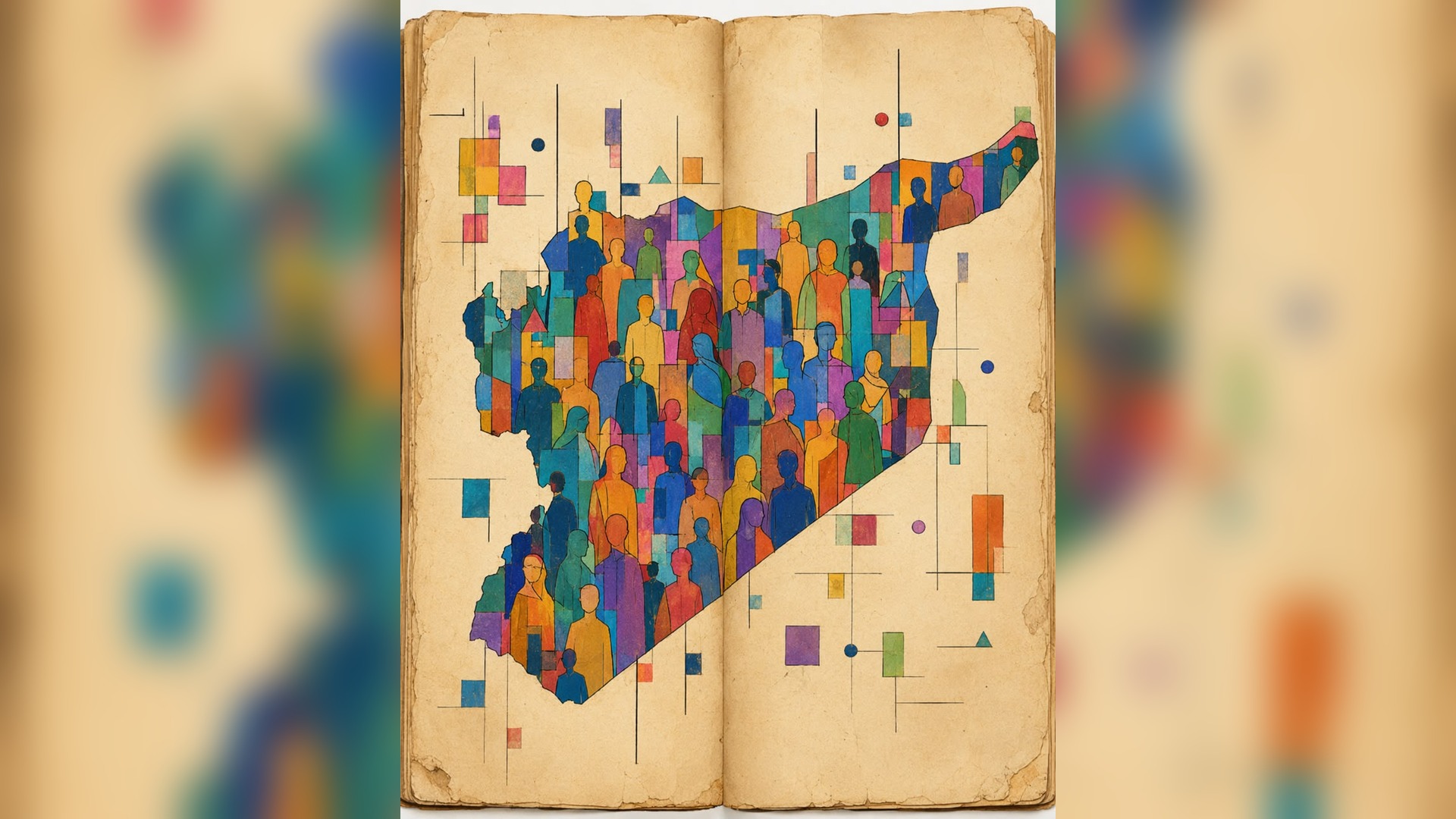
Throughout history, nations were never remembered only for what happened to them, but for the way they chose to tell what happened.
Wars end.
States change.
Generations disappear.
But stories remain.
And what survives in humanity’s memory is often not the event itself, but the narrative that ultimately prevails.
Perhaps that is why one of the most important questions facing Syrians today appears simple on the surface, yet deeply profound in meaning:
“Do we tell our own story… or do we let others tell it for us?”
After decades of authoritarianism, and after years filled with pain, displacement, division, and loss, Syria now stands before a rare historical moment.
A moment not limited to rebuilding roads, bridges, or buildings, but one concerned with rebuilding consciousness itself.
Over the past decades, Syrians have lived through enough stories to fill thousands of novels, tens of thousands of films, and millions of pages.
Stories of mothers waiting for their children.
Children forced to grow up too soon.
Cities transformed beyond recognition.
People who lost everything, then started again from nothing.
Stories of success and collapse.
Migration and return.
Fear and hope.
Yet a large part of these stories still survives only in people’s memories.
And human memory, no matter how powerful, remains fragile before time.
Future generations will not know what we lived simply because we lived it.
They will know it because someone decided to write it, film it, document it, or transform it into a novel, a song, a documentary, or a story worth telling.
That is why the greatest challenge Syrians face today may not be economic, political, or even architectural.
It may be cultural and existential.
How do we tell ourselves?
How do we preserve memory?
How do we transform the Syrian experience — with all its pain and hope — into knowledge future generations can learn from?
Great nations do not build their future upon forgetting.
They build it upon understanding.
And understanding begins when people gain the courage to look honestly at their past and transform it into meaning.
Perhaps this is why Syria today needs what could be called:
“A Revolution of Consciousness.”
A revolution measured not by slogans, but by ideas.
Not by speeches, but by the number of books written, films produced, research published, and stories preserved from disappearance.
A revolution that allows Syrians to see themselves as part of a story larger than their personal lives, larger than their cities, and larger than their generation.
Because nations do not survive on bread alone.
They survive on meaning as well.
And once human beings lose meaning, they lose direction — even if they possess everything else.
Perhaps the most important question for the coming stage is this:
What is the greater purpose capable of uniting Syrians?
Not a temporary political slogan.
Not a passing ideological project.
But a moral, civilizational, and cultural idea capable of giving future generations a reason to build, create, and dream.
That Syria becomes a country that produces knowledge rather than merely consuming it.
That it becomes a country capable of telling its own story to the world instead of listening only to what others say about it.
That it transforms pain into experience, experience into wisdom, and wisdom into a future.
“History does not forgive nations that abandon their own narrative.”
And great opportunities do not repeat themselves often.
Today, perhaps, Syrians stand before one of the most important opportunities in modern Syrian history:
The opportunity to choose the story future generations will read fifty or one hundred years from now.
And when that day comes, the same question will still remain:
“Did we write our story with our own hands… or did we leave others to write it for us?”