In modern Damascus, thousands of migrants, refugees, and travelers passed through the city.
Some stayed for a few years and left.
Others dissolved into the fabric of Damascus itself until they became part of its memory.
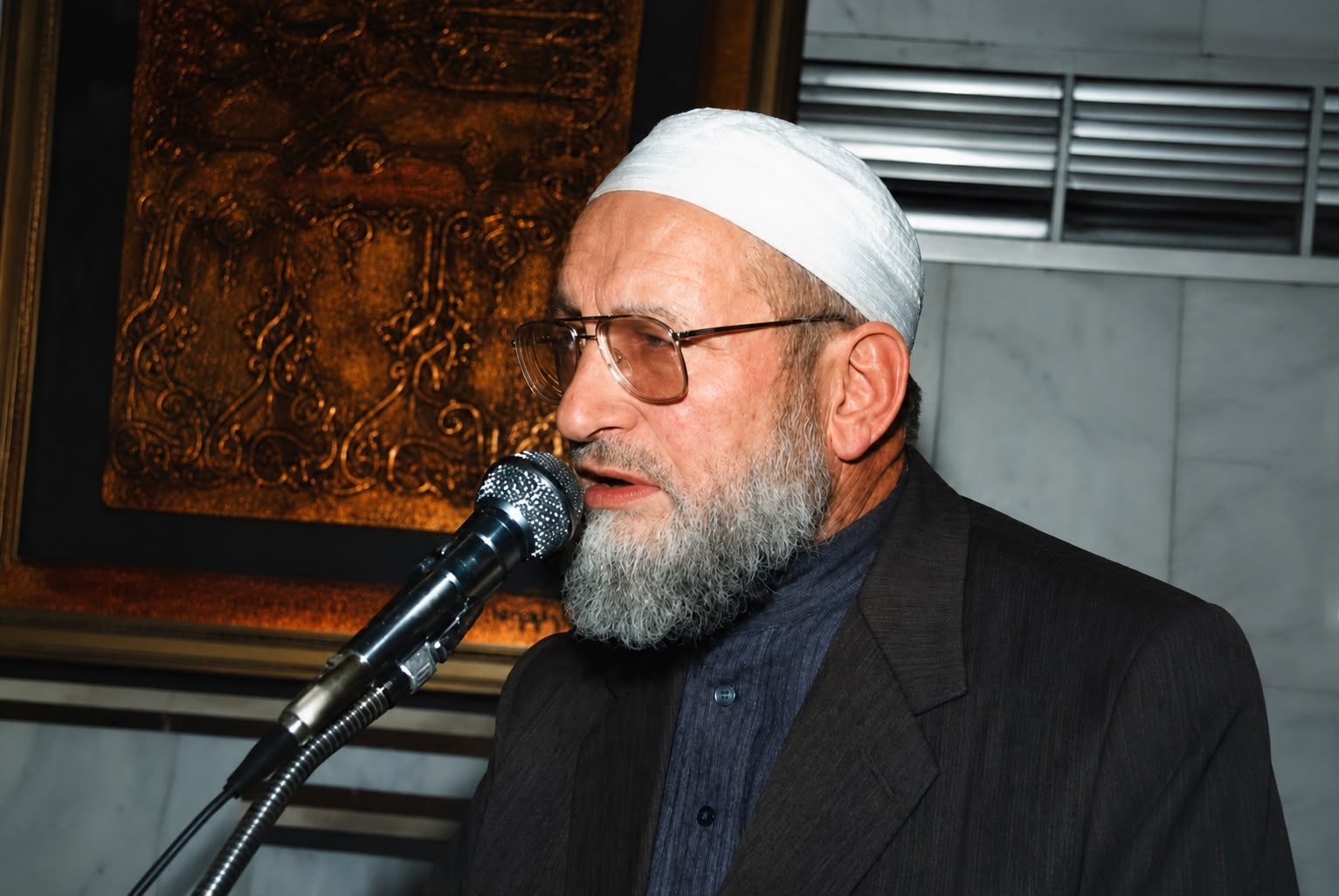
Sheikh Abdul Qader Al-Arnaout was one of them.
He was not born in Damascus, yet he spent most of his life there, became deeply attached to it, and eventually became inseparable from the city’s scholarly history.
Today, it is difficult to speak about Damascus’ scientific and religious movement during the second half of the twentieth century without mentioning his name among its leading scholars and Hadith experts.
Abdul Qader Al-Arnaout was born in 1928 in the village of Frila in Kosovo, then part of Yugoslavia.
His family belonged to the Albanian Muslim community, which had lived for years under political and religious pressure, prompting his father to migrate toward Bilad Al-Sham.
The young child arrived in Damascus during his early years, unaware that the city he entered as a refugee would become the complete stage for his scholarly and religious life.
Damascus in the 1930s was very different from the city we know today.
Circles of knowledge still filled the Umayyad Mosque, and the names of the great scholars of Al-Sham echoed through schools, alleys, and institutes.
It was within this environment that the young boy from the Balkans grew up.
His family’s financial conditions were not easy.
He was forced to leave formal education early and work repairing watches in order to help support his family.
Yet work never separated him from knowledge.
Between long working hours, he memorized the Quran, studied Hadith books, and attended scholarly circles until learning itself became part of his daily life.
Those close to him later recalled his remarkable memory and extraordinary ability to memorize from a very young age.
One of the first scholars to recognize his talent was Sheikh Saeed Al-Ahmar Al-Talli.
It is narrated that he once told him:
“You are made for nothing except knowledge.”
He then guided him toward the scholarly circles of the Umayyad Mosque, where Abdul Qader Al-Arnaout began studying under many of the great scholars of Damascus.
Unlike many scholars known mainly for official positions or authorship, Abdul Qader Al-Arnaout became closely associated with the scientific verification of Islamic heritage.
He believed that serving the Prophetic Sunnah was not limited to preaching alone, but also required reviving classical texts, reviewing manuscripts, verifying narrations, and presenting them accurately to new generations.
This marked the beginning of his greatest journey.
For decades, he spent his life among manuscripts and ancient books, working with rare patience and silence.
For him, manuscript verification was never merely a technical or academic task.
It was a lifelong mission.
He compared multiple versions of manuscripts, traced narrations and chains of transmission, and corrected errors accumulated across centuries of copying and printing.
In an era before digital tools existed, this work demanded years of relentless effort and research.
Throughout his life, he verified dozens of major works in Hadith, jurisprudence, biography, and Islamic history, earning among students of knowledge the title:
“Servant of the Prophetic Sunnah.”
Among his most famous works are his editions of Jami‘ Al-Usul fi Ahadith Al-Rasul, Zad Al-Ma‘ad fi Hady Khayr Al-‘Ibad, Sharh Al-Sunnah by Al-Baghawi, and Rawdat Al-Talibin, alongside many other books that became essential references in the modern Islamic library.
Yet the Sheikh’s life was not limited to books alone.
Damascenes knew him as a preacher, teacher, and respected scholarly figure in many of the city’s mosques and religious institutes.
He taught at the famous Badr Al-Din Al-Hasani Institute and delivered regular lessons in Hadith and its sciences, while many of his students later spread throughout Syria and the wider Islamic world.
Although his name became closely associated with Hadith studies, those who knew him personally often spoke about another side of his character:
his humility, warm spirit, and simple connection with ordinary people.
He was never isolated from society.
Instead, he remained close to people, their daily concerns, and their ordinary questions.
Perhaps the uniqueness of his experience lies in the fact that he combined two worlds rarely found together in one person:
the traditional world of memorization and classical study on one side, and the world of rigorous scientific verification on the other.
On the fourteenth of Shawwal, 1425 AH, corresponding to the year 2004, Sheikh Abdul Qader Al-Arnaout passed away in the Damascus he loved and lived in for more than seventy years.
With his passing, the city lost one of its most prominent Hadith scholars of the twentieth century.
Yet his influence never left with him.
To this day, his books continue to be printed, his scholarly editions continue to be studied, and his name continues to appear in academic studies and Islamic libraries from Damascus to Jakarta, and from Istanbul to Rabat.
Abdul Qader Al-Arnaout arrived in Damascus as a young refugee searching for safety alongside his family.
He left it more than seventy years later as one of the figures who helped shape its modern scholarly memory.
And in itself, this remains one of the most beautiful stories Damascus can tell about itself.